

LayerZero announced Aggregated Trading Liquidity and Settlement, also called ATLAS, a matching, clearing, settlement, and risk management engine built on its Zero blockchain. The system is designed to serve as neutral backend infrastructure for exchanges, trading apps, and prediction markets, without competing with them for users.
What is ATLAS
ATLAS launches in two configurations:
- Open ATLAS for crypto-native applications and prediction markets
- Institutional ATLAS, which lets financial institutions set custom market rules on the same underlying engine
Markets can range from spot crypto and perpetual futures to stocks, bonds, commodities, and tokenized assets.
How ZRO benefits
ATLAS introduces a fee split mechanism that ties ZRO directly to trading volume. Venues can stake ZRO for higher fee rebates, up to 65 percent, and after those rebates, 25 percent of remaining fees go to market creators while 75 percent funds ZRO buybacks and burns. To maximize rebates, venues must stake up to one percent of ZRO’s total supply.
LayerZero said ATLAS charges one all-in trading fee that already embeds the venue’s economics, “removing the incentive for sophisticated traders to bypass a venue and trade directly against the underlying exchange.”
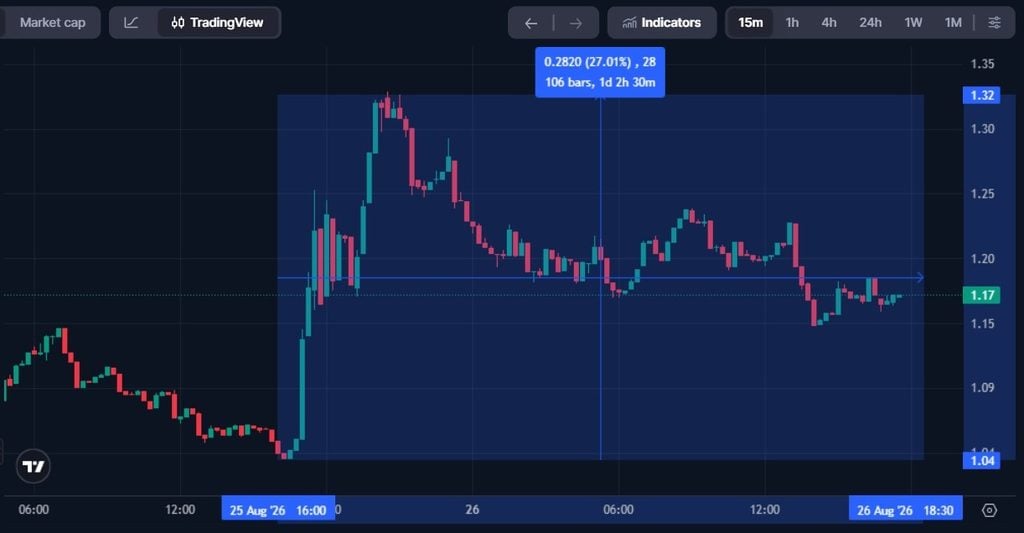
Following the ATLAS launch news, the ZRO token surged to $1.33, with a 27 percent gain on the day and 63 percent over the past week. The token is trading at $1.18 at the time of writing, hours before the announcement.
Technical capabilities
LayerZero claims ATLAS delivers sub-millisecond median latency in test environments, with 1.418 milliseconds at the 95th percentile and 2.641 milliseconds at the 99th. The system is provisioned for 200,000 transactions per second at launch.
ATLAS runs on Zero, the multi-core blockchain LayerZero announced in February, with investments from Citadel Securities and ARK Invest.
Zero separates execution from verification using zero-knowledge proofs, with separate zones running concurrently so exchange activity doesn’t compete with payments for block space. No mainnet date has been published.
Competitive position
LayerZero has been actively working to bolster its infrastructure. The initiative follows the backlash from the KelpDAO exploit in April, which prompted a wave of decentralized finance applications to transition their assets to rival frameworks perceived as safer, such as Chainlink’s Cross-Chain Interoperability Protocol. Now, it’s time to regain users’ trust.