

Kamino announced the launch of Institutional Commodity Yield, a new onchain vault infrastructure connecting real-world institutional credit markets with Solana users.
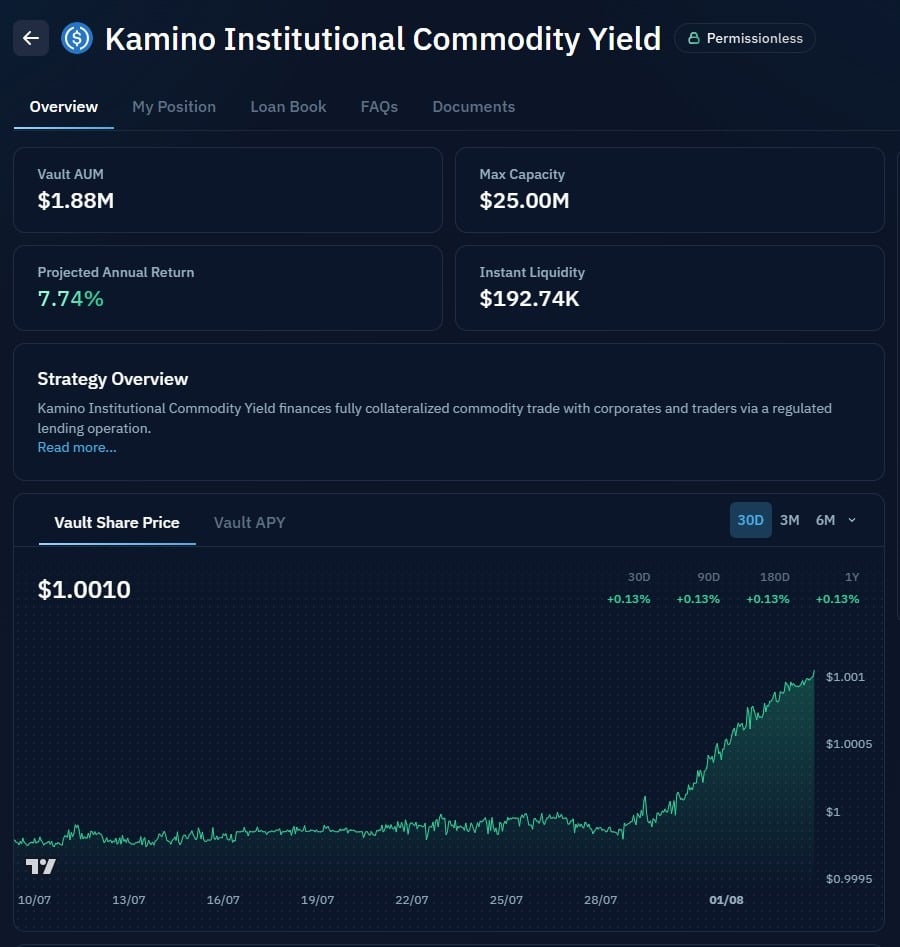
The first “Commodity Yield” vault is officially live with an initial deposit capacity of $25 million USDC, aiming to pull in around 7 to 8 percent returns through commodity trade finance.
It’s all part of Kamino’s bigger plan to bring those exclusive institutional yields (which used to be out of reach) directly onto the blockchain.
How Commodity Yield works
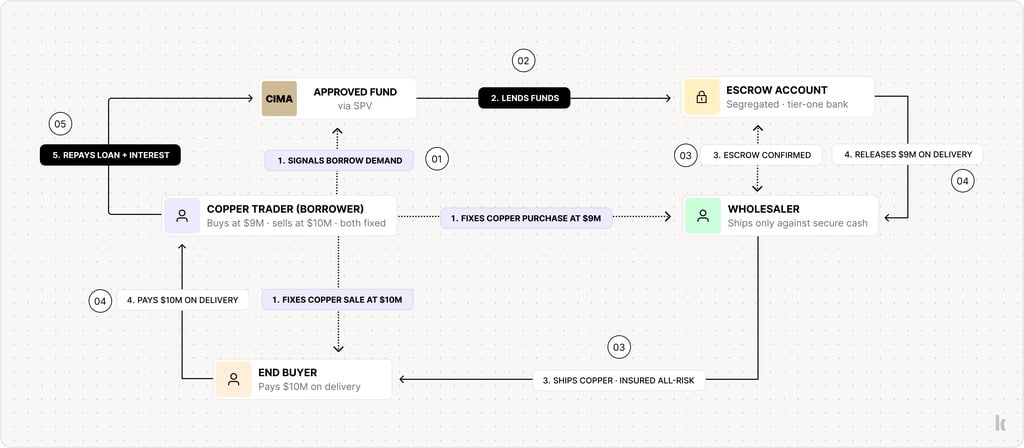
It all comes down to commodity trade financing. Imagine a copper trader who’s already lined up both sides of a deal: they are selling copper to a client for $10 million after buying it from a wholesaler for $9 million. That’s a sweet $1 million margin, but there’s a catch: the wholesaler won’t ship the goods until they get paid, and the end client won’t pay until the copper shows up, creating a financing gap.
That’s where the vault steps in. It funds the trader using a Special Purpose Vehicle (SPV) and a fund structure that’s overseen by the Cayman Islands Monetary Authority (CIMA). The money is held in a segregated escrow account, which gives the wholesaler the green light to ship the goods because they know the funds are ready and waiting.
Once the copper arrives and passes inspection, the escrow releases the payment. The trader then pays back the loan plus interest, and that interest is what flows back into the vault as yield for users.
Safety-wise, every single loan is fully collateralized either by the physical commodities themselves or by cash held 1:1 in escrow with tier-1 banks.
Risks and considerations
Kamino also disclosed important information on these matters:
- Depositors’ legal relationship is with the SPV, and the loan is characterized as unsecured.
- Importantly, depositors have no direct security interest in the underlying collateral.
- If something goes wrong at the lending level, it could impact the SPV and lower the value of your vault tokens.
- Capital deployed into active loans cannot be retrieved before maturity.
- Withdrawals exceeding the instant liquidity buffer enter a First-In, First-Out (FIFO) queue and are resolved as underlying loans mature.
- Participation is not a bank deposit and is not covered by any deposit protection scheme.
While things like strict lending standards, transparent reporting, and CIMA oversight help keep things secure, it’s always a good idea to read through the full risk disclosures.
Kamino’s broader institutional push
The Commodity Yield launch follows a series of developments strengthening Kamino’s position as the leading institutional yield venue on Solana. Earlier this year, Kamino became the fastest decentralized finance (DeFi) protocol to cross $400 million in a single product when Ethena seeded two lending markets with $200 million USDG each.
One pool hit 100 percent utilization within 24 hours, and USDe supply on Solana surged from $1.5 million to $350 million in just five days. The move marked the first time a traditional asset manager (Bitwise) took on a curator role for a Solana lending protocol.
And just last month, Galaxy Digital kicked off its $100 million “Galaxy Onchain Financing Rate” (GOFR) program, making Kamino one of the main spots for these loans. With up to $100 million in credit support and first-loss capital on the table, it’s a big shift that really turns Kamino from a potential integration partner into an active credit channel.
Kamino is also expanding into gold-backed lending, launching PAXG collateral loans. The platform’s Season 2 rewards distribution of $13.5 million in KMNO tokens is underway, with Season 3 now live.