
BlackRock just launched two tokenized money market funds (BSTBL and BRSRV), taking their cash management straight to the blockchain world.
- BlackRock Select Treasury Based Liquidity Fund (BSTBL) puts a tokenized version of a regular fund on Ethereum, with Bank of New York (BNY Mellon) as transfer agent and tokenization provider.
- BlackRock Daily Reinvestment Stablecoin Reserve Vehicle (BRSRV) is a new multi-chain tokenized fund designed for digitally native institutional investors, with daily dividend reinvestment and multi-blockchain accessibility.
Securitize acts as the main transfer agent and tokenization provider for the BRSRV fund.
What the tokenized market funds offer
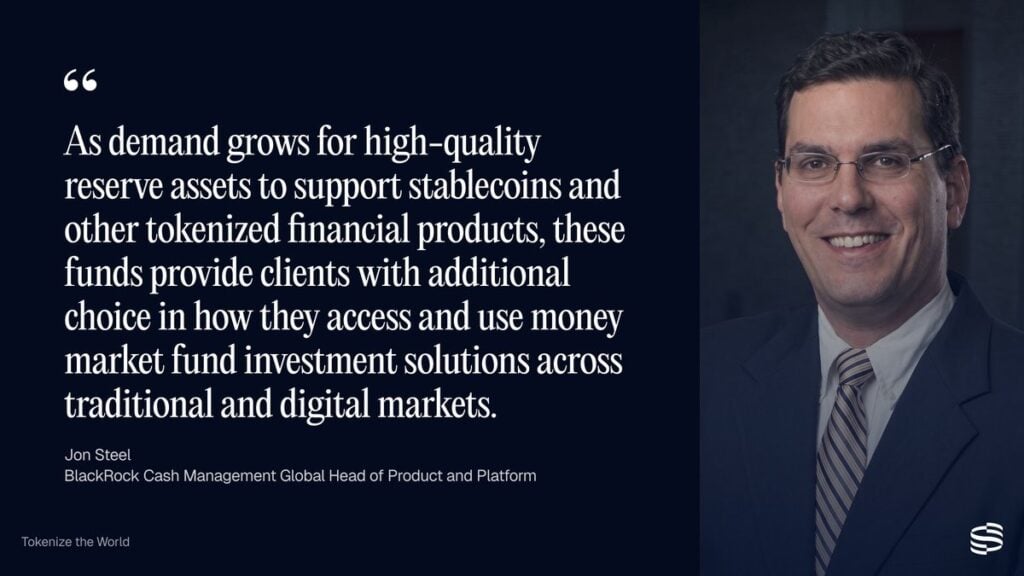
BSTBL extends a scaled cash management strategy into a digital format, allowing tokenized shares to be transferred between approved investor wallets subject to applicable law. BRSRV is designed for a range of digital asset use cases, including stablecoin reserve management.
Both funds seek current income consistent with liquidity and principal stability by investing in cash, short-term U.S. Treasury securities, and overnight repurchase agreements backed by U.S. Treasuries.
U.S. money market funds have actually shot up to over $8.4 trillion in assets because investors are looking for things like liquidity, keeping their capital safe, and getting a decent yield. Meanwhile, BlackRock‘s Cash Management Group is busy handling almost $1.1 trillion in different cash strategies.
The tokenization partners and significance
As said, BSTBL is tokenized by BNY Mellon, one of the world’s largest custodians, while Securitize serves as BRSRV’s transfer agent and tokenization provider. The launch follows BlackRock’s earlier BUIDL fund, which has become the largest tokenized Treasury fund with over $2.5 billion in assets.
These new options are built to count as “eligible reserve assets” for folks issuing stablecoins under the GENIUS Act, making them a pretty solid choice for managing those reserves.
The tokenized shares involve regulatory, operational, technological, privacy, and security risks, and investors should review the prospectus carefully.
The competitive landscape: Who’s challenging BlackRock?
To this point, the tokenized Treasury market has grown to over $16 billion, with the top five products controlling roughly 68 percent of the market.
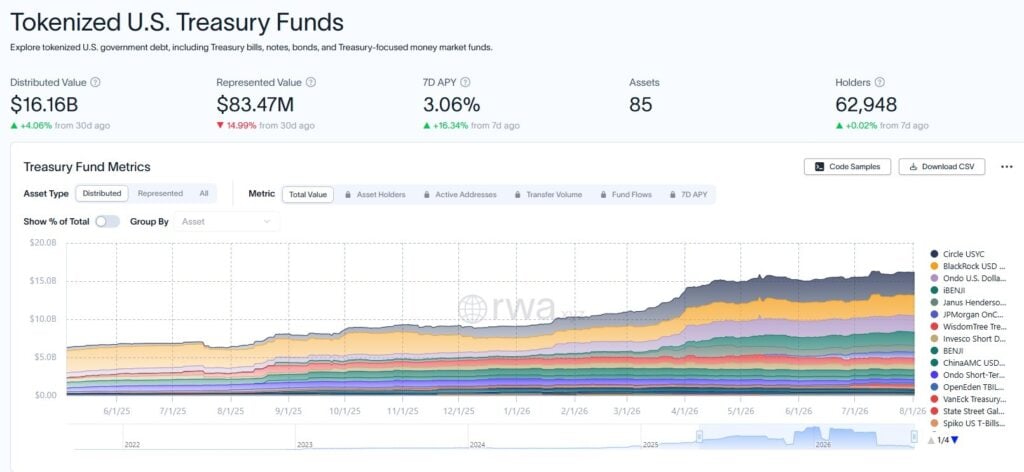
Circle‘s USYC is now basically BlackRock’s biggest competition, having briefly edged out BUIDL to become the top tokenized Treasury product earlier in 2026 with around $2.9 billion in Assets Under Management (AUM). The big advantage for USYC comes down to having a way lower barrier to entry for investors, thanks to its lower minimum investment ($100,000 vs. BUIDL’s $5 million), along with having deeper roots in crypto-native collateral systems ever since Circle went ahead and acquired Hashnote.
On the other hand, Franklin Templeton‘s BENJI, the pioneer launched in 2021, offers a $20 minimum investment on eight blockchains. Ondo Finance is also doing quite well, managing OUSG and USDY with a combined AUM that’s sitting near that $3 billion mark. JPMorgan also joined the mix with MONY in December 2025, which was specifically engineered to act as compliant reserve assets for stablecoin issuers under the GENIUS Act.
The competition is no longer about brand recognition, but about who builds the most efficient collateral rails.