
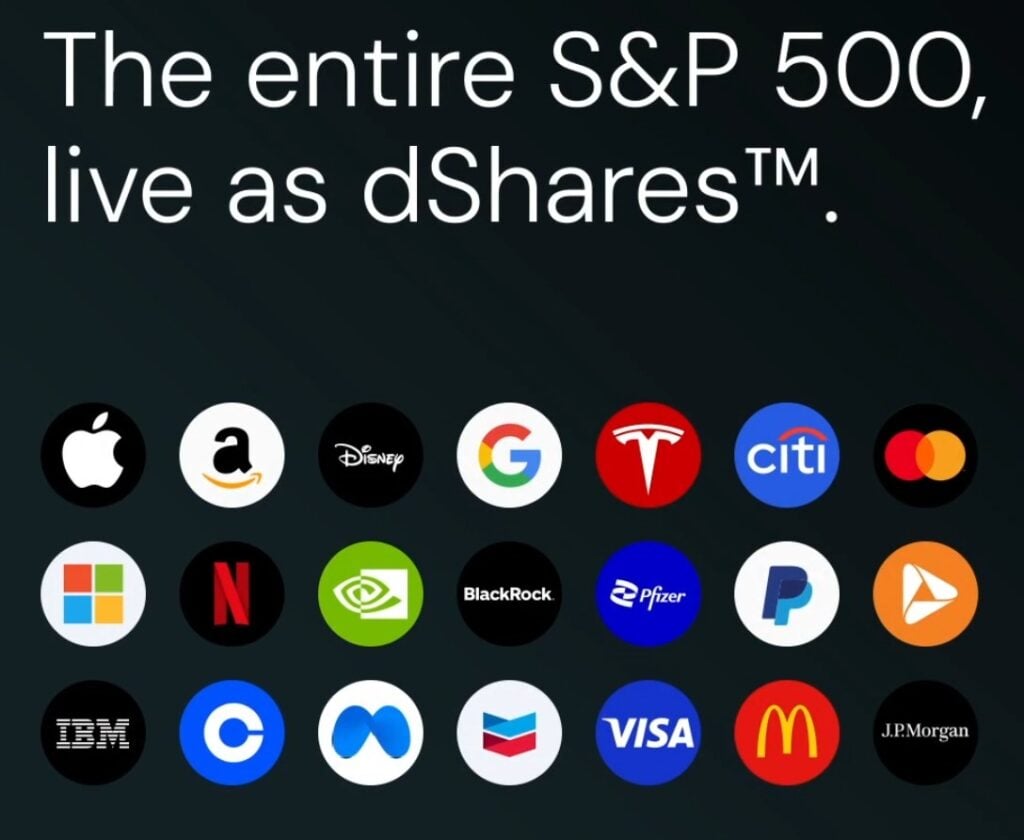
Dinari announced the launch of tokenized U.S. stocks to eligible American investors, offering 724 tokens including the entire S&P 500 through self-custody wallets using Circle’s USDC stablecoin.
The San Mateo-based company, founded by Stripe and Apple alumni, enables investors to buy and sell tokenized shares across Ethereum, Arbitrum, Base, and Avalanche. The tokenized equities market is projected to reach $5.5 trillion by 2030, according to Citi.
How Dinari’s tokenized stocks work
With Dinari’s dShares, every token is backed 1:1 by real stocks tucked away with regulated custodians. The best part? You still get all the usual shareholder perks [like voting rights and dividends (which land right in your wallet as USDC)], all while keeping your assets in your own self-custody wallet.
The whole platform runs on Dinari’s own regulated broker-dealer and transfer agent infrastructure, backed by big-name partners like Circle, Stripe-owned Privy, Para, and Monaco.
Co-founder and CEO Gabriel Otte said the goal is to make “the token itself the trusted ledger of the stock.”
The tokenized equities race
The launch comes as tokenized equities emerge as the next frontier after tokenized Treasury funds. Robinhood and Kraken parent Payward have expanded tokenized stock offerings outside the U.S. using offshore structures.
Last month, Ondo Finance unveiled a Securities and Exchange Commission (SEC)-aligned framework for tokenized stocks, though not yet available to U.S. investors. Securitize has argued for native blockchain issuance.
Citi projects tokenized securities could grow to a $5.5 trillion market by 2030. Dinari’s model occupies a middle ground: custodial tokenization with self-custody wallets, already live in more than 85 jurisdictions.
The tokenized stock market boom
Dinari’s landing at a crazy time for tokenized stocks. This market has absolutely exploded, going from about $32 million in January 2025 to a massive $1.7 billion by June 2026; we are talking a 5000 percent jump.
Back in March, transfer volumes hit $2.87 billion with over 265,000 hodlers. Right now, Ondo Finance is the big fish, owning nearly 60 percent of the market with over $900 million. xStocks is also in the mix with about $400 million.
When the SpaceX Initial Public Offering (IPO) rolled around in June, it showed everyone how risky those unbacked structures can be, which proves why Dinari’s “compliance-first” style works. To this point, the tokenized pre-IPO market zipped past $544 million in the first half of 2026, with everyone eyeing SpaceX, OpenAI, and Stripe.
Dinari’s custodial model (dShares backed 1:1 by underlying securities with full shareholder rights) puts it right in the sweet spot, acting as a bridge between the $300 billion stablecoin world and the massive $60 trillion U.S. stock market.