
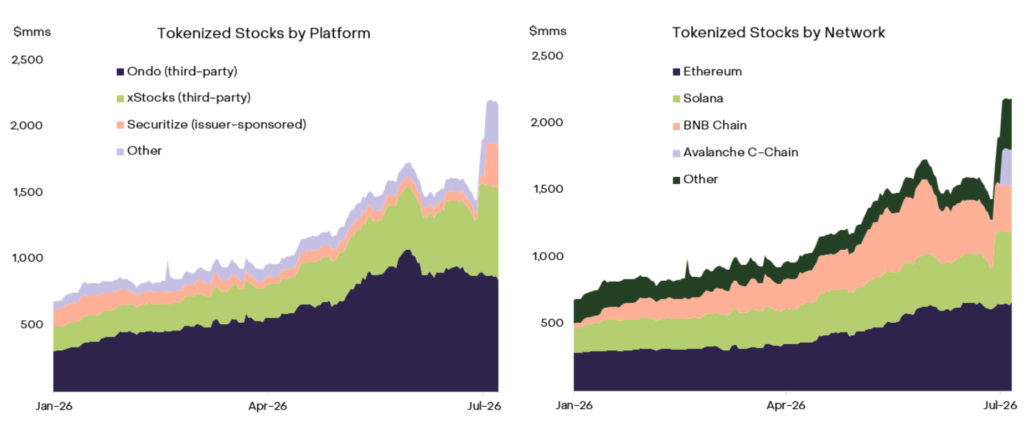
Grayscale published research highlighting how tokenized equities will drive utility to public networks, with Ethereum, Solana, Avalanche, and BNB Chain positioned as primary beneficiaries.
Three models are emerging:
- Wrappers (more than 70 percent of current tokenized stocks)
- Entitlement via DTCC’s Canton Network
- Issuer-sponsored native issuance.
Just this week, in an outstanding debut, Securitize’s New York Stock Exchange (NYSE) listing demonstrated issuer-sponsored tokenization on Solana and Avalanche.
Three models of equity tokenization explained
Grayscale points out three main ways equity tokenization is happening:
Right now, the wrapper model is the big one, making up over 70 percent of tokenized stocks. In this model, tokens basically act as a claim on equity held in a Special Purpose Vehicle (SPV), meaning the token represents your stake in those underlying shares.
Then there’s the entitlement model, where the Depository Trust & Clearing Corporation (DTCC) brings traditional securities onchain using the Canton Network. It’s a more institutional way of digitizing legacy assets and bridging the gap between traditional finance (TradFi) and blockchain.
Finally, the issuer-sponsored model is where companies actually issue their stock natively onchain, just like Securitize showed off at its NYSE listing. This is a huge deal for public networks because it builds actual demand for blockchain infrastructure from the ground up, instead of just wrapping what’s already there (existing assets).
Which altcoins stand to benefit from equity tokenization?
In its research, Grayscale identifies Ethereum, Solana, Avalanche, and BNB Chain as the primary beneficiaries of equity tokenization. But, of course, each network brings different strengths along with its own vibe:
- Ethereum offers the largest developer ecosystem and institutional adoption
- Solana provides high throughput and low fees
- Avalanche features subnet architecture for institutional use cases
- BNB Chain offers deep liquidity and integration with Binance’s ecosystem
For instance, the research suggests that as more equities move onchain, these networks will see increased transaction volume, fee revenue, and user adoption, which, in the end, is obviously good for the whole ecosystem.
From retail wrappers to regulated rails
This is a game-changer for the Web3 ecosystem for two major reasons:
- First, the fact that the Canton Network is getting involved shows that big, regulated institutions are finally putting down roots on blockchain infrastructure, rather than just treating it like a playground for experiments.
- Second, the issuer-sponsored approach (like the Securitize example) connects public equity issuance directly to blockchain networks. It’s essentially turning altcoins from purely speculative assets into the actual settlement layers for real-world securities.
So one thing crypto investors should be aware of is that tokenized equities are not just another run-of-the-mill decentralized finance (DeFi) product, but they are a solid bridge capable of bringing trillions of dollars in traditional market value onto both public and hybrid networks.
Moving forward, the race between the wrapper, entitlement, and issuer-sponsored models is going to be what ultimately determines which blockchains grab that value.