
When you’re investing in one share of any of the biggest companies globally, typically your trading will occur within market hours, and then there may be some delay of several days before the transaction actually settles. For tokenized equities, most of the friction has been taken out of that system. A tokenized security is actually a token representing an actual security (like a stock or ETF) on a blockchain and the trading doesn’t take place at a normal stock exchange.
What is tokenized equity?
A tokenized stock is not some new form of company or some side bet on the share price. This can be called a digital title to an actual share that corresponds one-to-one to that stock, where a regulated custodian holds the share and then a token reflecting the value of that stock is issued to the blockchain, kind of like a stablecoin collateralized by dollars; every token has something of value of that kind sitting behind it, where in this case that value would be a real share of stock.
The token is essentially a wrapper around the real position. So it will generally track the price of the underlying stock. The thing that will change it is how the user moves it and trades it.
Why tokenized equities are gaining attention
Investing in traditional stocks has some limits as well. There are set hours when the market opens and is available for making the trades. For settlement of trades, it may take some days and buying foreign stocks often includes extra paperwork and brokers. These kinds of barriers are eliminated in the case of tokenized equities. As mentioned, they operate on blockchain, which makes the transfer much faster and can be stored in a crypto wallet. In some cases it can even be used as collateral in DeFi and this gives the market participants greater flexibility in comparison to the traditional shares.
How tokenized equities differ from stocks
There are a handful of fundamental distinctions that every market investor should be aware of.
- Trading hours: Unlike a traditional exchange, which closes overnight and for days of the week, tokenized markets never close.
- Settlement: a normal stock transaction might not fully settle for several days (generally it takes around two to three), whereas token settlements can take just minutes.
- Availability: Traditional markets are restricted by geographic availability, by intermediaries (brokers), and by the requirement to put up significant initial cash. Tokenized markets are accessible by anyone with an internet connection and a wallet, and fractional ownership makes it cheap to invest in even the expensive stock without having to purchase a full share.
This same thing works with transparency as well. The traditional trades reside on a private system maintained by the clearinghouses and the brokers. But transfers are put on the public record in the case of token transfers, which are harder to argue, as they make the use of blockchain for providing transparency.
How the process takes place
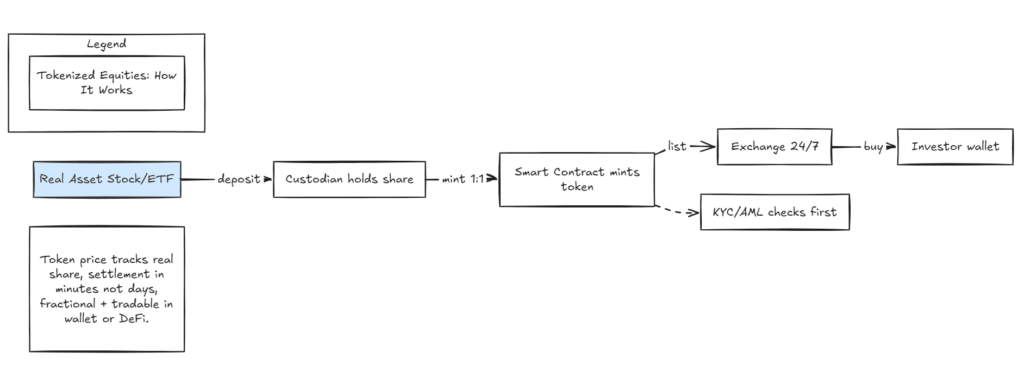
The first step is for a platform to choose an underlying asset (a stock, ETF, or real estate, for example) and then to create digital tokens tied to that asset on a blockchain. Smart contracts can be used to track the holders of those tokens, as well as rights related to dividends and shareholder votes; meanwhile, KYC (Know Your Customer) and AML (Anti-Money Laundering) standards can be incorporated to ensure compliance with financial regulations prior to trading the asset on authorized trading platforms.
Currently, most tokenization activities are led by fintech firms, though banks and privately owned companies are also considering tokenization to gain more attention from the market investors.
Tokenization is not limited to stocks
Tokenization extends beyond public stocks. The same technology can be used for private company shares, real estate, venture capital, and other hard-to-trade assets, making them easier to buy, sell, and own in smaller amounts. While the market is still developing and regulations continue to evolve, more financial institutions are exploring tokenization as a way to improve access and liquidity. Over time, it could make investing in assets around the world much simpler for everyday investors.