

Four Pillars just dropped a deep dive into Canton Network, that institutional blockchain everyone’s talking about. It’s been making waves with big finance players while definitely ruffling some feathers among the crypto purists. The report breaks down exactly why Canton’s success is making the industry a bit uneasy.
Why Four Pillars conducted this research
Canton has delivered tangible institutional results. Broadridge’s Distributed Ledger Repo (DLR) processes roughly $8 trillion in monthly repo volume. Depository Trust and Clearing Corporation (DTCC), JPMorgan, Goldman Sachs, Franklin Templeton, and State Bank of India (SBI) have joined the ecosystem. Canton Coin (CC) maintains a market cap of around 6 billion at the time of writing.
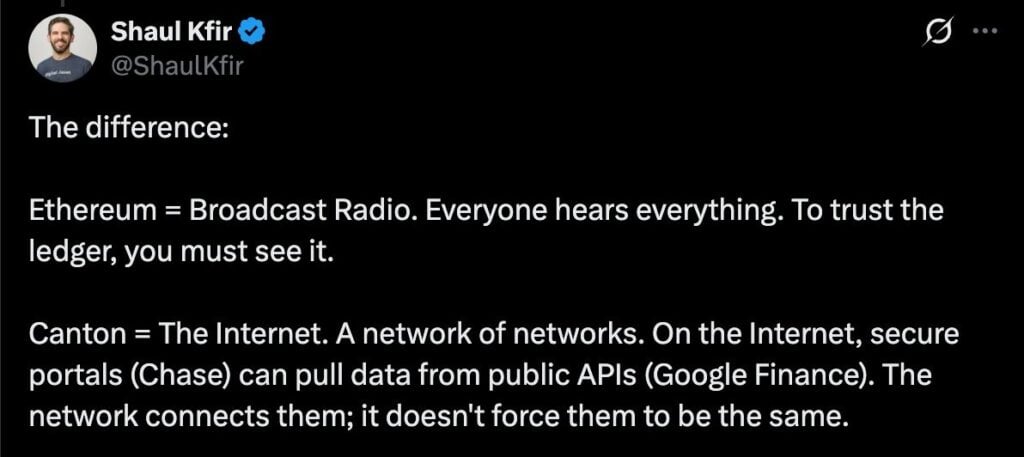
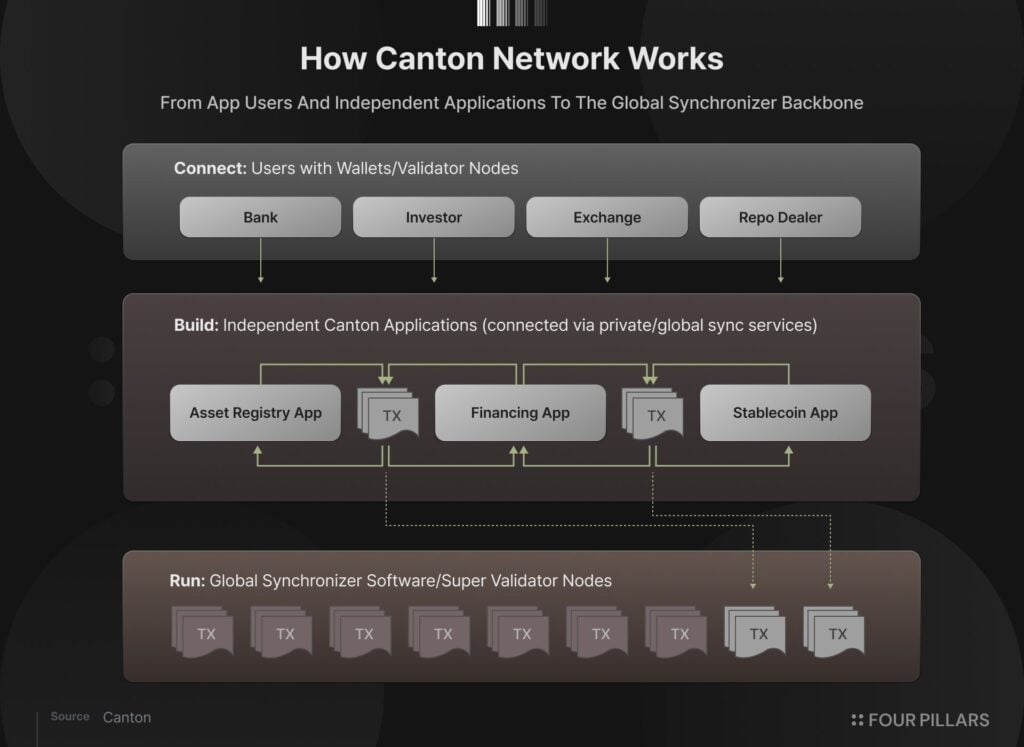
The problem, according to Four Pillars, is that these results are difficult to interpret through the conventional crypto lens. Canton does not operate like Ethereum or Solana (or other “traditional” blockchains), where all transactions are public, and all validators verify the same global state. In contrast, Canton’s contracts are disclosed only to relevant parties, and the Global Synchronizer coordinates only message ordering, not transaction content.
Key Findings
- Canton is not a private Ethereum: It sits between public chain transparency and private chain silos, allowing only relevant parties to see contract details.
- Intentionally hide certain details: Why? Because big institutions can’t risk leaking sensitive client info or getting hit with front-running scams if everything were public.
- Canton’s atomicity is “procedural,” not “single-block”: What matters is the guarantee that settlement risk does not occur, not how that guarantee is technically achieved.
- Canton’s tokenization differs from public chains: Assets are represented as programmable rights records (issuer, holder, viewers, transfer authorities) rather than ERC-20 balances.
- Canton’s biggest hit is “repo” (repurchase agreements): Broadridge DLR handles the whole repo process instantly and perfectly with one Daml smart contract, which means way fewer failures and lower clearing costs.
- Banks are looking for two different things: A way to get liquid cash (which is what they use Ethereum/Solana for) and a way to smooth out complicated operations between different banks, also called inter-institutional workflows (which is what Canton is for).
What the research is trying to show
Four Pillars highlights that the institutional crypto market will not follow one path only, and current chain adoption will not settle on one model/architecture. It could be said that the debate over whether Canton is a “real blockchain” is less important than understanding what institutional finance actually needs.
In this context, public chains maintain a liquidity moat that Canton cannot easily overcome. As for this, Canton has found product-market fit in repetitive, high-value, participant-restricted workflows where privacy and settlement certainty are priorities.