

The Florida Attorney General, James Uthmeier, filed a lawsuit against OpenAI and its CEO, Sam Altman, contending that ChatGPT is an unsafe product that incited violence and self-harm. This will be the first lawsuit of its type that has been filed by a state.
What the lawsuit actually says
Florida is taking aggressive action against ChatGPT. The state’s lawsuit against OpenAI consists of 75 pages detailing four counts of deceptive trade practices, two product liability violations, and claims of fraudulent misrepresentation and public nuisance. And there’s also a twist: the state has also named Sam Altman personally and wants him on the hook, alleging “reckless and willful conduct” and “utter disregard for the risk to human life.”
The suit claims OpenAI marketed ChatGPT as a safe product, while at the same time knowingly hiding that it could drive users toward harm, addiction, cognitive decline, and violence. It also points to specific incidents: a mass shooting at Florida State University (where the shooter had roughly 16,000 ChatGPT interactions), the killing of two graduate students at the University of South Florida, and a teenager’s death from mixing drugs based on ChatGPT’s advice.
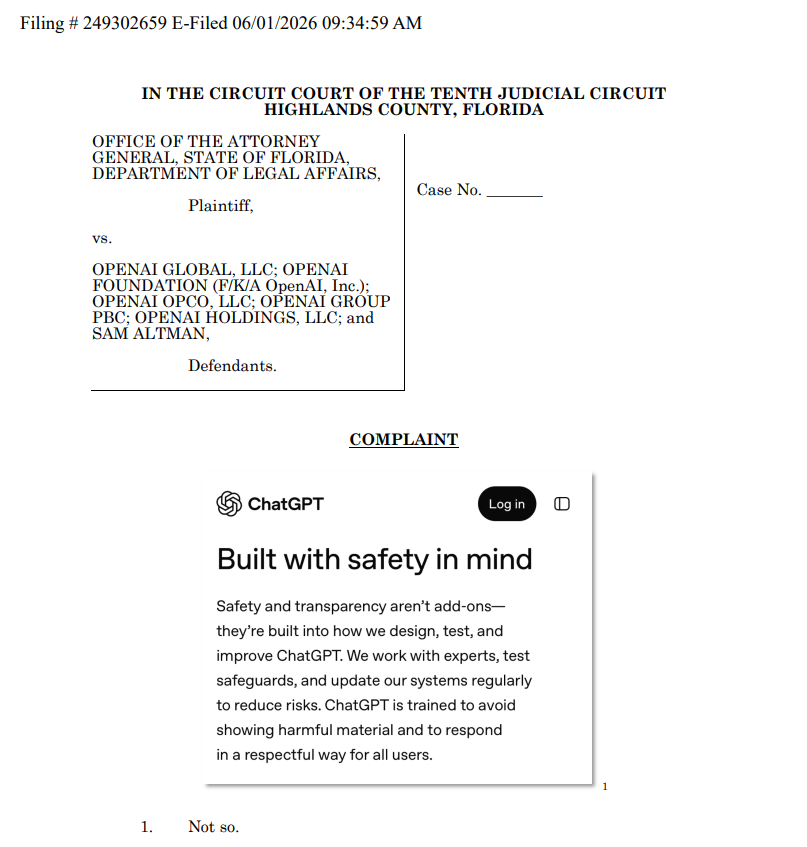
Does OpenAI prioritize profit at the expense of user safety?
Florida’s lawsuit lays out a very clear argument between safety and market value. The lawsuit states that OpenAI’s success can be “traced to a web of deceit and the exploitation of users… leveraging their data and safety to boost OpenAI’s market value at unacceptable costs.” Remember that OpenAI was founded as a nonprofit in 2015. Today, the company has a valuation of approximately $ 852 billion, and raised $122 billion in early March, as they reportedly prepare for an initial public offering (IPO).
Elon Musk made similar accusations in a 2024 lawsuit (later dismissed on a technicality), arguing the company abandoned its nonprofit mission. OpenAI spokesman Drew Pusateri pushed back on the shooting connection: “ChatGPT provided factual responses to questions with information that could be found broadly across public sources on the internet, and it did not encourage or promote illegal or harmful activity.”
Does this change anything in the AI ecosystem?
Short answer: potentially everything. Florida is the first state to go down this path, but it won’t be the last. Kentucky sued Character.AI in January. Families of victims from a British Columbia mass shooting have already sued OpenAI. Seven California lawsuits allege ChatGPT encouraged individuals to engage in self-destructive behavior. The legal theory here – that an AI chatbot can be held liable as an “unsafe product” – is completely untested.
For instance, if Florida succeeds, every AI company with a consumer-facing chatbot could face similar liability for what users do with their outputs. That changes risk calculations overnight. For those who build crypto and Web3 projects that are integrating AI agents, this is a flashing yellow light: Your smart contract may be good; however, the information your AI gives may expose you to lawsuits.