

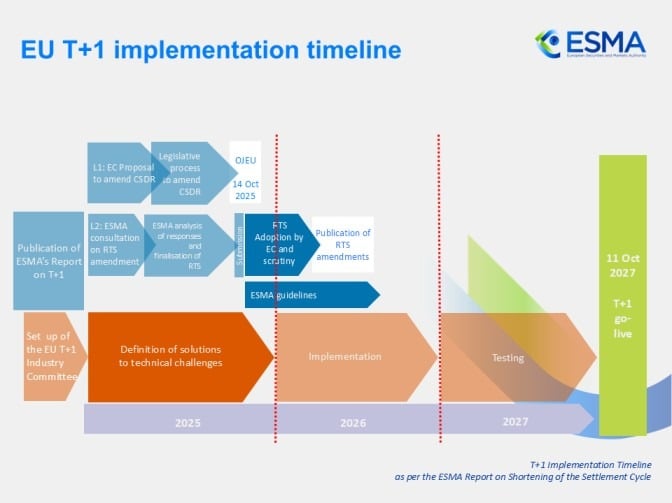
The European Securities and Markets Authority (ESMA) just gave the thumbs up for the European Union (EU) to switch over to a T+1 settlement (transaction date + 1 business day) cycle by October 11, 2027.
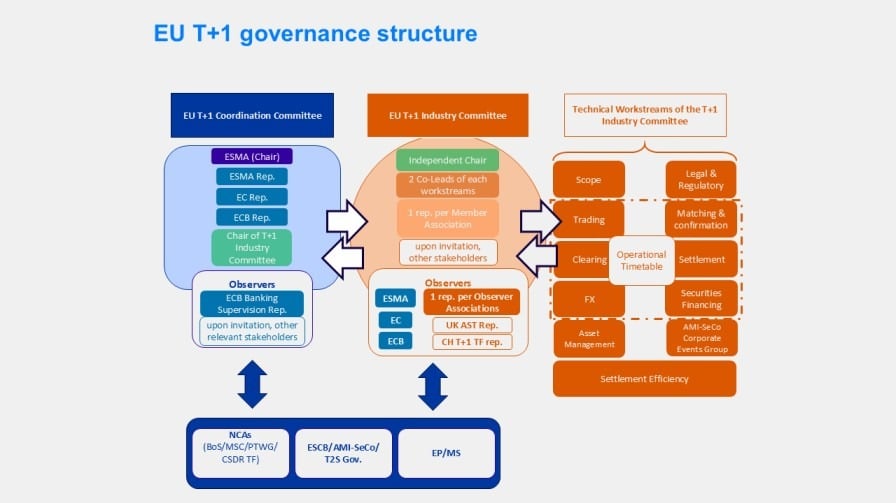
ESMA is all for the change, which is meant to cut down on risk, unlock cash, and get markets moving at today’s faster pace. Still, it won’t be easy since Europe’s fragmented infrastructure is pretty messy, needing around 30 depositories, 27 countries, and various currencies to work together, in contrast to the much simpler two-depository system in the U.S.
Europe’s fragmented infrastructure challenge
The U.S. transition to T+1 went smoothly largely because it operates through two central securities depositories [the Depository Trust & Clearing Corporation (DTCC) and the Fed’s Fedwire Securities Service] and a single central counterparty, the National Securities Clearing Corporation (NSCC). Europe, by contrast, must coordinate around 30 depositories and over a dozen clearing houses across multiple currencies, all switching on the same day.
Steve Durbin, CEO of Layer-1 blockchain RYT, commented: “Europe is asking around 30 depositories and over a dozen clearing houses, across several currencies, to switch on the same day. That coordination is the hard part, not shaving off the extra day.” Around a quarter of UK firms are still expected to miss the readiness deadline at the end of 2026.
Regulatory and operational pressures
One big thing about Europe making this move is that they have a penalty system tied to the Central Securities Depositories Regulation (CSDR) which you won’t find in the U.S. Basically, if a settlement fails, someone is paying a cash fine. Since T+1 gives everyone less time to breathe, the chance of things going wrong goes up, and so does the risk of getting hit with those penalties.
Securities lending is also squeezed: T+1 compresses the recall window for lent securities, meaning more sales risk failing, leading to greater potential penalties.
Then you’ve got the whole cross-border foreign exchange (FX) mess. International investors are basically racing against the clock to get their hands on the right currency before the deadline. The European Fund and Asset Management Association (EFAMA) actually thinks that about 40 percent of the daily FX flows from European fund managers might not be able to settle through Continuous Linked Settlement (CLS) once T+1 kicks in, which just adds more risk to the whole bilateral settlement process.
A stress test for legacy infrastructure
The transition exposes a fundamental tension: faster settlement through existing infrastructure may simply compress operational processes into a shorter window while increasing failure risk.
Again, Durbin noted: “T+1 chases the same goal as onchain settlement (faster settlement with less counterparty risk), and on those two it delivers. But it gets there by compressing the same overnight, check-everything-twice plumbing, which raises the risk of trades failing, the very thing onchain settlement is meant to remove.”
For blockchain advocates, this whole transition is basically proving exactly why shared-ledger models are so attractive; they do a great job of cutting down on all that heavy lifting related to reconciliation, counterparty, and delivery-versus-payment risk using atomic settlement, where cash and assets are essentially forced to move at the same time together or not at all.