

Bank of America (BofA) is telling investors to cash in on some gains. Its Global Research unit says that 70 percent of its “bear-market” warning signs are flashing, which historically happens right before the market peaks. They pointed to factors like excessive speculation, tech stocks having run up way too far, and unrealistic growth expectations as reasons to be cautious.
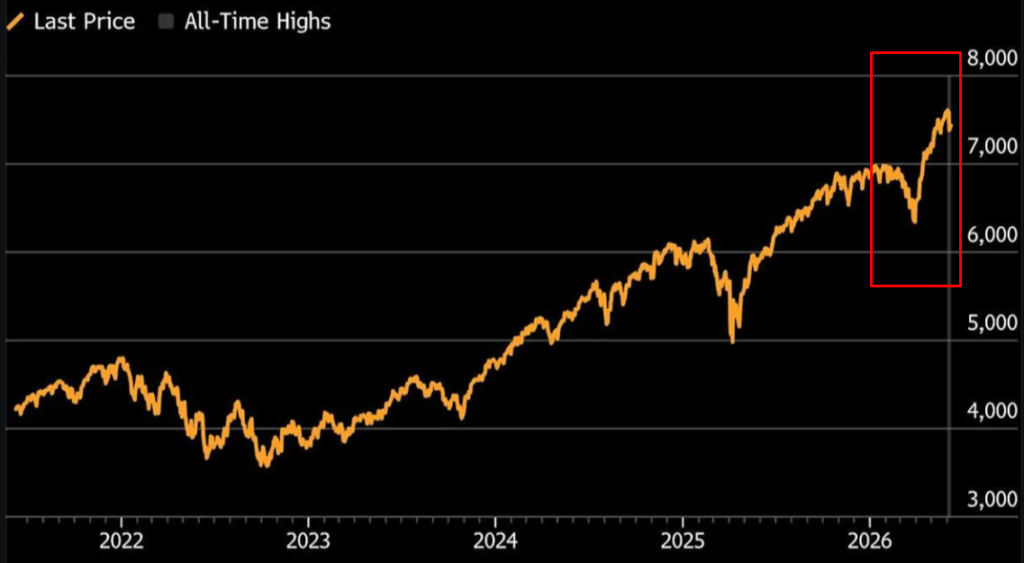
BofA flips cautious
Most investors who piled into the S&P 500 in 2026 think they own the entire stock market. But what they actually own is a heavy bet on Big Tech. BofA strategists led by Savita Subramanian say that bet has run its course. “Red flags emerged over the past month, pointing to a soft patch ahead for the S&P 500 index and for tech,” they wrote in a client note.
The gap between the stock market’s winners and losers is getting as wide as it was during the pandemic. It’s even crazier in the information-tech world; the gap between the best and worst performers over the last few months hasn’t been this wide since just before the dot-com bubble burst in early 2000.
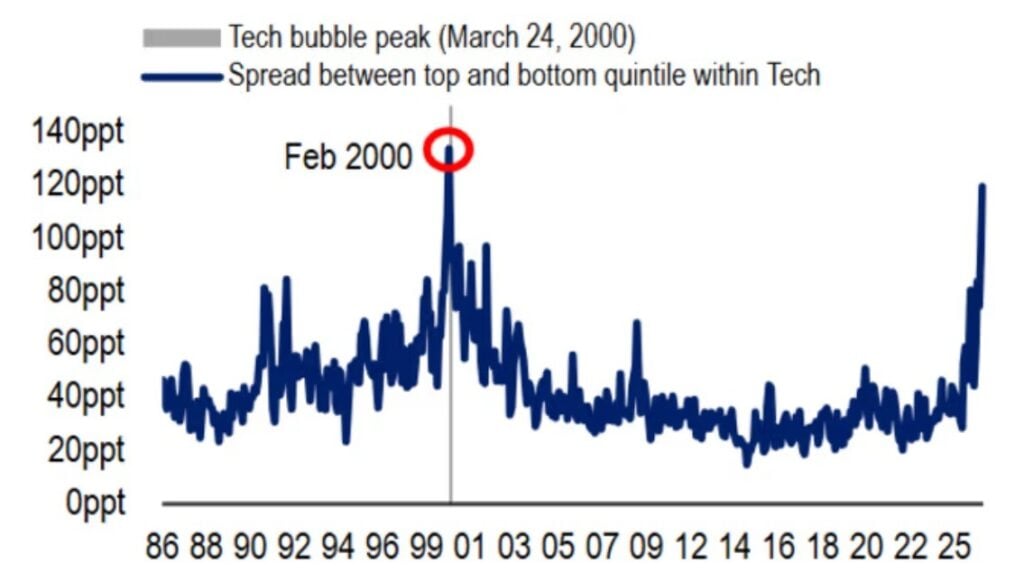
Why is Bank of America so worried?
Three specific signals are flashing red:
- First, high P/E (price-to-earnings) stocks are leading low P/E stocks by a wide margin, a classic sign of excessive speculation. Investors are paying premium prices for growth expectations that may not materialize.
- Second, long term growth expectations for the S&P 500 have breached “levels consistent with equities being more vulnerable to disappointment.” In plain English: the market is priced for perfection.
- Third, market gains are increasingly concentrated. Megacap tech and AI chip names have done most of the heavy lifting in a year that saw the S&P 500 rise nearly 9 percent year-to-date (YTD), despite the Iran-U.S.-Israel conflict, inflation uncertainty, and a new Fed chairman. When breadth narrows that dramatically, the risk of a sharp reversal grows.
Is there a real risk for investors?
Yes, but with a caveat. BofA is not calling for a crash. They are calling for selectivity. The bank reiterated its year-end price target of 7,100 for the S&P 500, which implies a 4.5 percent downside from current levels (around 7,430). That is a soft patch, not a bear market. But for investors who piled into the Magnificent Seven at peak valuations, that 4.5 percent could be much worse on a stock-by-stock basis.
The opportunity, BofA argues, is in sectors nobody wanted before: energy (up 28.7 percent YTD), healthcare [down despite positive Earnings Per Share (EPS) revisions], and financials (also down despite solid fundamentals). For instance, selectivity is key. The cap-weighted index is distorted by a handful of giants.
Antecedents: When 70 percent triggered before
To this point, BofA’s bear-market indicator model is not new. The 70 percent threshold has preceded market peaks multiple times over the past two decades. In 2000, similar signals flashed before the dot-com crash. In 2007, before the financial crisis. In 2018, before the Q4 selloff. And in early 2020, before the COVID-19 crash (though that was an exogenous shock).
This model isn’t a crystal ball for exact dates; it’s more about showing when the market is getting shaky. History shows that once we hit that 70 percent mark, a reality check is usually right around the corner. So, there’s no need to panic and sell everything; just stop chasing the hype and start taking profits while you can.