
Nvidia reported record quarterly revenue and gave a stronger outlook for the current quarter, underscoring how demand for artificial intelligence infrastructure continues to accelerate across cloud providers, enterprises and emerging edge-computing markets.
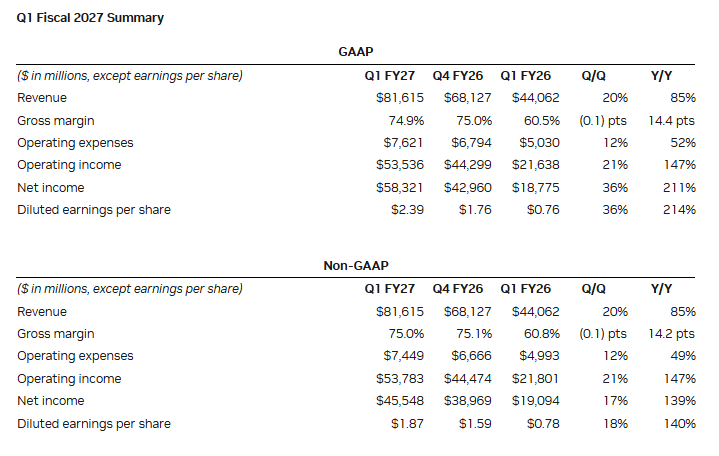
The chipmaker said revenue for its fiscal first quarter, which ended April 26, 2026, rose 85% from a year earlier to $81.6 billion, and was up 20% from the previous quarter.
Net income climbed to $58.3 billion, while diluted earnings came in at $2.39 on a GAAP basis and $1.87 on a non-GAAP basis, according to Nvidia’s earnings release.
AI data centers power another record quarter
Nvidia’s Data Center business remained the company’s main growth engine, with first-quarter revenue hitting a record $75.2 billion, up 92% from a year earlier and 21% from the previous quarter.
Under its previous reporting categories, Data Center compute revenue reached $60.4 billion, up 77% year over year, while Data Center networking revenue surged 199% to $14.8 billion. The figures show that Nvidia’s AI boom is no longer only about GPUs, but also the networking systems needed to connect massive AI clusters.
Chief Executive Jensen Huang said the buildout of “AI factories” was accelerating at extraordinary speed as companies move from experimenting with AI to deploying it in production.
“Agentic AI has arrived, doing productive work, generating real value and scaling rapidly across companies and industries,” Huang said.
Nvidia reshapes its business around AI platforms
Nvidia also announced a new reporting structure designed to reflect where it sees future growth. The company will now report two main market platforms, Data Center and Edge Computing.
Within Data Center, Nvidia will break out Hyperscale and ACIE, a category covering AI clouds, industrial and enterprise customers. The shift suggests Nvidia wants investors to look beyond spending by the biggest cloud companies and focus on a wider wave of AI factory construction across industries and countries.
Edge Computing, meanwhile, will cover devices and systems tied to agentic and physical AI, including PCs, workstations, game consoles, robotics, automotive and AI-RAN base stations.
That segment generated $6.4 billion in first-quarter revenue, up 29% from a year earlier and 10% from the previous quarter, helped by Nvidia’s push into autonomous driving, robotics, telecom infrastructure and local AI models.
China left out of outlook
Nvidia’s guidance also included one important limit, with the company expecting second-quarter revenue of $91 billion, plus or minus 2%, while assuming no Data Center compute revenue from China.
That assumption matters because China has historically been a major market for advanced chips, while U.S. export restrictions have made future sales less predictable. Even without China Data Center compute revenue in its forecast, Nvidia is still projecting another major sequential jump.
Buybacks and dividend signal confidence
Nvidia returned about $20 billion to shareholders through buybacks and dividends during the quarter. Its board also approved an additional $80 billion in share repurchase authorization and raised the quarterly dividend to 25 cents a share from 1 cent.
The results show Nvidia entering fiscal 2027 with extraordinary momentum, powered by demand for AI infrastructure and a broader push to turn its chips, networking systems and software into the backbone of the next computing era.
Nvidia stock pauses below recent highs
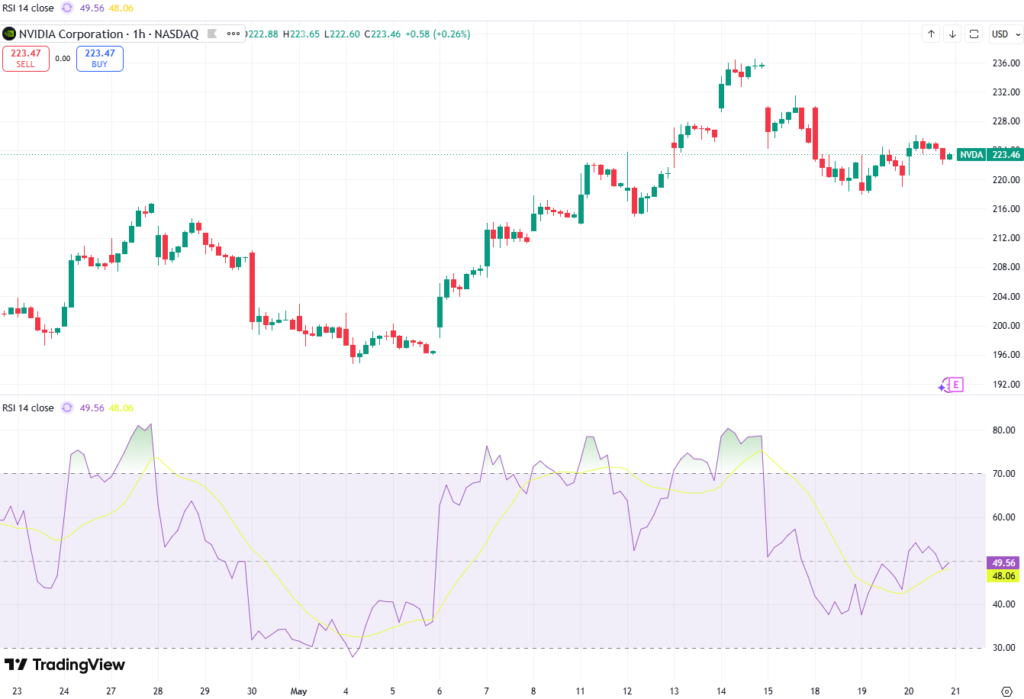
Nvidia’s hourly chart shows the stock easing into a consolidation range after a strong rebound from below $200 earlier in May to a recent high near $236.
Price is holding around the $223 area, above the recent support zone near $220, while momentum has cooled from earlier overbought levels, with the RSI hovering near 50.
A sustained move above the $230 resistance area would strengthen the bullish setup, while a break below $220 could open the door to a deeper short-term pullback.