

The XRPL RWA ecosystem just cleared, which the market thought would take 12-18 months. At the time of writing, the network value represented is $3.47B up 66.63 percent in the past 30 days, and network value distributed is $368.12M, up 7.72 percent over the same period based on data as per RWA.xyz.
Compare this with where the network was, at around $24M of tokenized RWA value at the start of 2025. All growth since has been structural rather than cyclic.
What the composition actually says

The $3.47B represented value figure is flattening two disparate pools. On the distributed end, on-chain fully issued and settled RLUSD accounts for $402.8M held by 47,755 entities (a 13.86 percent increase in 30 days). OUSG by Ondo Finance is second ($263.7M, up 18.88 percent), followed by USDB by Braza Crypto ($103.1M, up 17.93 percent) and Guggenheim Treasury DCP by Zeconomy ($40.4M). OpenEden’s TBILL Vault ($39.7M) is the only top ten product to see value retreat, losing 28.20 percent, and is the only issuer in the top ten to perform negatively amid an otherwise uniform rally.
This side has covered the different side. Justoken JMWH commodity instruments represent $2.23B of exposure on their own. CRX Digital Assets’ ASENA FIF asset-backed credit facility brings $213.8M and VERT Capital’s FIDC Byx Mozart Brazilian credit instrument adds $139.4M. Ctrl Alt’s diamond-linked DIA-AD-COL1 brings $105.2M. It’s clear XRPL is not trying to be a U.S. Treasury chain but rather to build a Treasury chain supported by a wider base of Brazilian credit and commodities, as well as structured products. The capital composition is fundamentally different from what Ethereum’s RWA story has historically built upon and is often missed from coverage on XRPL.
Transfer velocity confirms active use
Asset value sitting in the ledger is a stat for the balance sheet. Volume transacted is an operational metric. XRPL’s RWA 30-day transfer volume was $146.79M, up 44.38 percent. Stablecoin 30-day transfer volume was $2.51B, up 48.23 percent. In addition to this, Stablecoin market cap in the ledger is $523.32M, experiencing a growth of 14.02 percent in value with 58.60K holders, up 2.18 percent.
Active RWA holders: 29 of 302 distinct RWA products. Holder count seems slim for the value of assets, but it’s appropriate to an institutional-class deployment where one party amounts to hundreds of millions in committed capital. It’s not a typical retail DeFi distribution.
Ripple executive Luke Judges reported that the true tokenized RWA number on XRPL, reflecting assets held in other data repositories beyond RWA.xyz, might be more in the realm of $3.75B. XRPL is the fifth largest globally by tokenized asset value, sitting behind Ethereum (which holds more than 50 percent of all global tokenized assets) and second for 30-day RWA growth per RWA.xyz’s network comparison data.
The institutional names doing the work
CRX Digital Assets has the biggest platform holding with $590.5M (representing 17 products, +457.7 percent MoM, which single-handedly drives aggregate growth metrics), and if the percent value growth of 66.63 percent is structural or a one-off credit book migration, it will have a huge impact on whether this trend is sustainable or an artifact that artificially enhances the underlying direction. SG FORGE ($11.6M) holdings are trivial in comparison, but a regulated European bank operating live tokenization infrastructure over a public ledger can be interpreted very differently than a native crypto issuer. Underneath these tokenized U.S. Treasuries on the XRPL are drivers Ondo, OpenEden, and Zeconomy, which are projected to increase from $50M in 2025 to $418M in 2026.
BNB chain: a different posture in the same race
The increase in institutional tokenization flows onto public blockchains is a zero-sum game over infrastructure positions. XRPL’s momentum comes at a time when BNB Chain, a genuine contender for institutional dollars due to Binance’s institutional clearing facilities, is dealing with price levels that historically cause uncertainty for both developers and issuers.
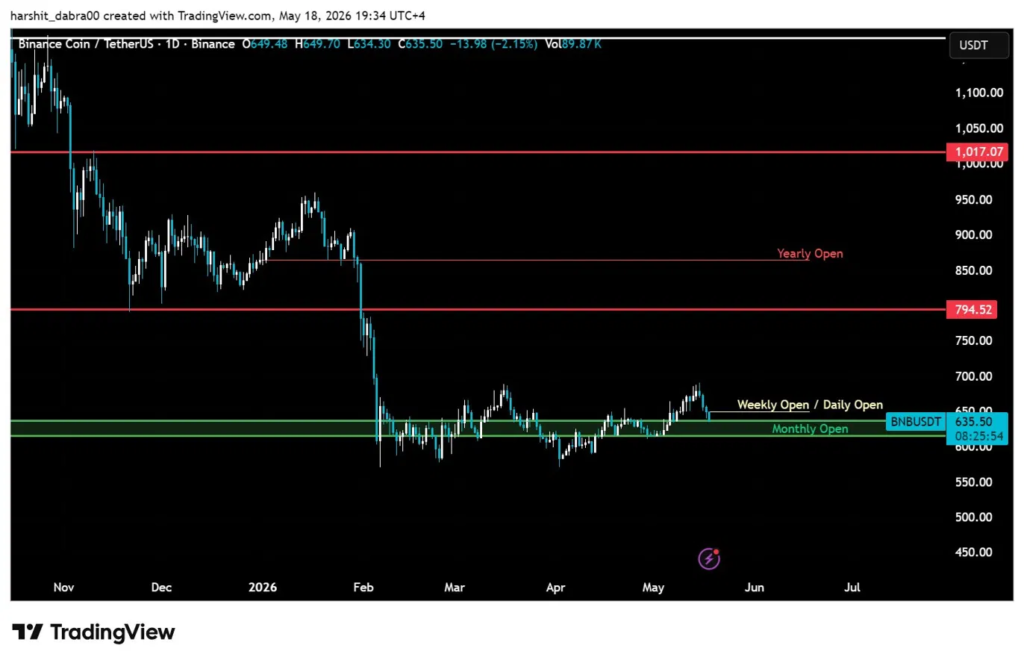
BNB, at $635.50 at the time of writing, is trading down 2.15 percent for the session and has a daily trading volume of $1.35B. The daily chart highlights that the current price is clearly below the key SMAs, including the SMA200 ($759.32) as well as the EMA200 ($710.99). The SMA30 is at $639.37 and a daily RSI14 is 51.84, suggesting neutrality, but the general trend here is one of medium-term consolidation. The price of the native coin of the Binance ecosystem got rejected from the $860-$870 level back at the start of 2026 and has since been forming a base around the $600-$650 level.
Open for the month is close to price, giving the present region a respectable medium-term support, and $628.06 (daily 78.6 percent Fib ret.) represents a level one will need to observe for price action on the downside, while closing daily above the $710.25, 127.2 percent Fib extension, will signify the initial steps in structural recovery. BNB Chain’s goals in tokenization are proceeding in a price environment that does not show the asset itself accumulating institutionally.