



Stellar (XLM) is changing hands at $0.2380 at the time of writing, up a fraction from the past session and the asset is almost holding on to the zone where its downtrend took place.
The sudden rise with no consolidation
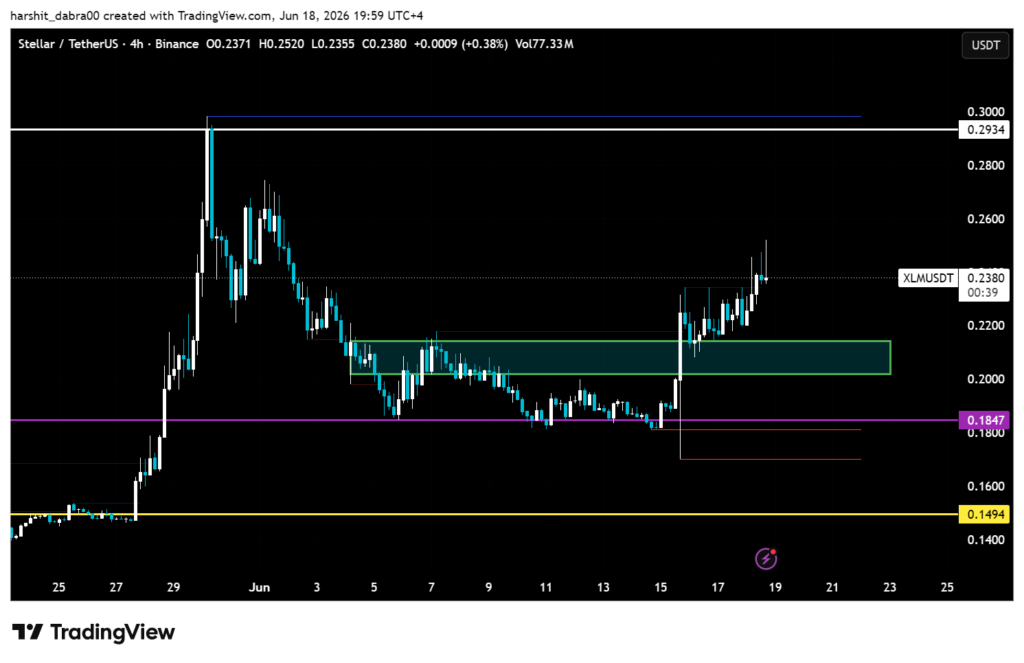
Zooming out, the last month has presented a more volatile scenario compared to the last two days. The asset made a top out at $0.2934 in the last week of may, the top of which is the swing from which every fib level beneath it came before crashing back into a multi-week chop. Lower highs with resistance through early this month, then into range between $0.20 and $0.2143 for nearly eleven days, prior to a push lower towards $0.14 region before the swing low and rebound was put in. XLM stepped down, followed by the lower lows into the mentioned range.
The move back up has just skipped it. The price soared through the marked zone from $0.20 to $0.2143 on June 16th, tested the bottom, then reversed. Following this, the price came right back up in a straight-line move through the box, through the daily pivot at $0.22467, to an intraday high of $0.2520 and then finished out the day at $0.2380. Didn’t pause to stop to visit with anything anywhere and no retrace on a move this large from the low. This info must be taken into consideration before any indicator readings.
Momentum stays strong but not overheated
RSI7 is holding the reading of 69.85 which is in the overbought zone and makes sense given how the move came off $0.18 was. RSI14 and RSI21 are positioned at 61.58 and 59.65, which are bullish but don’t lie in the overheated zone. This means that the shorter timeframe got ahead of the broader read and can’t be said to be the other way around. The MACD line is well above the signal; the histogram is barely indicating a positive reading with 0.00035. The direction is positive but the mentioned figure needs more extension to follow up to the bullish category.
If we look at the significant moving averages, then all of them are below the current price. At the time of writing, SMA7 was standing at $0.20, EMA7 stood at $0.21, and SMA30, SMA200, EMA30, and EMA200 all remained stacked between the price zones of $0.19 and $0.20. Averages are designed to lag; that is how it works For all six to move back below the price in two days, the price needs to move fast enough to carry them with it. This doesnt take place in the case of poor momentum
Volume traded $757.23 million, considerably higher than anything we got from the 11-day consolidation period. We don’t typically see volume like that accompany a move that’s going to reverse on its face, but then again, it doesn’t exactly confirm continuation, either. It does suggest the buying force that pushed the price higher wasn’t the most weakly funded group you’ve ever come across. A move that carries low volume can get killed in silence but in this case, it is already in target as the price is trending with good momentum.
Why the XLM level of $0.238 matters
As XLM’s price is currently sitting at $0.2380 following a wick to $0.2520 that was sold back down. The resulting rejection is the response from the market to how deep this move gets without taking a break.
Below, the marked zone from $0.20 to $0.2143 currently needs to function as a base rather than a resistance. That zone aligns up very loosely with the 50 percent retracement that is present at $0.2183 and the pivot at $0.22467, three independent measures coming together on roughly the same point on the chart.
A close back inside the box reverses this from a breakout into a failed attempt and leaves the market participants who bought the move from $0.22 to $0.25 with not enough to hold the position. On the positive side of it, the next real test is the 23.6 percent retracement that is positioned at the price point of $0.2596. The 127.2 percent and 161.8 percent extensions at $0.3392 and $0.3934, as well as with the prior swing high at $0.2934, stay theoretical until price finds its way there.


