



The Wednesday trading session ends with Bitcoin closing at $64,142 and this is the lowest closing since April. The mentioned price is down more than 20 percent compared to May’s high of $82,500. Bitcoin is trading at a discount of 49 percent to January’s record all-time high. The downtrend was even quieter and that makes it worse.
The reason behind this isn’t the same structural breakdown that the market participants saw in February and this is because the market doesn’t seem to have any clear buyers at this point in time. February had a reason for the drop, then stopped cleanly at an area. This one has seen a drift for two weeks and then the floor fell out. In addition to that, there was no bullish divergence anywhere on the bounces and no absorption volume.
The previous area low is now acting as resistance, and the year-to-date low around $60,000 is the only prior place for anything significant to happen somewhere between the current timestamp and the next real decision.
The March-April range, $65k to $75k roughly, was more of a distribution phase and was termed as “accumulation” by the large portion of market participants. It wasn’t up until about the May push higher to around $82,500 and at that price it appeared to be recovering. But the case failed hard and the structure was destroyed in days.
The capital flowed somewhere else
Outflows in spot Bitcoin ETFs have now broken above the $3 billion figure in recent weeks. This number is not that significant as an absolute dollar value compared to the fact that over $10 billion flowed towards the DRAM ETF during the same two-month timeframe. As soon as Jensen Huang declares Marvell Technology to be the next trillion-dollar firm, this statement is less of an offhand remark and a signal towards the current target of institutional focus as well as a time frame of that focus.
Here, the companies are like Dell and have seen a rise of over 40 percent in just a matter of days. Marvell has risen over 40 percent in a week. Sandisk has returned more than 4,000 percent in a year. The companies like Micron, Samsung, and SK Hynix now qualify as belonging to the trillion-dollar club. The largest cryptocurrency, Bitcoin, during the same period, has gone through a drop of 49 percent from its all-time high.
What the Bitcoin’s structure stating
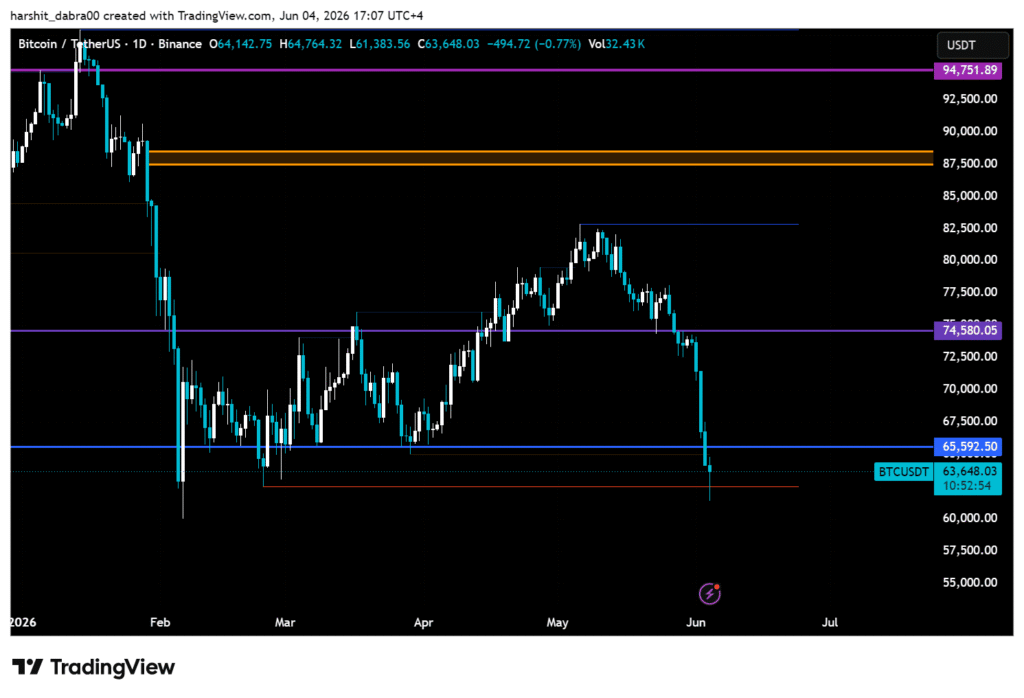
The major high from the price level of $94,751 is 33 percent above the current trading price of the asset. Previous breakdown area near $87,500 is 27 percent up. Neither one of these holds that much relevance in the immediate future. The only one thing that does is the $60,000 level, which is YTD low, a round number, and where Feb’s capitulation took a pause.
While the important pyschological level of $60,000 remains a weekly close, the structure is shaky but durable. A clean break of this level leaves the market in uncertainty about the whole 2026 range lower or not. First big resistance for any bounces is going to be $65,592 which previously acted as the base level for Bitcoin this week; it will be a struggle and take weeks to rally back above if there is no supportive macro event.
In the case that the largest cryptocurrency closes below $60,000 then the short-term invalidation for the case (bear) will stand at the same volume-based reclaim of $65,592.
The AI bubble argument
The comparison of cannabis and EVs can only go so far. AI carries actual revenue, actual CapEx, and sovereign sponsorship. The primary reason for the correction doesn’t necessarily have to prove the thesis wrong. The thing that needs to be proven in the next two quarters a little under what is already factored in.
Both the AI narrative-dominating companies, Anthropic and OpenAI, IPOs, will serve as the biggest driver of this move. Both have allocations, and those will come from somewhere. In the event that valuations come in at the wrong levels, the rapid transition back into non-correlated assets is likely to be very quick. Gold’s lack of performance during this same time is an indication of the narrative that this is a single-sector pursuit, and outside that, liquidation is occurring to pay for the opened-up positions.


