

The U.S. and U.K. have decided to bet big on regulated stablecoins, looking to upgrade cross-border settlements between them quicker, cheaper, and more transparent. On Tuesday, the U.S. Treasury and U.K.’s HM Treasury issued a joint statement outlining a unified vision to support stablecoins issued in one country to access financial markets in the other.
The decision was taken after a Transatlantic Taskforce for Markets of the Future, launched as a joint initiative between the U.S. and the U.K. determined that stablecoins could improve transatlantic payments, transactions, and the overall financial market infrastructure.
“The U.K. and the U.S. intend to enable the use of stablecoins in cross-border finance. Both governments affirm that providers of lawful, regulated stablecoin and digital-asset services should have fair, risk-based access to financial services and markets,” the joint statement released by the two nations said on Tuesday.
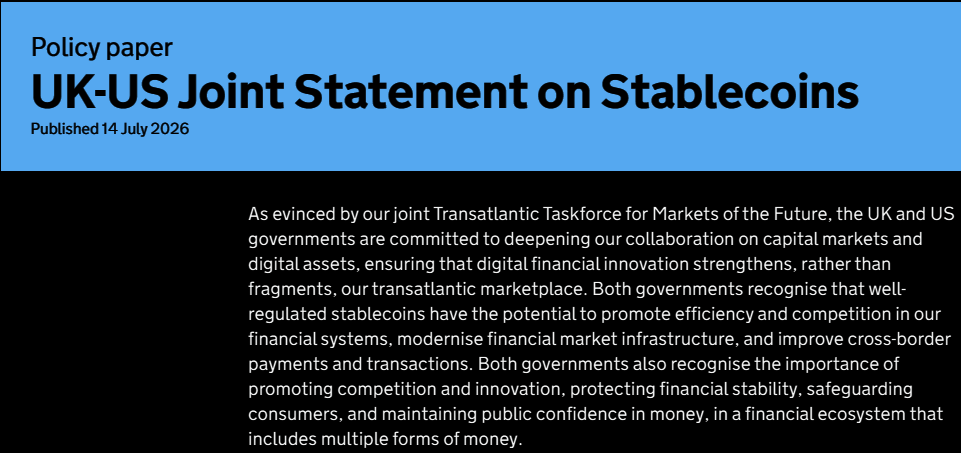
Source: www.gov.uk
Together, the countries have vouched to set standards in infusing stablecoins into existing financial systems — while keeping the focus on prioritizing consumer protection as well as national financial stabilities.
Stablecoins are digital assets pegged to reserve currencies. The U.S. passed its landmark GENUIS Act last year, that lays out comprehensive rules for stablecoin issuers — defining how they can interact with banks and the mandates needed to keep them eligible as issuers.
In the U.K., stablecoin regulations are still taking shape. While issuers are expected to comply with the AML guidelines, the U.K. is working on spelling out detailed laws to regulate these tokens. The Financial Conduct Authority (FCA) and the Bank of England are expected to collectively oversee these regulations.
Under the transatlantic collaboration, however, both the countries will work on setting common requirements for 1:1 asset backing, clear reserve custody, and insolvency protections for stablecoins to adhere to, internationally.
“Neither government intends to impose burdensome reserve requirements that are disproportionate to risk and that create unwarranted barriers to entry,” the statement noted.
At present, USDT along with USDC, XAUT, RLUSD, USD1, and PYUSD are among popular stablecoins with most of them pegged to the USD. This means one USDT values equal to $1. XAUT, meanwhile, is pegged to gold so one token of the XAUT represents one troy ounce of real physical gold.
As per CoinGecko, the valuation of the stablecoin market at the the of writing stood at $306.37 billion as of press time.
While the U.S. is already seeing stablecoin integration with the services being offered by Wall Street giants, the U.K. is also taking calculated steps to explore this token ecosystem.
In May, the Bank of England (BoE) said regulated stablecoins and tokenised bank deposits should all be supported in the future of U.K.’s retail payment system.