

From the start of this month, Toncoin (TON) started doing something that it had not been able to do in the second half of May. The pattern is that it has crossed over its Monthly, Weekly and Daily Open on just one 4-hr candle and tested the recent resistance at $2.177 and been facing some rejection. The session was open at $2.096 and the asset managed to mark a high of $2.099 on the candle high wick; the price spiked at $2.177 on the move up.
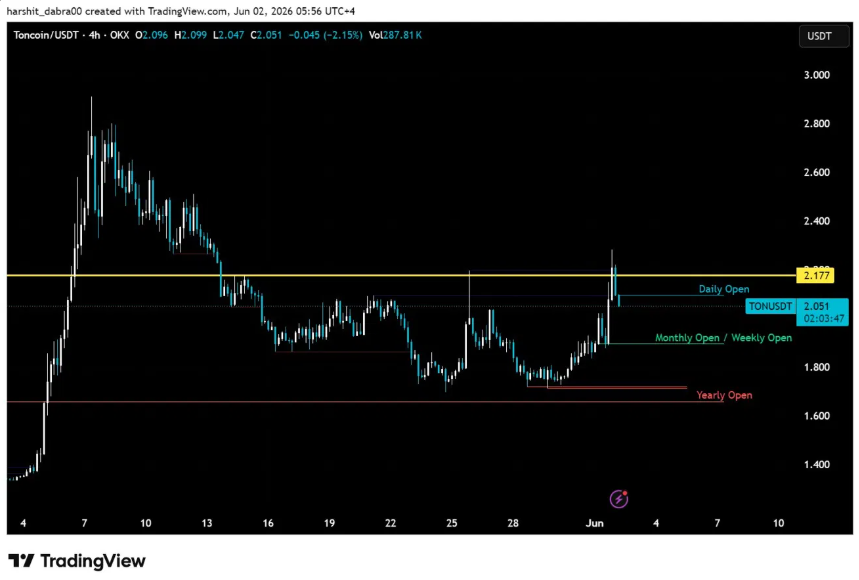
At the trading price of $2.051, the relative asset is in an awkward spot based on structure. The Monthly and Weekly Open (both in teal on the chart) are having an intersection around the price levels of $1.95 – $2.00 levels and this is just below the price. The Daily Open is priced in just above that, at about $2.10. Price is compressed between the thin zone, which is below the Daily Open marked in the above chart. What TON’s structure performs in the next few sessions gives much more clarity about the nature of this recovery than the June 1 candle expansion.
The baseline is already set from the past month
To understand what this month has opened into, we have to look at May’s price series. At the start of the previous month, May 4, the price was $1.35 and after just 3 days later, it hit $2.46 with a sustained volume of $1.92 billion. A move carrying that much magnitude in 72 hours pulls in a specific type of participant that are momentum traders, short-term speculators, and later-stage buyers catching the breakthrough. The decompression of a crowd like that is usually harsh. The same happened with this digital asset and was no different in this case as well; it saw a fallback to $1.76 from its May 4 high of $2.46 in the time period of the next 3 weeks. This is the area where the Yearly Open of ~$1.65 acted as macro support for the structure to avoid collapsing.
TON experienced a bounce back from $1.76 and went towards the Monthly Open, but the approach to June was slow and low volume compared to the surge up. This is what makes it an important point to note. Those “quiet” bounces, without volume at resistance, are much more to be suspicious of than ones that are supported by buying pressure. In fact, the spike that occurred on June 1 to $2.177 was just carried by a single candle, a high-volume spike, only to reverse instantly.
There can be cases that need to be noted; in the case of rejection, it falls back down and will not be called as a continuation. In the case of consolidation below it, the first thing is building the pressure and then breaking through it on the next attempts.
The levels that needs to be noted
The closest base level is $2.09 (Monthly/Weekly Open Cluster), where traders reviewed their positioning at the start of the session. Price above this level is helping the bullish reading to be intact. Closing below $2.00 on a 4-hour close the June 1st move as a bull trap that will return control back to the May range that can be called more of a “compression range.” $2.177 is the resistance to watch; the price has rejected this twice. Two straight rejects of this level establish supply. Third attempt only has bearing with volume on the current session and must not be the reading that takes out the heavily tested supply zone.
Above $2.177 the next important level on the chart is $2.29 and this is the 38.2 Fibonacci retracement of the swing from $1.33 to the swing of $2.89. The stated level is not so distant from the May 10-May 13 zone consolidation. Test of this level would signify structural recovery, not a mere bounce and this is 12 percent above the current price level; therefore, it’s the first “target.” The downside support is the 61.8 Fibonacci of $1.93; this figure is a key level for a normal pullback or something worse. On a daily candle close below $1.93 the yearly open close at $1.65 comes back on the table.