
Solana is leading the real-world asset tokenization arena, especially the gold tokenization market. Despite Solana being adopted by many, the coin has crashed below the trendline of the symmetrical triangle, which could have a bullish breakout.
The Solana network is spearheading the real-world tokenization sector, outclassing BNB, Ethereum, and Avalanche chains. Gold tokenization on the Solana network grew by 690% year over year, while the second largest growth was recorded on BNB (314%), which is less than half of the growth on Solana. This stark difference shows how Solana has been dominating the tokenization sector.
Historically, increased real-world asset (RWA) tokenization tends to strengthen a blockchain’s fundamentals by attracting more users, liquidity, and institutional participants. As more tokenized assets are issued and traded on Solana, network activity increases, generating higher transaction volumes and greater demand for block space, which can support the long-term value of SOL.
However, broader market weakness and cautious investor sentiment have so far prevented the tokenization boom from translating into a sustained price rally.
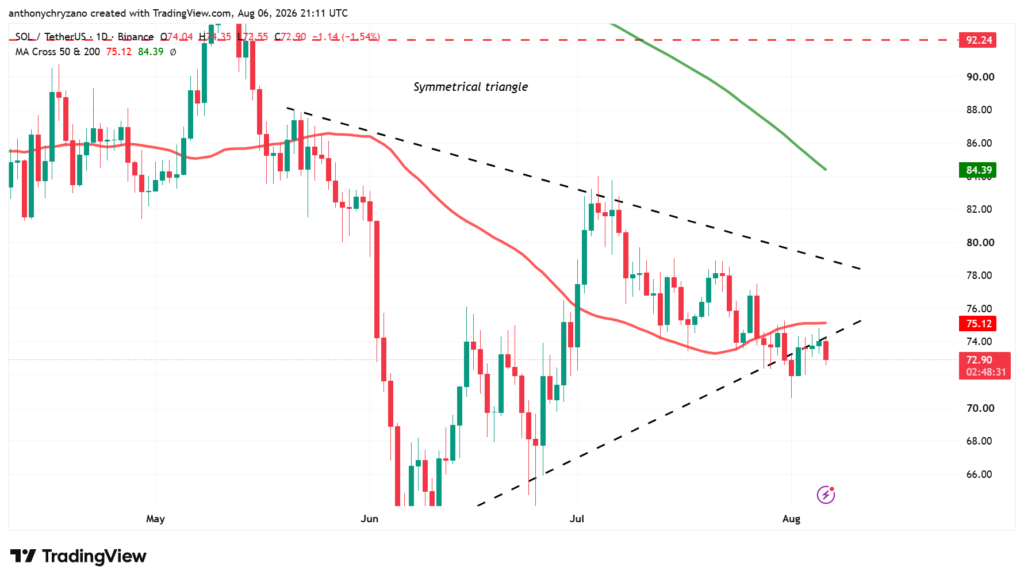
As shown in the chart above, SOL has fallen out of a symmetrical triangle, which could have given SOL a chance to rally. The symmetrical triangle is a neutral pattern, where the breakout could happen in any direction. Now that SOL has crashed below the lower trendline of the symmetrical triangle, it is important that it once again recover and rise above this level. Even in the event SOL rises above the trendline, the 50-day MA, which is just above the trendline, could pose an immediate threat to the prices. As such, to be on safe ground the coin will need to clear the 50-day MA, which is at $75.