

Currency Spectrum? – Yes. To help clear up the usually confusing world of crypto, MicroStrategy’s Executive Chairman Michael Saylor has officially rolled out something he calls a “Digital Assets Monetary Spectrum.”
The whole idea, which he broke down in a new post and a deep-dive strategy paper, sorts digital assets by what they actually do and how risky they are, ditching the old habit of labeling everything the same way. For instance, this new structure lands as Saylor tries to bridge the gap between traditional finance (TradFi) and the fast-growing digital world by giving investors and regulators a clear taxonomy for investors and regulators alike.
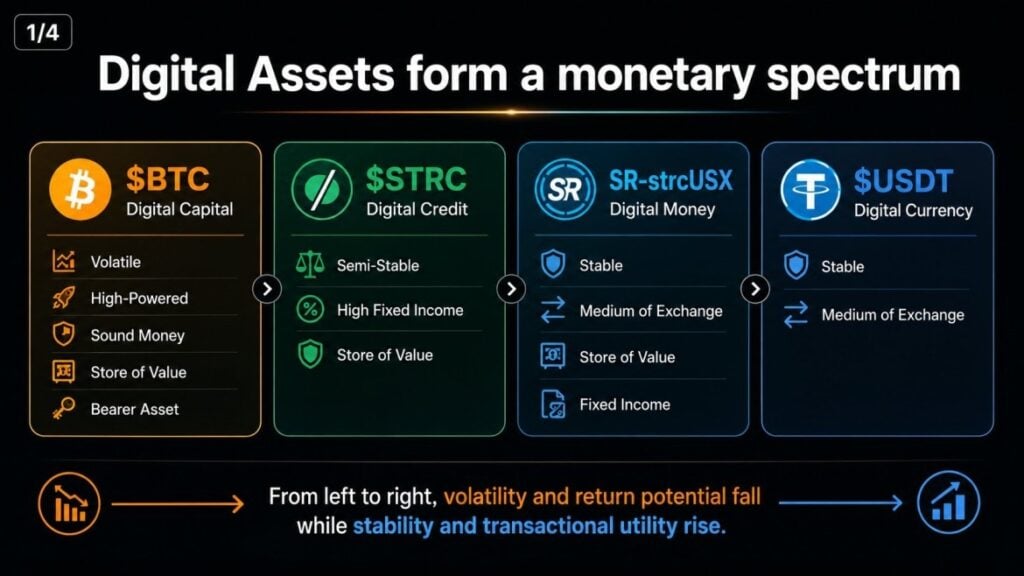
The spectrum of money: From capital to currency
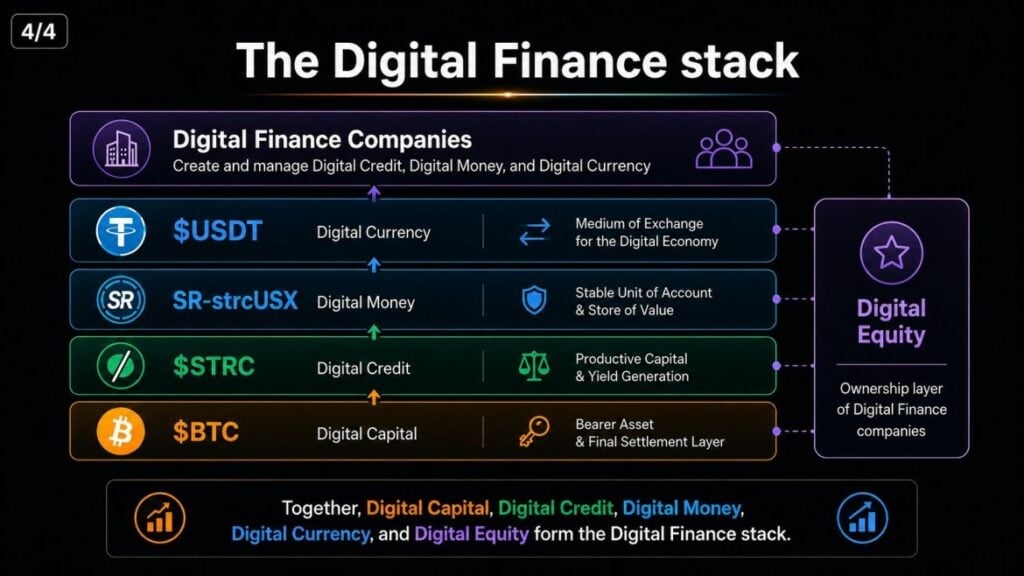
Basically, Saylor’s whole idea boils down to a neat four-tiered system. You have got Bitcoin (BTC) sitting on one side, which he dubs “Digital Capital.” It’s like a volatile, high-powered bearer asset, kind of like a digital version of gold that’s meant for holding value over the long haul. Moving forward, all the way on the other side, you find Tether (USDT), which Saylor calls “Digital Currency.” So it serves as a reliable medium of exchange for your everyday spending.
The basic rule of this spectrum is that moving from left to right means you trade off wild price swings and big profit potential for more stability and ease of use. It basically sets up Bitcoin as the king of saving for the future, while stablecoins take the crown for actually buying stuff.
Bridging the gap with digital credit and money
Now, to connect these two extremes (mentioned above), Saylor introduces intermediate layers. STRC (its Nasdaq-listed shares) functions as “Digital Credit,” offering semi-stable, high fixed-income characteristics for yield-seeking investors.
Furthermore, SR-strcUSX [a Solstice Finance’s senior-tranche token on Solana, offering decentralized finance (DeFi) users priority access to dividend yield from STRC] is positioned as “Digital Money,” a hybrid that merges the stability of currency with the income-generating power of capital.
When you put it all together, what you are looking at is a complete “Digital Finance Stack,” which is basically a system where financial firms handle digital credit, money, and currency, all built on a foundation of “Digital Equity.”
A vision for 21st-century dominance
This taxonomy is not merely academic; it is central to Saylor’s vision for how the U.S. can stay ahead economically. He believes that by setting these ground rules, digital assets will tap into trillions of dollars in value, keep the dollar strong via stablecoins like USDT, and turn Bitcoin into the world’s go-to digital vault.
To make this work, he’s pushing for common-sense laws that respect Bitcoin as a long-term investment and stablecoins as everyday cash, finally letting banks handle these assets and offer loans against your BTC holdings.