

Fresh data received on Thursday suggests that Bitcoin’s (BTC) 30-day perpetual futures demand has returned to positive territory, while on-chain spot demand remains negative. In other words, traders are already busy increasing leveraged exposure, even before genuine spot buying has fully recovered.
Bitcoin rally driven by derivatives market
The rising activity in the BTC derivatives market is concerning, since it shows that there is still no real demand for the top cryptocurrency. Rather, investors are still choosing to speculate on the digital asset, hoping to make a quick profit.
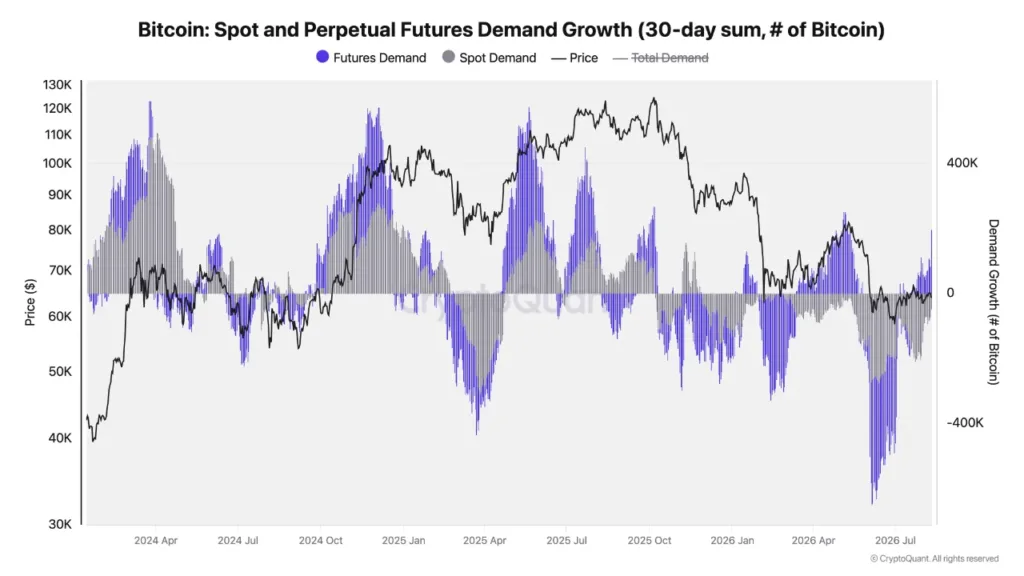
Notably, a similar price structure came to surface back in April 2026, when BTC rallied heavily from around $66,000, to as high as $79,000, on the back of rising futures demand. However, at the time, the spot demand for the cryptocurrency remained weak.
Eventually – without sufficient spot demand for BTC – the rally faded. As of August 2026, BTC is trying to stay above $60,000. However, compared to April 2026, there is one key difference in August.
Data shows that U.S. spot exchange-traded funds (ETFs) have started to recover. According to SoSoValue, so far, August has seen only one day of net outflows from U.S. spot ETFs. The following chart confirms the same.
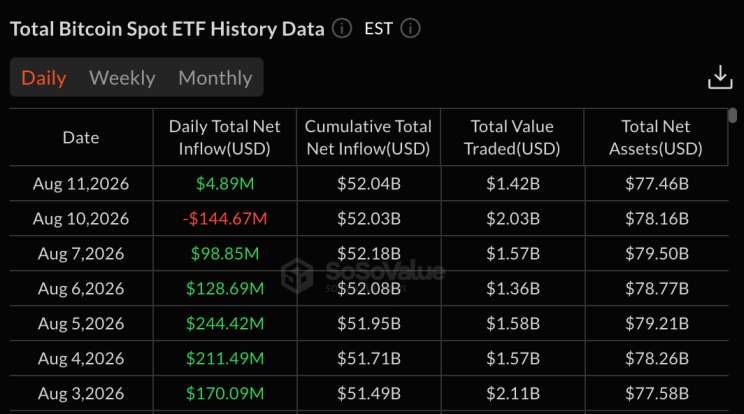
The combination of soaring BTC futures demand, coupled with rising ETF flows, and declining on-chain spot demand suggests that although buyers are returning, they have not yet absorbed enough existing supply to create broad-based spot demand.
The next confirmation is clear – spot demand for BTC needs to turn positive at the earliest. If futures demand, ETF inflows and spot buying rise together, Bitcoin could transition from a leveraged rebound into a more sustainable uptrend.
Is BTC threatening another leg down?
On the contrary, if BTC open interest continues to climb while spot demand remains in the negative territory, then the market would remain vulnerable to another leverage-driven reversal.
This time, the cryptocurrency could fall below its 2026 low of around $59,200.
Meanwhile, the odds of a volatile move are increasing with a recently-observed slump in BTC liquidity across crypto exchanges. In the short-term, the market may see further negative price action – as BTC Binance inflows have surged to levels last since around 2022 bottom.