
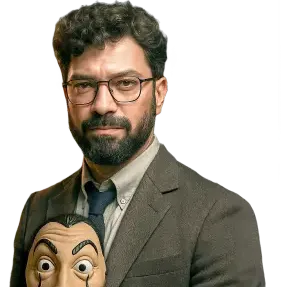
The Telegram messaging app has been blocked in India until next week pending a government probe into a recent medical entrance exam paper leak. Indian authorities have alleged that Telegram could be misused by organized cheating rackets to circulate fraudulent information which could lead to chaos among students.
The action against Telegram did not sit well with its founder Pavel Durov, who slammed Indian Prime Minister Narendra Modi’s government on Tuesday. Durov, 41, also hit out at Indian billionaire Mukesh Ambani’s telco Reliance Jio for allegedly sabotaging access to Telegram for “millions of users” outside India, including in the UAE.
The fresh developments have intensified tensions around the leak of a centralized exam in India which is critical for admissions to medical colleges in the country.
Here’s what exactly happened
Indian Education Ministry’s National Testing Agency (NTA) conducts the National Eligibility-cum-Entrance Test-Undergraduate (NEET-UG) exam every year. This is essentially an eligibility test for students to get admissions into medical colleges.
While this test is held only annually, this year, it is being done for the second time. Originally, the test was held in May this year, but the results were cancelled after it came to light that the exam was leaked. An NTA insider, P.V. Kulkarni, has been arrested on charges of being the mastermind behind the leak.
For many students in India these exams are make-or-break as the seats to medical colleges are limited which makes these tests highly competitive. The cancellations led to several alleged suicides by aspirants who had appeared for the examination.
This sparked widespread protests in India demanding the resignation of India’s education minister Dharmendra Pradhan. The test is scheduled to be held again next week with over a million students expected to appear for it.
The NTA, in order to curb the spread of any misinformation ahead of the re-test, has asked network providers to block access to Telegram until next Monday.
“Acting on inputs received continuously from NTA, from State law-enforcement agencies including the police forces of Bihar, Gujarat and Rajasthan, and from its own continuous monitoring of public channels and platforms, 14C has secured the prompt take-down of a substantial number of Telegram channels, groups and bots,” the NTA said in its statement.
The NTA along with India’s IT ministry have issued this block on Telegram until 22 June while also restricting the app’s feature to let users edit sent messages until 30 June.
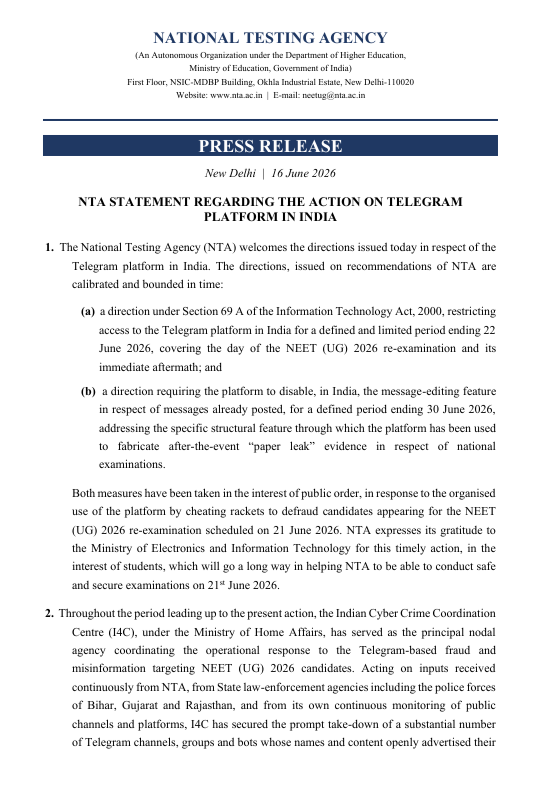
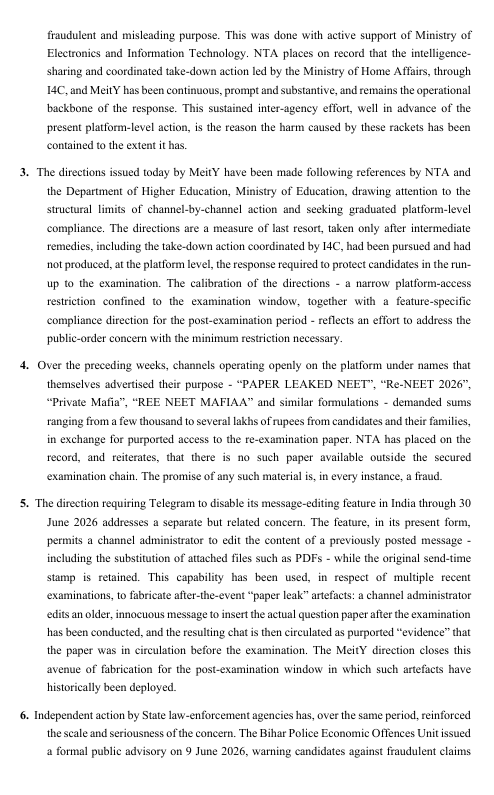
Source: NTA
Durov condemns India’s action, calls it a mistake
Durov said that the restriction on the platform is being levied not just for the NEET aspirants, but for over 150 million Telegram users in the country.
“And the ban hasn’t stopped anything. The leaks just moved to other apps,” the Telegram founder said defending his platform.
Telegram has claimed that, over the past week, internally scanned its India network to identify and remove hundreds of channels circulating NEET related exam materials.
“We’ve also been making the “edited” label more visible to prevent backdating scams. Telegram is a force for good. Banning it — even temporarily — is a mistake,” Durov noted on his Telegram channel.
The Telegram founder has also levied rather serious allegations against Ambani-led Jio through a post on X claiming that Reliance is using “BGP hijacking” to sabotage Telegram access for Indian users presently outside the country. In BGP hijacking, malicious actors falsely advertise IP ownerships redirecting internet traffic away from its legitimate destination to cause outages.
“This may be part of a competitive war, as Reliance is partially owned by Meta — the company behind WhatsApp. Such abuse of global Internet routing is alarming. I wouldn’t be surprised if Reliance/WhatsApp were also behind the recent lobbying effort to ban Telegram in India,” Durov claimed, posting screenshots to support his claims. In 2020, Meta invested $5.7 billion to acquire a 9.99 percent stake in Jio Platforms.
As of now, neither India’s IT ministry nor Reliance Jio have responded to Durov’s accusations.
Why Telegram and not WhatsApp?
Telegram lacks a localized compliance team to handle law enforcement requests in India. It has only recently started setting up these teams in regions like Dubai and Belgium.
Unlike Telegram, WhatsApp’s parent firm Meta has developed better history with the Indian law enforcement agencies.
Furthermore, Telegram’s unique message-editing feature allows malicious actors to backdate posts and manufacture fake proof of leaks, while enabling automated bots to monetized frauds.
All these factors put together brought Telegram under scrutiny in India over its competition WhatsApp.