


A mega-alliance of over 140 fintech giants launched a new stablecoin in the market on Tuesday, called the Open USD ($OUSD). Pegged to the U.S. dollar, OUSD has been designed by a startup called Open Standard, which will operate as an independent company governed by an extensive board of directors including members from crypto and TradFi heavyweights BlackRock, Coinbase, Visa, and Stripe among others.
The stablecoin is launching natively on the Solana blockchain. The official announcement statement detailing the token’s features said it will allow businesses to mint and redeem OUSD free of cost and with no limits on volume.
This gives the OUSD a clear edge over stablecoin giants Tether and Circle as both are known to levy charges on corporate clients, often around 0.1 percent or a flat minimum to convert fiat dollars into stablecoins or vice versa.
To keep OUSD rooted to a community-first model, the stablecoin has put a feature called the “Earn by Default” on the table. Under this, all of its network partners will receive portions of the revenue generated by OUSD’s underlying USD reserves. A small management fee will be cut from these portions to cover the operational overheads.
“Existing stablecoins have great strengths, but to use them at scale, businesses need something that’s open, low-cost, high-throughput, broadly accessible, and aligned to their interests,” said Abrams commenting on the launch.
A total of 44 crypto platforms are part of the OUSD-fueling alliance. These include Bybit, Solana, OKX, Ripple, Crypto.com, Fireblocks, Gemini, MetaMask, Aave, and eToro among others.
Google, Samsung Electronics, IBM, and Infosys from the Big Tech cluster have also joined the initiative alongside banking giants like BNY, Standard Chartered, and the Commonwealth Bank of Australia among others.
It appears that the OUSD could see a major push in the international remittance arena. Payments processing platforms like Western Union, Nuvei, and Remitly afterall, have joined the network-supporting group of companies.
Stripe has already announced that it will be making the OUSD token the defaut stablecoin for its business clients.
“Open USD is a constructive step toward giving businesses more choice in how they access tokenized value and participate in internet native digital rails,” said Samara Cohen, Global Head of Market Development, BlackRock.
This initiative has essentially given a concrete inroad to players from the crypto, fintech, and big tech industries into the thriving stablecoin market, which at the time of writing was worth $307 billion.
The stablecoin launched under legal clarity of the GENIUS Act, could onboard some of the world’s largest payment operators and tech platforms actively onto the stablecoin ecosystem.
“The more great infrastructure this industry builds together, the faster we close the gap between what payments are today and what they should be,” said Shan Aggarwal, Chief Business Officer at Coinbase.
In a potential reaction to the OUSD launch, Circle CEO and Co-Founder Jeremy Allaire posted about how USDC remains the world’s “most trusted” stablecoin, especially among institutions.
While Allaire did not directly address the launch of the OUSD, he did say, “We welcome continued innovation and competition in the space and look forward to remaining laser-focused on building the best stablecoin infrastructure possible and driving more customer and partner success.”
At the time of writing, Circle stock was down by 11 percent, trading at $64.60 under the CRCL ticker on NYSE.
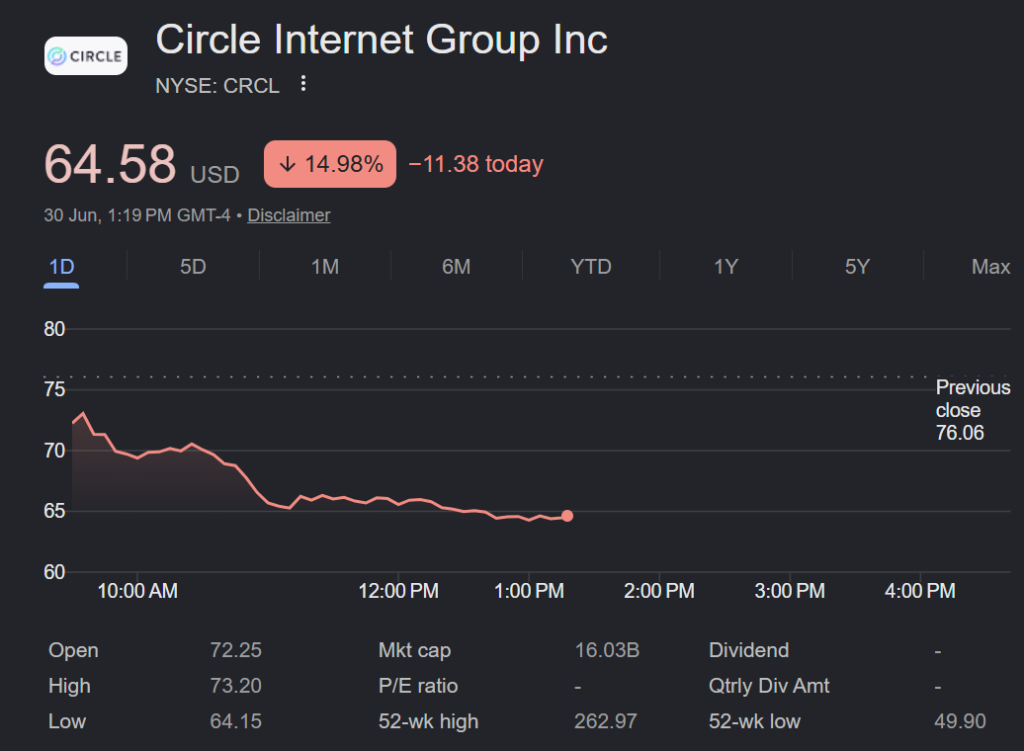
Source: NYSE
Meanwhile, Tether chief Paolo Ardoino also chimed into the conversation, exhibiting subtle boast about USDT being the world’s largest stablecoin by market cap.


