

Consensys, the software firm behind MetaMask, has submitted a formal comment letter on the OCC stablecoin framework implementing the GENIUS Act. While the firm praised the Office of the Comptroller of the Currency for a “serious effort,” they flagged three specific “issues” that it believes diverge from what Congress authorized and could impede innovation.
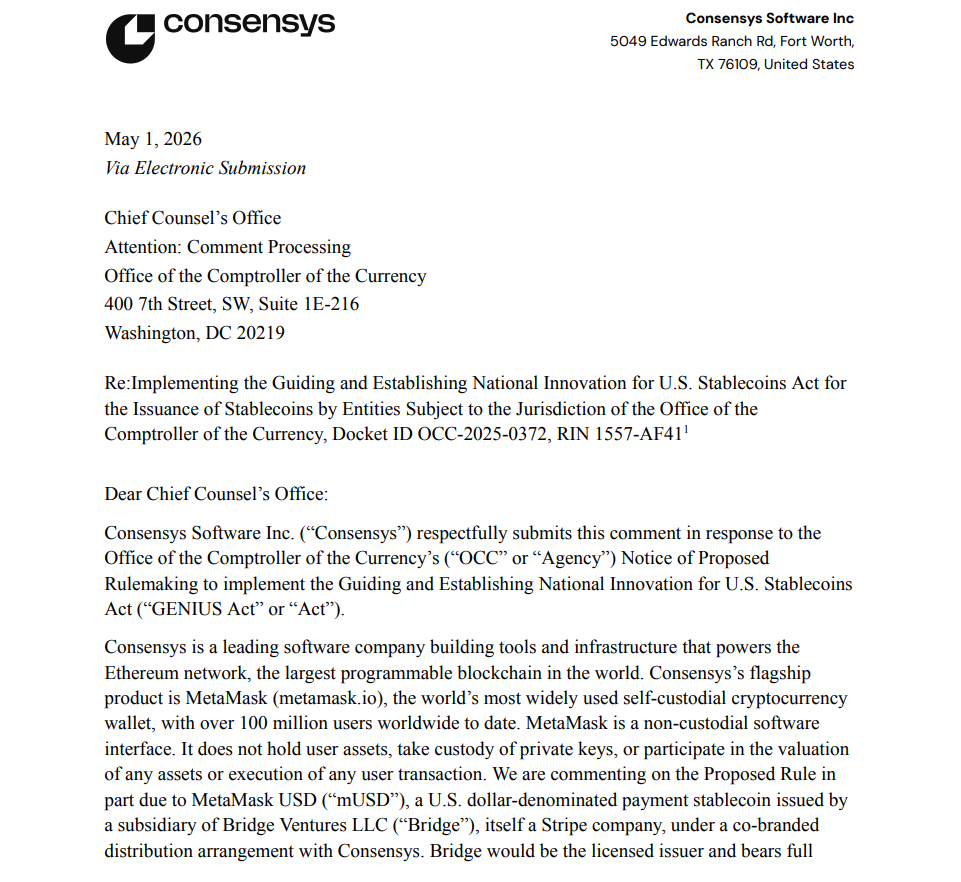
Three flags raised by Consensys on the OCC stablecoin framework
1. The yield prohibition overreach
Under the GENIUS Act, issuers of stablecoins are prohibited from paying yields to holders (fiercely debated). The proposed rule by the OCC expands this prohibition to “related third parties.” On this matter, Consensys believes this is inappropriate, arguing that an independent distributor receiving a commercial fee for a wallet interface, the section that allows them to pay users’ incentives, is not considered an issuer’s payment of yield using their reserve. But, Congress twice rejected amendments to extend this prohibition to a non-issuer; therefore, the OCC should honor both.
2. Decentralized Finance (DeFi) access and non-custodial wallets
Whichever DeFi protocol a MetaMask user chooses, such as Aave or Morpho (to name some), the yield is paid by the borrower, NOT the issuer. In fact, the GENIUS Act also specifies that non-custodial software interfaces lack the characteristics required to be classified as a regulated intermediary. Upon this, ConsenSys requests the OCC to clarify whether, when a user accesses DeFi protocols through a wallet that allows them to do so, this would make the wallet service provider a “related third party” paying yield on the issuer’s behalf.
3. Multi-brand stablecoin issuance
The OCC is currently thinking about banning a licensed issuer from supporting multiple co-branded stablecoins. On this third point, according to Consensys, just having the issuer identify itself prominently and disclose the reserves for those stablecoins is the right solution. But, if there are still concerns after such disclosures, pool segregation is one way to address this from a structural standpoint. The letter indicates that if the OCC prohibits the issuance of multi-brand stablecoins, “it would foreclose the distribution model entirely,” as it would put OCC-supervised issuers at a disadvantage to Federal Deposit Insurance Corporation (FDIC)-supervised issuers, who are not subject to such a restriction.
Nevertheless, Consensys’ lawyer, Bill Hughes, also echoed their position through a long post on X about these matters and the importance of drawing attention to them.
The GENIUS Act context
So far, the GENIUS Act has established a federal framework for payment stablecoins with regard to reserve requirements, licensing standards, and prohibiting issuers from paying interest to hodlers. To this point, the OCC stablecoin framework, if it continues this way, will be implemented for banks and trust companies under its supervision.