

Cash is a quiet value destructor. In the case when a business holds a lot of capital in a money market fund, then it can’t be termed as “capital preservation.” The basis point here is it’s just watching inflation erode its value. The issue is relatively recent in origin, but the solution that public companies are now reaching for is nothing new: it is Bitcoin on the balance sheet. Currently, there are now over 170 publicly traded entities that have done just this.
The real challenge with cash reserves
Every sizable corporation generates more cash when compared to what it can right away put back to work in the business itself. That capital has to sit in a certain place. Previously, the options were just a few dull, short-duration bonds, treasuries, or money market accounts. Safe, boring, and steadily losing ground to inflation.
Bitcoin is staking a claim entirely different from that. The supply metric is finite; that is, it is finite at 21 million coins. It can’t be conjured into existence by a central bank. The reward rate drops by 50% approximately every four years. That finite supply is the entire premise for a CFO worried about holding purchasing power in five years.
There’s also the signaling aspect of this. The companies that continue to accumulate bitcoin serve as the venue for investors who want indirect access, packaged as familiar regulated wrappers like brokerage accounts, pension plans, and no self-custody complexity.
It’s the company’s equity that turns into the proxy. This demand from investors is what results in a true premium on the valuation of the underlying Bitcoin. In addition to this, the premium offers real economic utility.
Companies prefer three ways to do so
The first way is by conservative allocation: Following this way, the company allocates 1-5% of cash reserves. This includes cold storage with no debt. Over the long run, This strategy serves as an inflation hedge accompanied by a limited downside. Most companies start with this level.
The second is the market positioning, where it acts as a benchmark for investors that are looking for exposure without the complexities of self-custody. At a time when there was no direct access, Metaplanet built its entire network in this manner.
The most interesting method is levered accumulation, where equity or convertible debt issuance is exclusively used for accumulation of more bitcoin than cash flow can absorb. This metric is calculated as bitcoin per share and not by earnings. Issue shares above NAV, take proceeds and buy BTC; each remaining share now gets involved in more BTC without pro-rata share dilution. The investment is accretive in the case when the stock is trading at a premium to its bitcoin holdings and becomes dilutive in the other case.
Who is doing it and why it matters
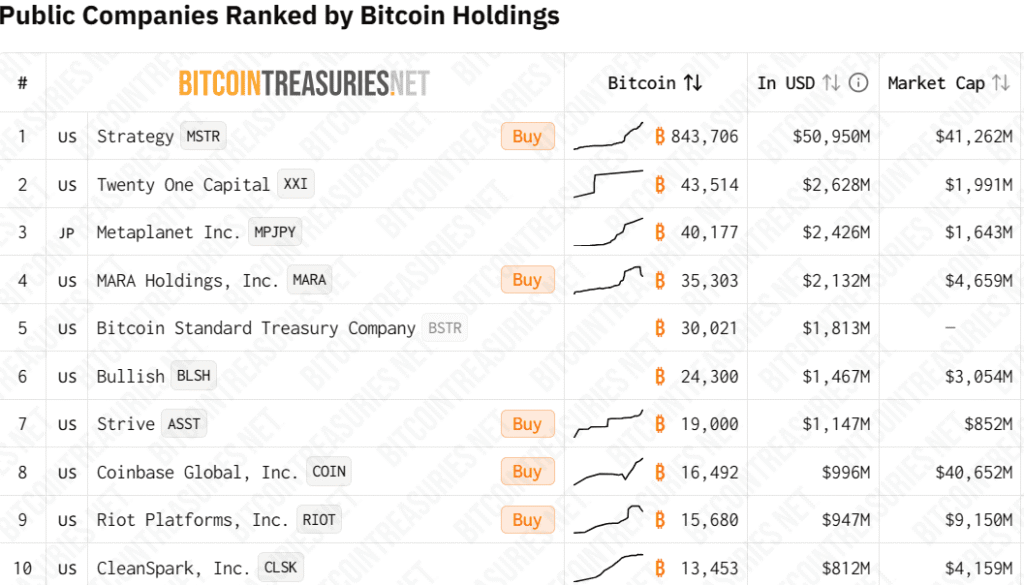
Strategy currently holds 843,706 BTC or about 4% of the supply. In terms of public companies, nobody else comes close. 21 Capital is second-highest at 43,514 BTC and designed from scratch as a treasury vehicle. Metaplanet (40,177 BTC) stands as the first non-US holder and serves as proof the inflation hedge thesis will work for other currencies too. Below that the list becomes messier: MARA holdings, Riot platforms, & CleanSpark (amongst others) are mining companies that hold BTC as a natural product of generating it, not as a treasury allocation. A miner selling a new coin to generate margin is not the same as a treasury selling out capital that has been invested in the company.
The Flywheel and Its Limits
So why is the leverage model sustainable? It is because there is a premium. By allowing the BTC treasury stock to be trading at 1.5x NAV for BTC the company could actually issue shares, buy more BTC, and still continue to increase BTC per share even after diluting that share. BTCYield is the calculation of that very fact. How much did BTC per diluted share increase by during the period?
The model only works so long as the premium remains. When the stock price is trading very near the BITCOIN NAV, new share issuances are dilutive, not accretive. When the price of bitcoin falls the unrealized losses are recognized via the income statement and look like losses, although not a single Bitcoin has been sold.
Strategy, the creator of this model, sold 32 BTC in order to satisfy compulsory preferred stock dividends, which was cheaper than either selling shares (diluting equity) or adding further debt. Versus the 843,706 BTC they have in aggregate, it was 0.004 percent of the holding. The mechanics of it were not about conviction; they represented that preferred shareholders have a contractual right to receive fixed payments of fiat on a fixed schedule irrespective of Bitcoin’s price. Leveraged acquisitions entail real liabilities; a company could be 100% dedicated to a BTC thesis and still be forced to sell a small amount to satisfy the liabilities that it has relied on in order to finance a greater amount.