

Kraken Exchange moved their funds to the Chainlink bridge following the hack attack on the LayerZero bridge, resulting in a loss of $292 million. Although there was a significant transfer of funds to the Chainlink blockchain, the LINK token has retracted below the psychological resistance level of $10.
Kraken Exchange is replacing the LayerZero bridge with Chainlink’s Cross-Chain Interoperability Protocol (CCIP) after the LayerZero bridge was exploited for $292 million. It’s not just Kraken that took the initiative to migrate their funds, but also other affected platforms, including Kelp, Solv, and Re. Kelp, which lost 116,500 rsETH (restaked ether) from a LayerZero-powered bridge, is migrating too.
LayerZero admits of making a mistake
LayerZero later said it “made a mistake” by allowing its own verifier network to secure high-value assets in the configuration used. In total, an estimated $3 billion in total value locked has since migrated.
If a hack is severe enough on a bridge, organizations and big platforms generally decrease their exposure right away so they can save money, cut down risks, and keep users’ trust. This particular hack showed that the bridge’s validation system had some vulnerabilities, enabling attackers to manipulate its cross-chain messages and steal funds.
Even though some reports suggested the issue stemmed partly from a custom configuration rather than LayerZero’s core technology itself, the broader market still associated the incident with LayerZero-powered infrastructure.
Migration to Chainlink reflects trust on its infrastructure
The move towards Chainlink CCIP was motivated by a change in the trust that the market had. The security system of Chainlink is considered to have a more robust and decentralized structure, which makes it seem like a better option for transferring institutional funds across chains post-exploit.
Consequently, shifting money to a Chainlink bridge was an important decision, one that was both functional and aimed at reassuring users.
There were significant consequences for LayerZero’s reputation because bridges demand a great deal of trust and security. After an attack has been carried out, users will become reluctant to use the service offered by that particular bridge, while other firms will reconsider their own position in relation to the firm and the other competing services. In the cryptocurrency sector, a firm’s reputation is likely to fall drastically after a security breach.
The incident increased scrutiny around LayerZero’s security model and amplified concerns across the broader DeFi ecosystem, leading many participants to reassess their cross-chain strategies.
Despite Kraken moving funds into the Chainlink ecosystem, the prices have not budged. It is usually the case that if protocols or organizations move to the Chainlink network, this will be taken by the market as an indication that Chainlink is perceived to be secure and reliable, which in turn might have positive impacts on the value of LINK due to its significance to the cryptocurrency world.
Moving assets and integrations to Chainlink CCIP from large platforms due to vulnerabilities and bridge hacks elsewhere enhances the perception that Chainlink is the “safer” way. This helps boost confidence amongst traders, speculative investors, and bullish sentiments surrounding the Chainlink token.
Chainlink fluctuates inside bear flag
As shown in the chart below, LINK is alternatively hitting the upper and lower trendlines of the bear flag. A bear flag is a bearish continuation pattern that forms after a strong downward move in price. It usually signals that the market may continue falling after a short period of temporary consolidation. The pattern is called a “bear flag” because the chart visually resembles a flag attached to a flagpole.
The first part of the pattern is the flagpole, which is created by a sharp and aggressive sell-off. This move reflects strong bearish momentum, where sellers dominate the market and price drops rapidly. After this decline, the market typically enters a pause phase where price starts moving sideways or slightly upward inside a narrow range or channel. This consolidation area forms the “flag.”]
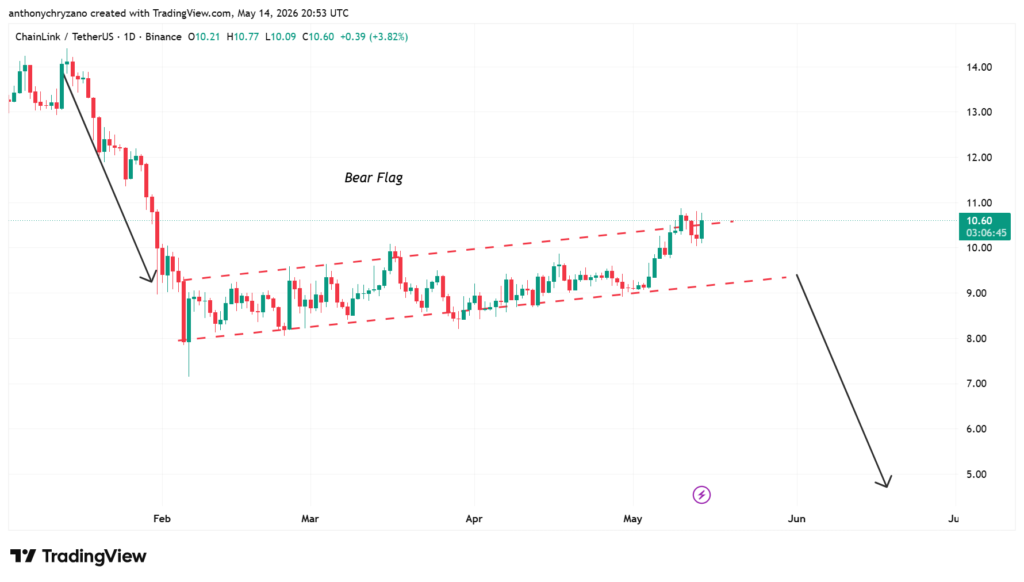
Inside the flag, traders are usually repositioning rather than reversing the trend. Some short sellers take profits after the initial drop, while buyers attempt to catch a reversal or relief bounce.
Nonetheless, there tends to be little buying interest at this stage when compared to the initial interest in selling. The more experienced traders can take advantage of the momentary recovery to open new short positions and even sell out their shares.
In the case where the breakout happens, it is expected that the following downturn will be in favor of the trend’s direction. That is why the bear flag pattern is termed a continuation pattern rather than a reversal pattern since it depicts the manner in which markets tend to exhibit wave-like movements.