

Bull Bitcoin announced it had filed a legal challenge before France’s Conseil d’État to annul Decree No. 2025-1276, the implementing measure for the European Union (EU)’s DAC8 [Council Directive (EU) 2023/2226] crypto tax reporting directive.
The exchange, which recently secured Markets in Crypto-Assets (MiCA) licensing, argues the rules create an “international financial-data honeypot” linking identities and home addresses to crypto activity, endangering holders’ physical safety.
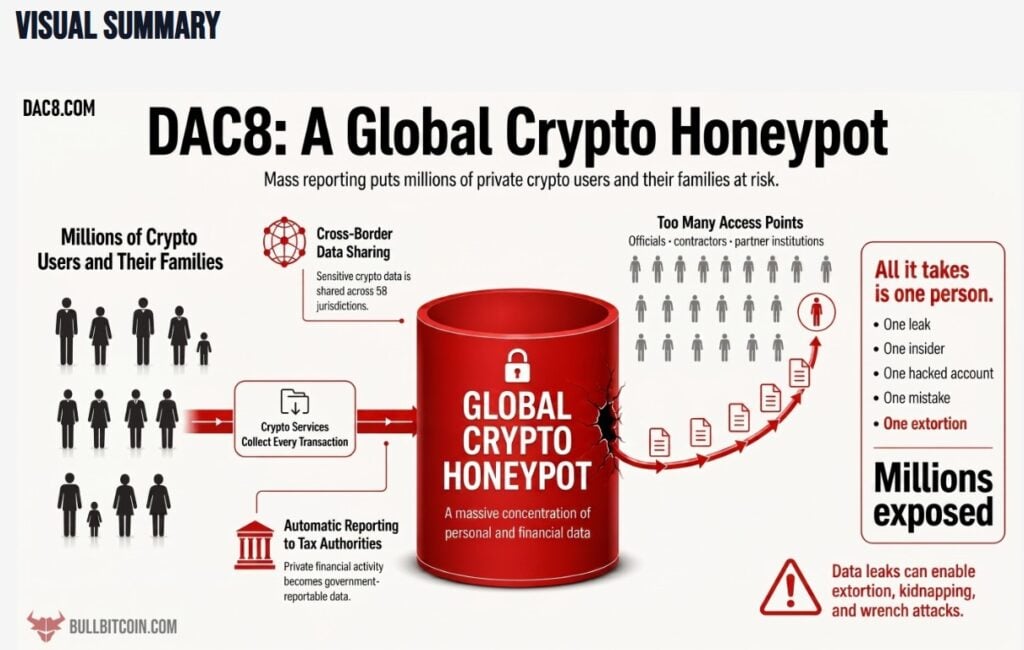
What DAC8 requires and why it’s controversial
Since January 1, 2026, DAC8 requires crypto-asset service providers across the EU to collect and report detailed user data (including full identity, home address, tax identification number, transaction histories, and transfers) to tax authorities, which then automatically exchange the information across all 27 member states.
On this sensitive matter, Bull Bitcoin argues this creates an unprecedented “mass surveillance infrastructure,” warning that “the more authorities, civil servants, contractors, systems, and foreign jurisdictions that have access to this data, the greater the risk that it will eventually be leaked, stolen, or illegally accessed.”
The “wrench attack” epidemic
To this point, France has emerged as one of the countries hardest hit by crypto-related violent crime. So far, French police recorded 41 crypto-related kidnappings since the start of 2026, and wrench attacks increased by 75 percent globally in 2025, with France seeing the most incidents (19 of the 72 verified cases).
Bull Bitcoin’s founder, Francis Pouliot, has branded DAC8’s implications as transforming “Know Your Customer” (KYC) into “Kill Your Customer.”
A less intrusive alternative exists
Bull Bitcoin argues that French law already gives tax authorities specific information-request powers under the right of communication (Article L. 81 of the Tax Procedure Code), so they can just stick to investigating individual taxpayers.
The exchange thinks this approach is “safer and more proportionate than mass collection,” and says DAC8 doesn’t really respect the rules on proportionality set out in Article 52 of the Charter of Fundamental Rights.