



Bitcoin dropped from $67,000 to $59,000 in the time period of just five days. Following that, it got stuck right after friday’s $10.2 billion deribit expiry which shows that the max pain theory is seriously flawed. Max pain is $72,000 and this is 11k over spot, the widest disparity of the year. The asset wasn’t trading toward the mentioned favorite level but instead away from it and that massive spread is the main story.
The gap between spot and max pain is currently the widest this year
On Friday at 8am ET, a batch worth $10.2 billion in BTC options is scheduled to expire on Deribit. Max pain of that group is $72,000. Spot is currently trading close to $61,160 a decline from highs of this week at $67,000. This corresponds to a 15 percent “gap” that exists between when option sellers want the price to be at expiration and where it currently is. For option analysts to pin price action to max pain during option expiration, the current price action has to be relatively close.
This is not something newly developed. Back in 2020 and 2021, BTC managed to drift toward max pain in advance of some quarterly expiries, typically enough so that individuals gradually began managing it more than as a confidence. But Wintermute’s Jasper De Maere has already pointed out the fact that recent expiries haven’t truly pulled price up to max pain the way the theory claims, and the aforementioned one looks the same. The correction from $67,000 wasn’t triggered due to any occurrence taking place in the options market. It was leverage that was unwinding on its own terms.
Simply take away the max pain script and what you have is really straightforward: someone got caught wrong-footed by a $6,000 correction in just under five days. That wasn’t triggered by this week’s expiry. It merely brings about a settling between folks who were holding the wrong position following the trade.
The drop recently retraced the move
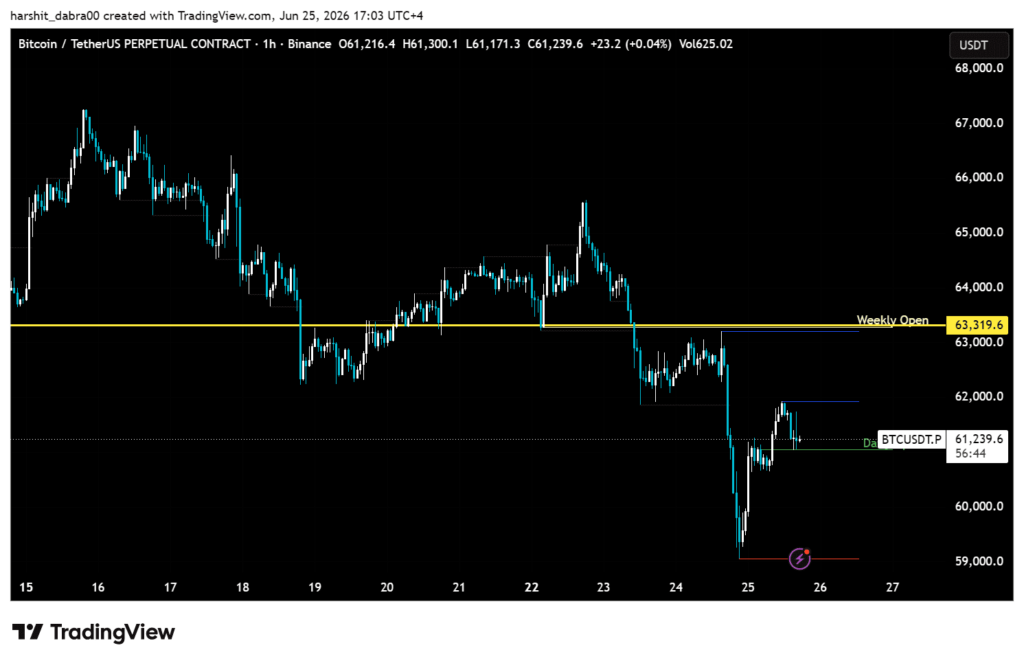
The chart spells it out pretty clearly. The weekly open was at $63,319.60; this was to be resistance into Monday’s & tuesday’s price that touched just under $65,000 intra-day, then took a sharp correction back under. It never even had any form of hesitation after that, dropping from about $63k yesterday right up to touching bottom at $59,029 in the first part of today, & that figure lines up damn near perfectly with the $59,029.86 swing low of the fibonacci retracement.
Since the low, the price has rebounded from the zone of $61,000–62,000 and this largest cryptocurrency is now consolidating right at $61,239, standing on the dotted reference line and the hourly candle is still open. Short-term structure is now showing a higher low forming off the $59,029 base, along with resistance that is standing strong near $62,000 from the bounce high. Not much regarding if the recovery looks more on the aggressive side and this looks more like a short-term rebound and should not be considered until we get a clean reclaim of the weekly open around $63.3k.
Sellers are slowing down but still hold the control
Short-term RSI readings are positioned on the weak side: RSI7 is standing at 29.73, RSI14 at 33.20, and RSI21 at the level of 34.86, and these figures normally signal some kind of bounce, and one is presently underway.
However, a downtrend does not signify that oversold levels mean as much as they do in range market conditions, and any moving average currently on the chart here lies stacked in a bearish manner: SMA7 at $63075.68 is lower than the 30 SMA at $65884.70 and lower than the SMA200 at $76307.78, with the spot just less than 20 percent off the 200 day average. The EMA7 at 62957 is positioned just about the spot, not less than the spot again, which shows that this is far from reaching the quick moving average even, and the MACD, at 2069.37, is considered negative if we look at it with the 2306.37 signal, even though a positive MACD Histogram of 237.27 indicates that bears are slowing down but still holding the control.


