

The current ‘altcoin season is dead’ narrative in the crypto market stems from a misreading of market dynamics and an incomplete interpretation of chart data. Although the data on charts reveal this narrative when the data is put it into context and processed, the altcoin season is not dead.
According to pseudonymous data researcher Cryptollica, the loudest narrative in the crypto market is that “Alts have been bleeding to BTC for 5 years. Alt season is dead.” However, this is not the case.
The crypto market has come to the conclusion that the altcoin season is dead and will not arrive any time in the future, as it has been looking at indicators like the altcoin season index and bitcoin dominance. But there is more to it than just that.
Altcoin season index still lingers close the Bitcoin season territory
The main indicators that traders and investors look for are the altcoin season index indicator and Bitcoin dominance. The Altcoin Season Index primarily evaluates whether altcoins are outperforming Bitcoin over a specific period, rather than relying on sentiment or social media discussions.
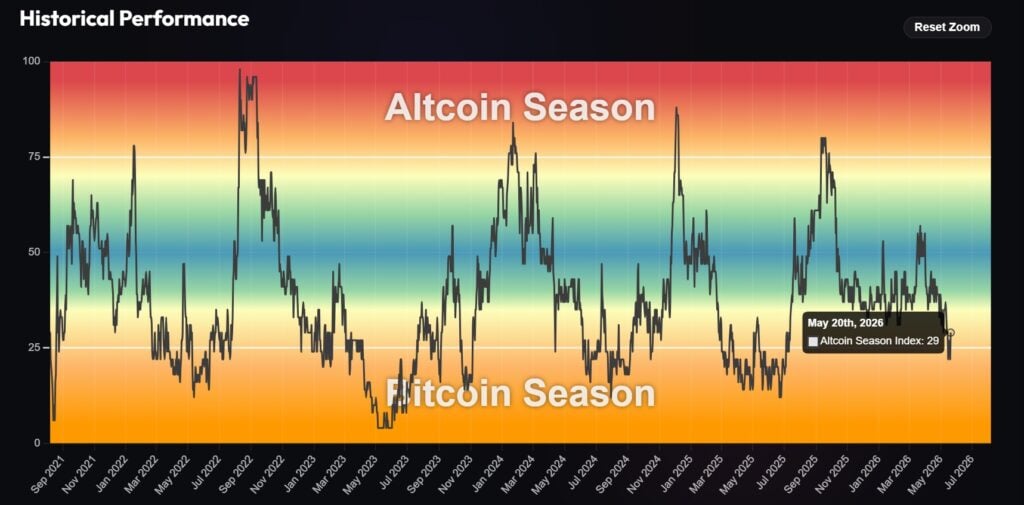
The altcoin season index scale runs from 0 to 100, and values within the range of 0 to 25 are considered Bitcoin season, while values from 75 to 100 are considered the altcoin season. Values between 25 and 75 are considered to be neutral.
One of the main factors it considers is the relative price performance of a broad group of altcoins compared to Bitcoin, usually over a timeframe of around 90 days. The index tracks whether a significant portion of major cryptocurrencies, often among the top assets by market capitalization excluding stablecoins, is generating stronger returns than Bitcoin. If a large percentage of these altcoins outperform BTC, the market is considered to be entering an altcoin season.
The index also indirectly reflects shifts in market capitalization and capital rotation within the crypto market. Historically, liquidity tends to flow into Bitcoin first before moving into large-cap altcoins and later into smaller assets as investors seek higher returns. As a result, the index captures changing market dynamics through the collective performance of multiple assets.
However, it does not directly account for factors such as social media hype, fear and greed levels, or trading activity alone, as its main purpose is to measure the broader relationship between Bitcoin and altcoin performance.
With ASI showing a value just above the Bitcoin season level, the market is closer towards the Bitcoin season level, and as such, the investors have given up hope on seeing the altcoins spiking.
Bitcoin still holds dominance with 60% of the market
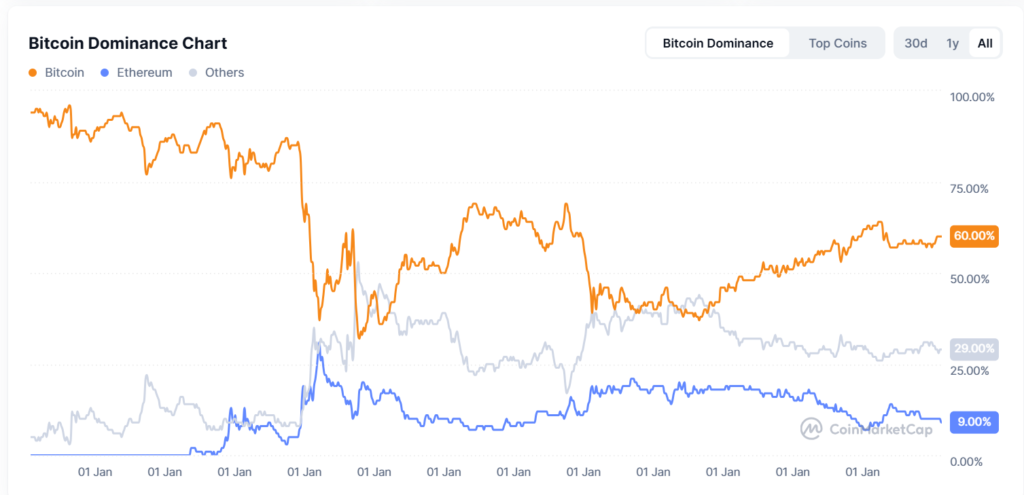
The above chart shows that Bitcoin is still dominating the market with 60%. Bitcoin dominance refers to the percentage of the total cryptocurrency market capitalization that belongs to Bitcoin. It measures the concentration of the entire crypto market’s value in Bitcoin compared with altcoins.
Altcoin market cap bottom fuels altseason expectations
According to Cryptollica’s observation, altcoin dominance has been moving inside the same structural channel since 2017. The researcher observed a cycle pattern that goes like this: Bottom → Altseason → Cycle top → Multi-year bleed → Bottom
For instance, in 2017, the market bottomed after bleeding for about three years. In 2021, the cycle reached a crest after five years of compression. As of 2026, it is once again at the bottom and testing the multiyear support zone. However, this time the altcoin season is taking longer to arrive because, as each cycle, the bleeding lasts longer; as such, the researcher mentioned, “This is not death.”
The chart below shows that the total market cap, excluding Bitcoin, is currently at 1 trillion. Since 2021, the altcoin market cap has been making higher highs and higher lows, and it has now reached the lower trendline. This means that the market cap is once again starting to climb.
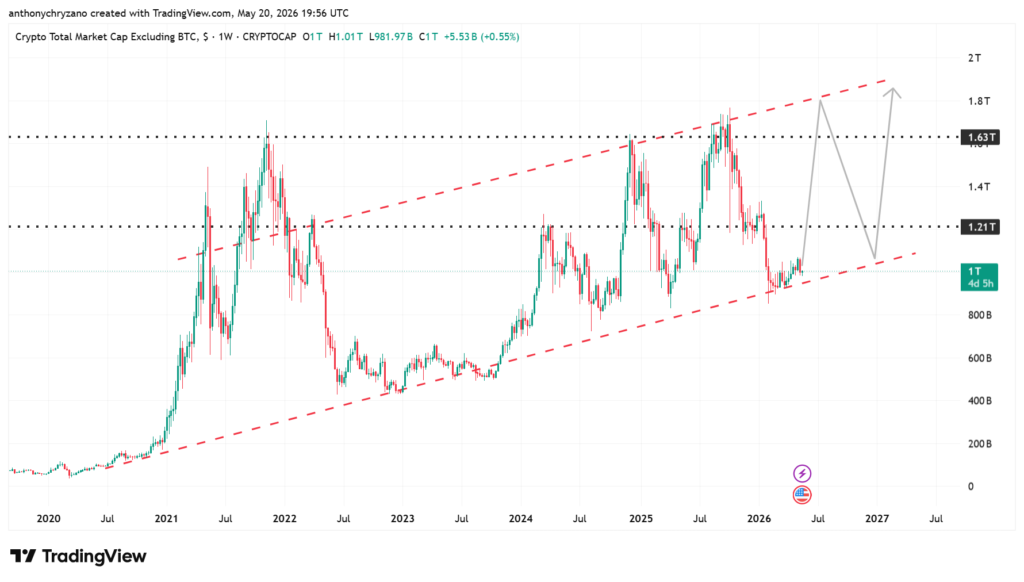
Given that the altcoin market cap follows and abides by the pattern it has been building for the past 5 years, there is a high chance that it could hit values around 1.8 trillion. As such, although the altcoin season index and the Bitcoin dominance could be showing information that is not favorable to the altcoin season, the bigger picture shows that the altcoin season is much closer.