

For the 30-day period ending in April, Ethereum’s exchange outflow amount totaled approximately 19.8 million ETH approximately-the lowest figure since September 2024. The figure is straightforward and basic at face value. What is underneath that is not an attractive look for those hoping for an indication of a real build-up.
Exchange outflows, as they increase, usually means ETH is flowing into cold storage or self-custody wallets. This indicates the conviction trade: when ETH holders remove supply from the sell-side platform. A declining figure suggests the opposite: more ETH is entering exchanges, keeping potential sell pressure available. This value for April indicates the conviction trade has been understated.
The 19.8 million ETH figure in context
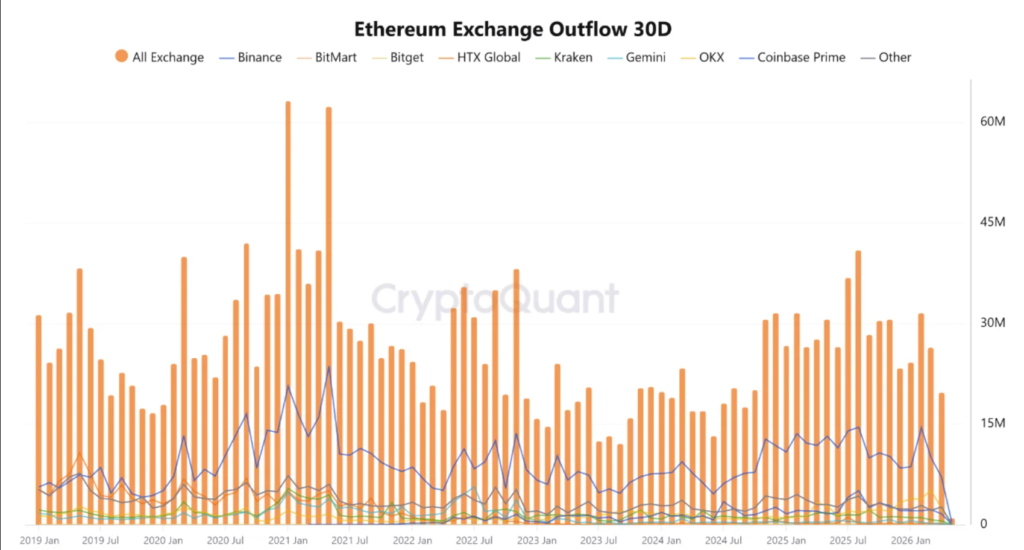
At around 19.8 million ETH withdrawn on all exchanges in April, the reading sits where it did 7 months ago. In order to put how far it has come down into context, the earlier readings in the more recent history in the same chart covering late 2024 through early 2025 monthly outflow readings consistently were following the 25 to 35 million ETH range, with one move almost to 40 million ETH in the middle of 2025; the 19.8 million is an almost precipitous fall.
The price action that represents that decline is no drift down; it is a very decisive drop, and it comes just as the Ether price action has consisted of sideways action, with the overall crypto space treading lightly due to volatile action over the last few months. Outflow figures such as the low ones present herein, in such a directionless and calm market, mean something more when prices are stagnant. The overall setup can be seen more as an indecisive state rather than a confident one.
Where the withdrawals are actually coming from
This breakdown of April withdrawals across exchanges is particularly interesting. Of the total 19.8 million ETH withdrawn in April, 7.09 million were withdrawn through Binance (35.8 percent of total exchange withdrawals that month). That is a fairly large amount. April has more than a third of total exchange outflows coming through Binance.
Following that was OKX with around 2.4 million Eth (about 12.1 percent). Coinbase Prime had around 1.62 million ETH (about 8.2 percent), while Kraken had about 557k ETH (the value was below 3 percent of all outflows).
In total, those four named exchanges represented 11.667 million ETH or about 58.9 percent of the total of April. The rest, 8.13 million ETH, or about 41.1 percent, belonged to the aggregated bag of the other exchanges.
That significantly limits the context when one transaction is more than 1/3 of all monthly outgoing transaction value in a low outgoing month. It isn’t an overall, evenly distributed, reduced activity in the ecosystem; it is just Binance and it is going at a (relatively) normal outgoing pace.
One data point to highlight is Coinbase Prime’s figure of 1.62 million ETH. Because Coinbase Prime is the leading institutional custody and trading venue in the U.S., the data from Coinbase Prime’s outflow figures is generally a fair indication of institutional accumulation activity. 1.62 million ETH in April is, therefore, weak, but it is certainly not confirmation that outflows from institutional sellers are still positive and that the pace of institutional accumulation has at least slowed from more robust levels.
What low outflows actually mean right now
The normal view that decreasing exchange outflows is bearish to conviction is true in the long term: fewer holders of ETH going into cold storage means more available supply of ETH for the market to grab. This is the perspective that needs to be considered. However, April’s information fits better with the picture of people being more cautious and awaiting events, rather than actively distributing ETH.
But a low outflow driven by selling (where ETH is sitting in exchanges due to selling pressures by holders) is structurally different from low outflow driven by inaction (where holders neither accumulate nor distribute heavily). April’s data looks more like the latter given flat price movement and low volume, which points out that Holders are not panicking and exiting; they are taking a pause.
This differentiation is significant to what follows. If outflow numbers continues to remain somewhat compressed at, and close to, 19.8M ETH for the next several weeks, that would align with the idea that the current market cycle lacks an obvious catalyst in terms of conviction buying that drives outflow numbers higher. The lack of significant withdrawals is not merely a demand indicator; it is also indicative of risk preferences towards ETH at this very moment.
This narrative is also supported by the context of sideways price movement. It has not given Ethereum holders strong reason to jump aggressively in either direction, and unless there’s a fundamental market shift or significant breakout, we’ll likely continue to see low outflows.
Traders and Investors must consider this
In the context of short-term trading, the outflows of April also strengthen the case for continued range-bound price action. The high exchange balances, caused by less outflow activity, imply readily available sell-side liquidity. When any sustained rally in price is attempted, there will be selling overhead from the previous holders of ETH who failed to move their ETH into cold storage when outflows were higher.
For long-term investors the crucial question is if April represents a brief pause or the start of a broader, prolonged phase of accumulation. The data cannot necessarily give the answer, but given the seven-month low readings in this particular metric, coupled with low volume on Coinbase Prime, this does not look like the accumulation setup that we typically see when a breakout to the upside is nearing.
The number to track is whether Binance’s percentage of the outflows begins to normalize lower as we get broad-based participation back across exchanges or if even Binance’s numbers compress more. It would be a strong second straight month below 20 million ETH total for all exchanges that further makes the argument for declining long-term buying power.