

Decentralized markets on the run. Variational, a protocol designed for decentralized derivatives trading and based in the Cayman Islands, has secured $50 million in Series A funding from Dragonfly Capital. This new investment follows a $10.3 million seed round led by Bain Capital Crypto in 2021 (which was announced in 2024). The new funds will allow Variational to build a platform that will connect traditional finance (TradFi) liquidity with blockchain technology and support the growth of real-world asset (RWA) trading in the decentralized finance (DeFi) space.
The problem with current RWA trading models
Existing onchain RWA platforms like Hyperliquid face a “cold-start problem,” whereby each new market must create its own crypto-native liquidity from scratch, which requires millions in subsidies.
Variational described this in March 2026: Hyperliquid’s oil perp futures were measured against the Chicago Mercantile Exchange (CME) and only had 1percent as much depth for bids and asks ±2 basis points (bps) of the mid-price, 20 times more slippage on a $1 million trade, and slippage exceeding 160 bps during weekends due to geopolitical news (200 times the CME baseline).
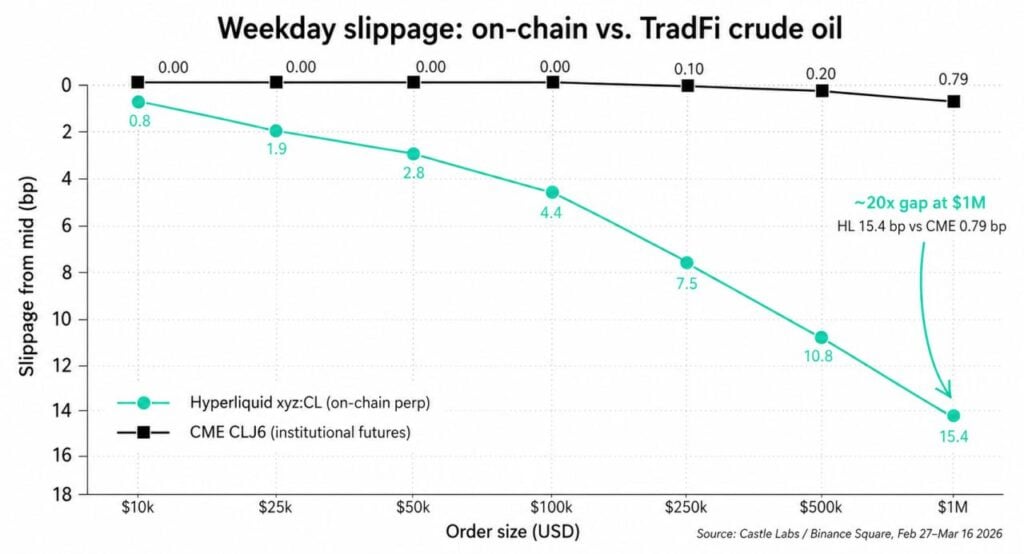
Light’s incentivization program of $250K per week has been in place since April, demonstrating that on-chain RWA depth cannot develop organically at TradFi-competitive scale.
Variational’s brokerage model
Instead of rebuilding liquidity order book by order book, Variational aggregates liquidity from existing venues (both crypto exchanges and traditional finance dealers), acting like a brokerage.
“Order books have a cold start problem. They’re not porting liquidity, they’re rebuilding liquidity. Even on the most liquid stuff, there’s still a 100x gap or more between liquidity on Hyperliquid and traditional finance sources like the CME.” – Co-Founder and CEO Lucas Schuermann.
The Omni app (from the protocol) offers zero-fee trading, cross-margining using just one USDC balance, and up to 50x leverage. The founders of Variational previously ran a quantitative trading firm that was sold to Digital Currency Group.
Three-Phase rollout plan
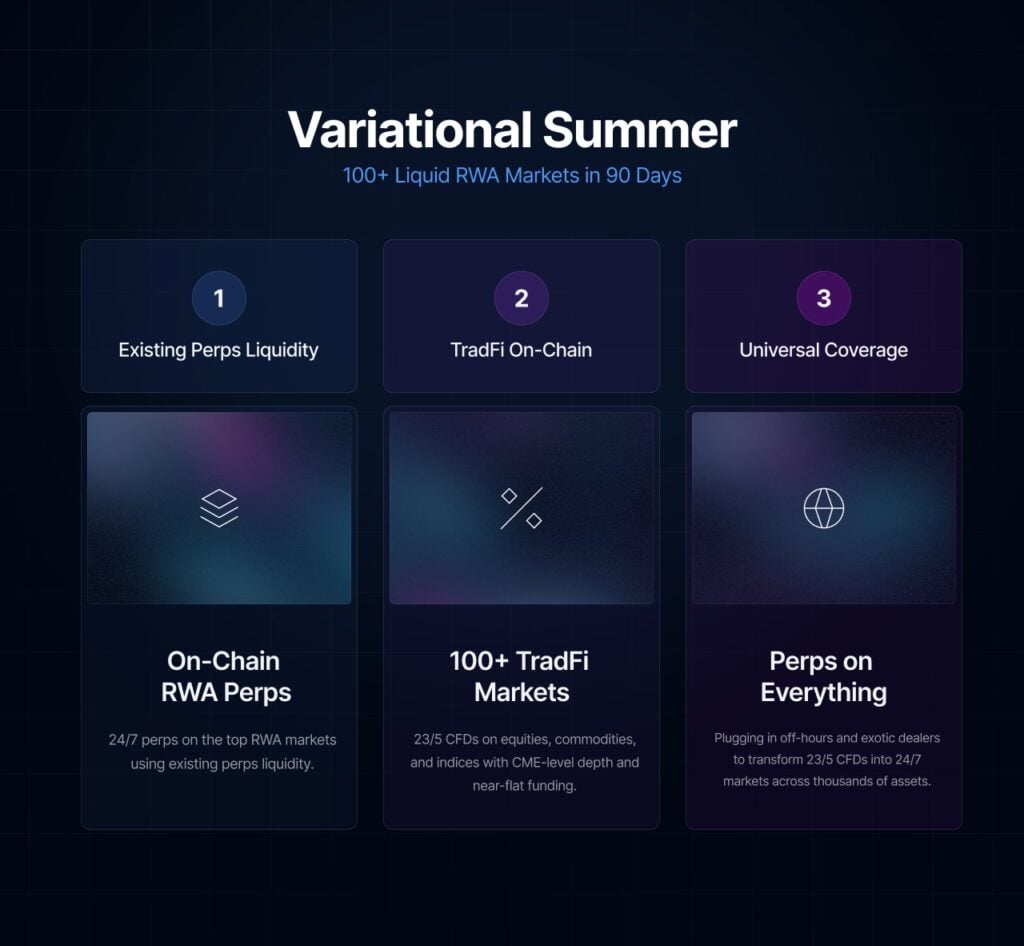
- Phase 1 (May 2026): Aggregating existing perpetuals liquidity. Launching 24/7 perps for West Texas Intermediary (WTI) Crude Oil, Gold, and Silver by aggregating from existing crypto venues. Users can trade these alongside more than 450 crypto listings with zero fees from a single cross-margined account.
- Phase 2 (around June 2026): Bringing TradFi onchain. Introducing up to 23/5 Contracts for Difference (CFDs) for more than 100 markets, including international indices (Singapore 30, China A50), commodities (Wheat, Natural Gas), and single name equities (Nvidia, Coinbase, Strategy, Alibaba). These CFDs will route directly to tier-1 non-bank dealers under already-signed agreements, delivering near-flat funding rates (around 4 to 6 percent) and CME-level depth. For the time being, these will operate during regular “banking” hours and alongside the crypto perpetual contracts that are open 24/7.
- Phase 3 (Q3 2026 and beyond): Universal coverage. Expanding CFDs to 24/7 trading by plugging in specialized off-hours dealers, and adding perps on prediction markets, pre-Initial Public Offering (IPO), and exotic markets. Partnerships across Asian jurisdictions are already in active commercial conversation.
How will RWA trading be affected?
By offering methods to circumscribe the traditional cold-start problem, Variational will be able to deploy new markets at a speed similar to a software integration, as opposed to years of subsidising those markets with liquidity. The protocol is designed to provide a single account that can be cross-margined across all asset classes, including crypto, stocks, commodities, indices, and currencies, thus offering execution quality typically associated with a prime broker and instantaneous settlement similar to DeFi.