

Tezos developers introduced Tezos Encrypted Ledger (TzEL), a new experimental smart rollup design, on the Ushuaianet testnet. TzEL has been created for private, post-quantum payments. This innovative prototype aims to replace vulnerable elliptic-curve cryptography (ECC) with quantum-resistant primitives [hashes, Module-Lattice-Based Key-Encapsulation Mechanism (ML-KEM), Zero-Knowledge Scalable Transparent Arguments of Knowledge (STARK proofs), addressing a growing threat: quantum computers capable of breaking current encryption are no longer theoretical.
Why is quantum-resistant private transaction protocol important?
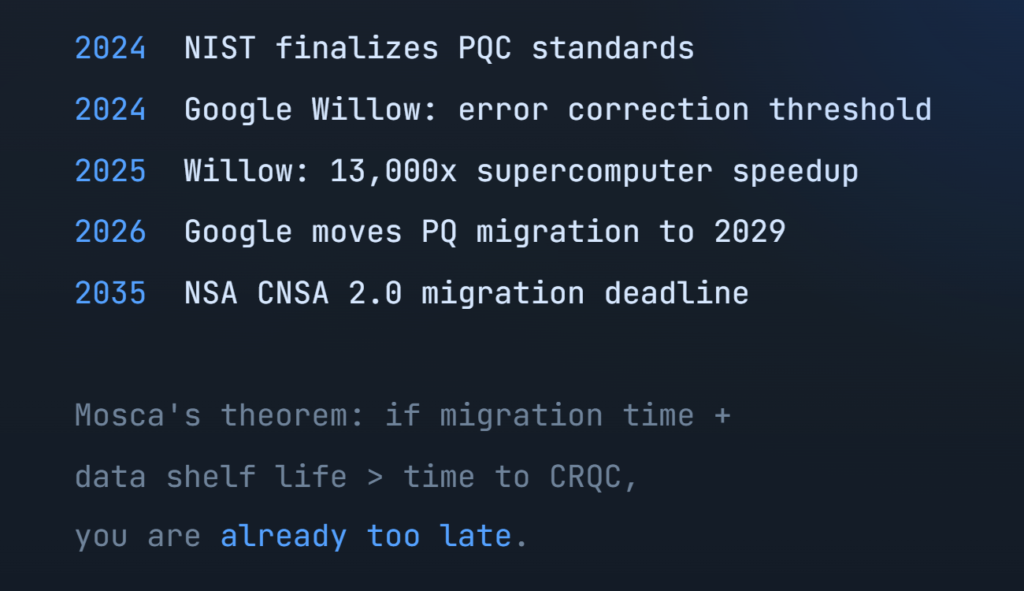
Something to recall for this matter is that Google’s Willow chip crossed the quantum error correction threshold in 2024 and, in 2025, demonstrated a 13,000x speedup over supercomputers. In March 2026, Google accelerated its own post-quantum migration deadline to 2029, citing “store now, decrypt later” as a primary driver. To this point, the National Security Agency (NSA) requires that all national security systems migrate by 2035.
Every deployed privacy protocol (e.i, Zcash, Aztec, Penumbra) relies on elliptic curves for note encryption, key agreement, or signatures. When those curves break, transaction graphs will be fully exposed retroactively.
How TzEL works
The Tezos Encrypted Ledger operates as a smart rollup with a separate data availability layer (DAL) for posting large STARK proofs. Key features include:
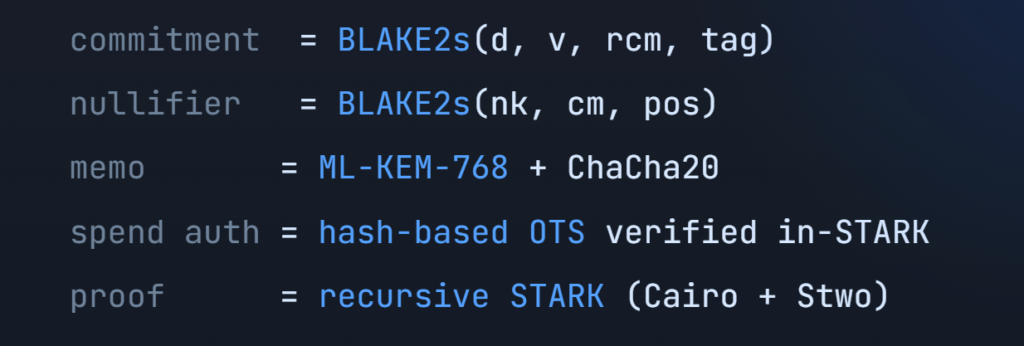
- No elliptic curves anywhere: The system uses ML-KEM-768 [National Institute of Standards and Technology – Federal Information Processing Standard 203 (NIST FIPS 203)] for encryption, BLAKE2s (a high-performance, secure cryptographic hash function optimized for 32-bit platforms) for hashing, hash-based one-time signatures for spend authorization, and STARKs for proof verification
- Separation of authorization from proving: Each wallet locally approves transactions with a hash-based signature, while proof generation runs on a larger machine, keeping wallets small and delegable
- Watch-only visibility without spending: Detection material can flag incoming notes; viewing material can validate and decrypt; spending authority stays separate, enabling delegated scanners
The system is in an experimental stage, has no real value, but has successfully drawn a complete test path from wallet to rollup execution (not just isolated proofs or local demos).
Implications for the crypto industry
The Tezos Encrypted Ledger is an important advance in achieving financial privacy that will be resistant to quantum attacks. Most blockchain privacy protocols today are vulnerable to retrospective decryption. TzEL has proven that post-quantum private payments are technically feasible today on a live testnet, using NIST-standardized cryptography and Tezos’s smart rollup architecture.