

The Polygon Ithaca hard fork just hit the mainnet at block 50,185,000, and it’s packing a punch with automatic payment failover, fresh security layers, and better node tracking. Rolling out via Heimdall v0.10.0, aims to make transactions way more reliable and cut down annoying operational disruptions. Even with this solid technical win, the POL token is still hanging out near record lows, trading about 94 percent under its all-time high (ATH).
What Polygon Ithaca hard fork fixes: Reliability where it matters
Before Ithaca, if the node responsible for producing blocks encountered issues, the network could stall for approximately 15 minutes with no automatic recovery. This was a risk during peak activity: sales rushes, payroll runs, or checkout moments. Now, Ithaca introduces:
- Automatic failover that rotates in a healthy producer, keeping transactions flowing
- The upgrade also adds safeguards to block oversized transactions before they can slow or destabilize the network
- For payments, predictable performance is the entire product
The upgrade is part of a broader effort that includes three previous mainnet upgrades in under five months (Lisovo, Giugliano, Zurich), each strengthening the chain’s reliability.
Market reaction: POL token stays stuck near record lows
Despite the successful technical upgrade, POL’s price remains near historic lows, trading at roughly $0.07, down over 90 percent from its ATH. Since the Ithaca fork focuses on the network’s plumbing instead of switching up the token’s math or rewards, most traders aren’t seeing it as a reason to jump in just yet.
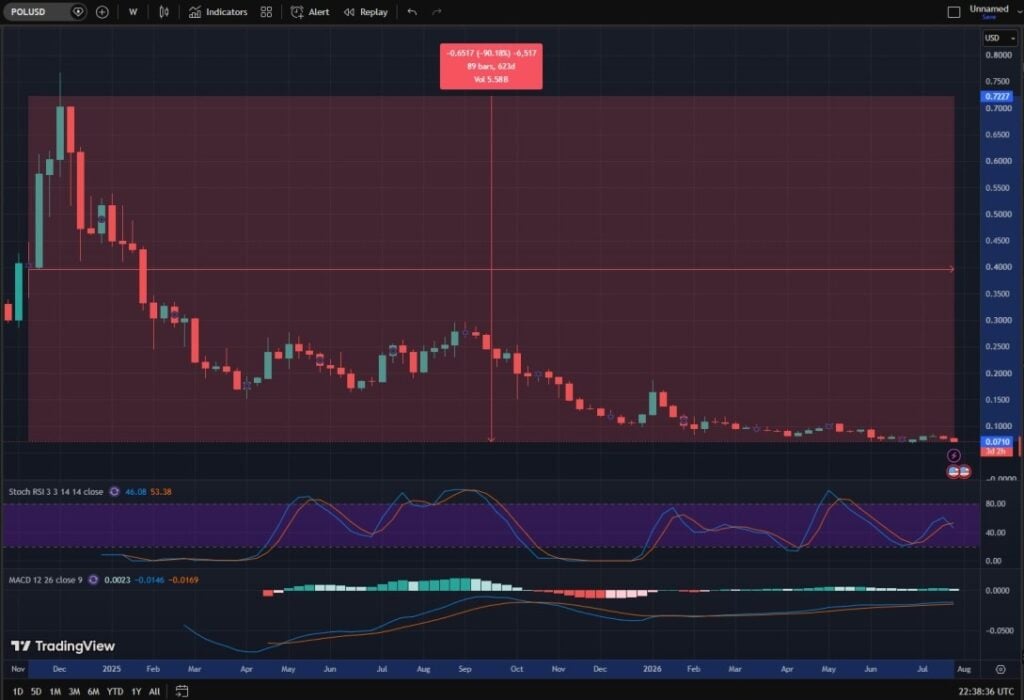
Big exchanges like Binance had to pause deposits and withdrawals for a bit while the upgrade was going down, though everything went back to normal once they saw the network was holding steady.
For the devs and validators, this makes Polygon a much safer bet, but for regular hodlers, it’s a reminder that a better engine doesn’t always mean the price tag is going up right away.
Beyond Ithaca: Polygon’s strategic shift and AggLayer
The Ithaca upgrade arrives amid a broader strategic transformation at Polygon Labs. Back in July, CEO Marc Boiron shared news about the firm’s second round of layoffs for 2026, all part of moving from a standard blockchain foundation to a crypto-powered payments outfit aiming to be profitable by 2027.
The restructuring follows Polygon’s $250 million acquisition of Coinme, a U.S. payments firm licensed in 48 states, and wallet developer Sequence, bringing regulated fiat on- and off-ramps and enterprise wallet infrastructure into the stack.
On the technical front, Polygon’s AggLayer went live on mainnet July 18, connecting the network’s proof-of-stake (PoS) chain with custom chains built using the Polygon Chain Development Kit (CDK) through a shared liquidity infrastructure.
AggLayer enables assets and data to move seamlessly across connected chains without requiring separate bridges, directly addressing decentralized finance (DeFi)’s liquidity fragmentation problem.
The network also hit 5,000 transactions per second (TPS) to serve stablecoin payment rails, achieved by raising the block gas limit to 160 million at 1.5-second block times. Stripe, Cash App, and Revolut are among the reported users of Polygon’s payment infrastructure.