

Polygon (POL) crossed a major resistance level after the network made its first block time reduction upgrade since its genesis block. With this time reduction, the network can now process 14% more transactions per second.
Polygon reduces block time by 240 milliseconds
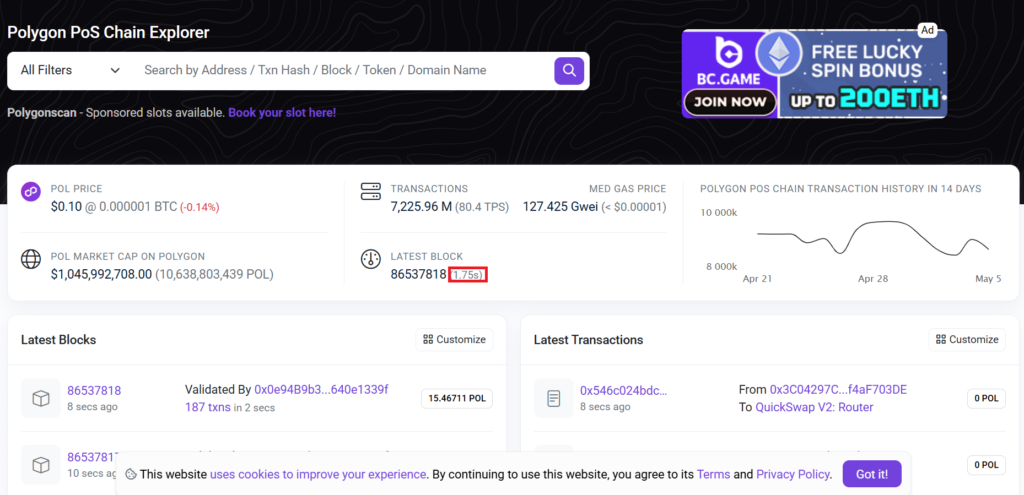
Polygon made its first-ever block time reduction upgrade as the network plows the field for stablecoin payments and settlement infrastructure. The network reduced its block time to 1.7 seconds, which is 240 milliseconds less than its usual time. Although the reduction might look very minute and negligible, the network has already started to benefit from it.
The network can process 14% more transactions per second
According to Polygon software engineer Lucca Martins, the network is now able to process 14% more payments per second, which enables it to reach a theoretical throughput of about 3,260 transactions per second (TPS).
Reducing block time is important for Polygon because the network is increasingly positioning itself as infrastructure for stablecoin payments, real-time settlements, and high-frequency financial transactions. In payment systems, speed and responsiveness are everything. A shorter block time means transactions are confirmed faster. This improves the overall user experience and makes the network feel more similar to traditional payment platforms.
Lesser block time is a main ingredient for sustenance in market
When it comes to transferring stablecoins, fast block production becomes another key factor. The less the time it takes for the transfer from one account to another, the better. Since its usage will be primarily for merchants, payment processors, and finance-oriented applications.
- In practical terms, lower block times can help Polygon support:
- Faster checkout experiences
- Quicker cross-border payments
- Better real-time settlement systems
- Higher transaction throughput during heavy usage
Additionally, lower blocktime enhances the efficiency of DeFi and payments dApps by ensuring that the price and balance data updates faster. As Polygon expands its footprint within the stablecoin and payments space, low latency can be a key differentiator between itself and other financial systems and blockchain platforms.
POL knocks over the 100-day MA after 3 months
With this new upgrade to the block time, Polygon crossed an important resistance level, which is the 100-day moving average, after almost three months. This is such a critical level that is important to traders because it helps smooth out short-term price fluctuations and provides a clearer view of the market’s medium-term trend.
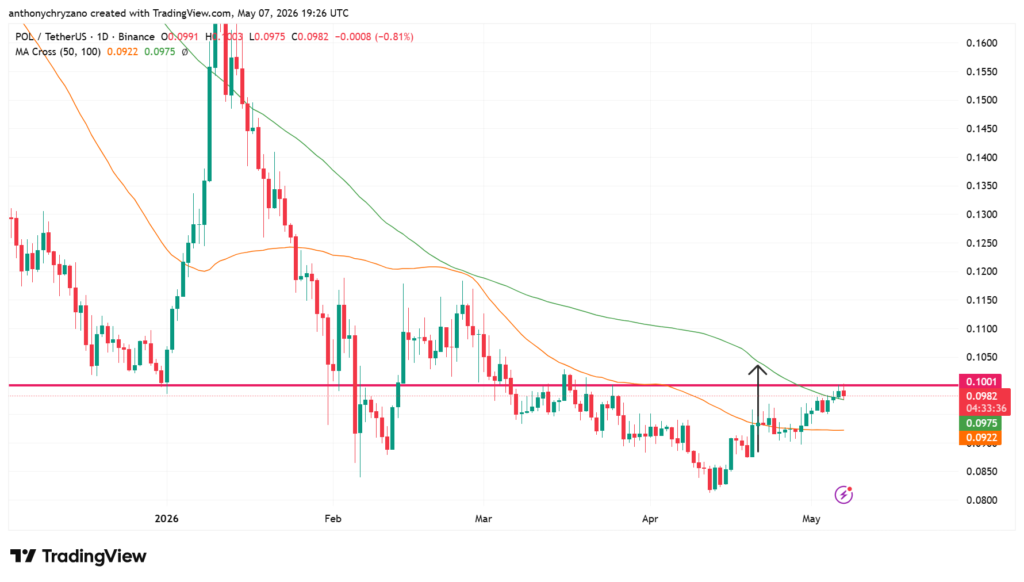
By filtering out daily noise, it allows traders to understand whether an asset is generally in an uptrend, downtrend, or consolidation phase. It is also widely watched because price often reacts around this level, acting as dynamic support in bullish conditions and resistance in bearish ones. Many traders and institutions use the 100-day MA to confirm trend direction and identify potential reversal points, making it a key reference level in technical analysis.
From a technical point of view, POL prices were trading inside a falling wedge, as shown in the chart below. A falling wedge is a bullish chart pattern that forms when price is moving downward inside a narrowing range between two downward-sloping trendlines.
Inside the pattern, both highs and lows are making lower levels, but the key detail is that the lower lows are weakening over time. What it does mean, however, is that while sellers continue to drive prices lower, they are losing steam with each action, while buyers get more proactive at each dip and begin stepping in sooner with their purchases.
As the wedge tightens, so does the volatility and compression of price.This compression builds pressure in the market, like a spring tightening. Eventually, selling pressure becomes exhausted, and buyers gain control.
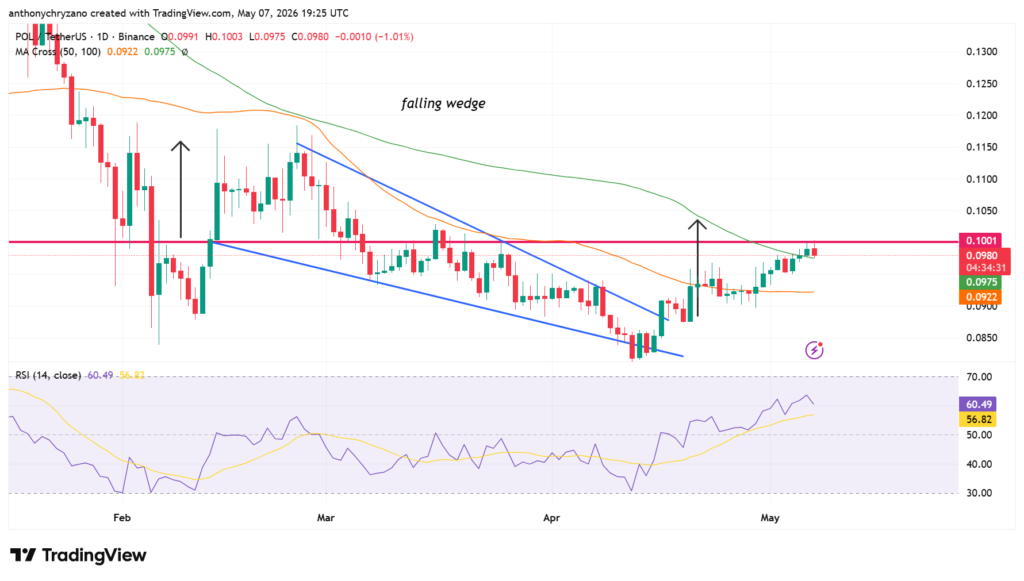
Just like a conventional falling wedge would break out upwards, POL too broke out upwards. On its way upwards, the token started breaking major resistance levels like the 50-day and 100-day MA as mentioned in the above paragraphs. Now that POL has reached $0.09, the next thought that could hit anyone is that the rally might be over and the prices might start to consolidate or maybe even fall.
POL’s rally is not over
However, going by the relative strength index indicator, which shows if the price of a token is overvalued or undervalued, there is no such indication as overvalued. The RSI value is well within the normal range between 30 and 70. This shows that POL still has more room for appreciation, as the market still doesn’t think that the price is too high.
From another perspective, when the falling wedge pattern breaks down, the ensuing upward movement tends to target a price level roughly equivalent to the height of the wedge at its largest width during its initial development. This is a standard tenet in technical analysis when calculating expected price targets following a breakdown.
This is because of the reason that the falling wedge represents a phase where there is selling pressure that is constrained. The level of volatility starts dropping during the course of development, as does the selling pressure. After the breakdown occurs, the pressure of the sell-off is then released, leading to a strong trend formation. From here on, the height of the wedge represents the potential of the upside movement of prices.