



OKX has unveiled Exchange OS, a major protocol upgrade on X Layer that transforms market creation from a centralized platform decision into an open, permissionless mechanism. The infrastructure lets ecosystem participants like developers and institutions launch their own trading venues using the same powerful tech that runs OKX.
What Exchange OS does for you
Exchange OS takes all the complicated stuff (like matching trades, handling margins, and sorting out risk) and bakes it right into the protocol. This lets other people (the operators) focus on creating cool user interfaces on top. Anyone who wants to start a trading spot just stakes some OKB, and they get to pick their own assets, data sources (oracles), how they make money, and even their own rules [like running a fully Know Your Customer (KYC)-compliant exchange or a completely permissionless Web3 market]. Moreover, everyone uses the same awesome technology, but keeps their risk groups separate.
For traders, this is great because they get one unified account and margin system that works across everything (spot, perps, and outcomes). No more capital getting stuck on different platforms. Plus, this tech claims to be seriously fast: we are talking millisecond trade matching, quick settlement, and a massive throughput of up to 300,000 transactions per second (TPS).
The announcement represents just the first step for us towards reaching a major goal. The launch of Exchange OS will gradually proceed through opening up the various underlying infrastructure components, developing/deploying functionality, and enabling participants from within the platform ecosystem. The whitepaper released today describes the Exchange OS architecture, its governance model, and the roadmap for accomplishing that vision for the product.
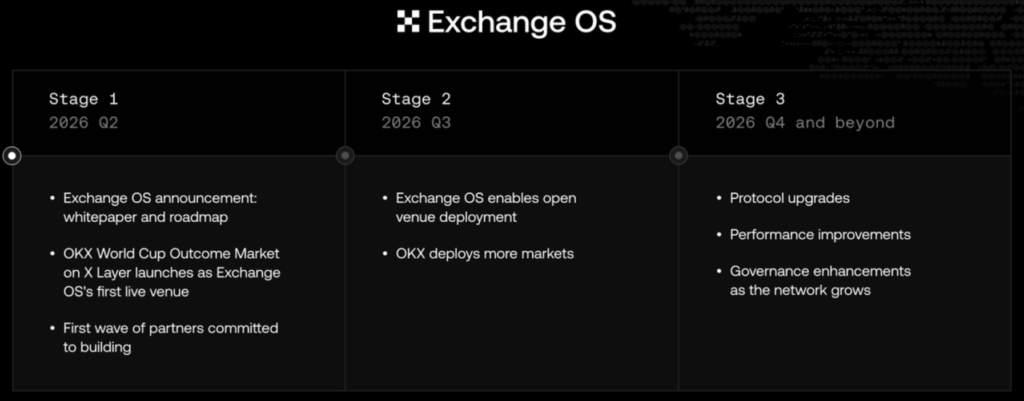
Source: OKX
How does it add value to the crypto market infrastructure?
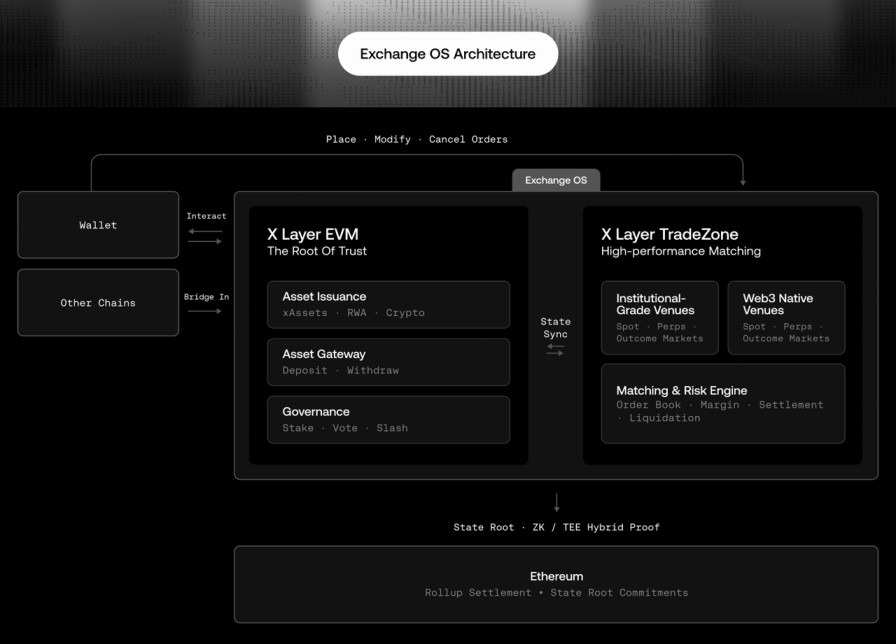
By providing common/shared “market rails,” Exchange OS can remediate the fragmentation within onchain finance. Thus, deployers no longer create new complex systems from scratch. Asset issuers list their assets just once and will have access to any venue where that asset is available. Interfaces integrate only once, allowing any deployer’s interface to reach all deployer marketplaces. Market makers (MMs) provide liquidity across a shared layer rather than siloed venues.