
Enjin announced that a governance referendum (#10) is now open to expand its Relaychain active validator set from 25 to 35 over the next twelve months. The proposal would increase the set in four staged increments (27 in August 2026, 30 in November, 32 in February 2027, and 35 in May), all enacted by a single on-chain vote. A reviewed continuation to 50 would follow, with further growth decided by the network.
Why the expansion matters
Enjin launched with 25 validators in 2023; small enough to guarantee performance while the network proved itself, large enough to be meaningfully decentralized.
Today, demand has outgrown the set: more validators are registered than there are slots. A larger set means more operators, more geographic and provider diversity, and less reliance on any single party: a network that is harder to disrupt and easier to trust.
The expansion reflects the decentralized network the Enjin whitepaper envisions. The current cap has held at 25 since April 2025, and all slots are occupied.

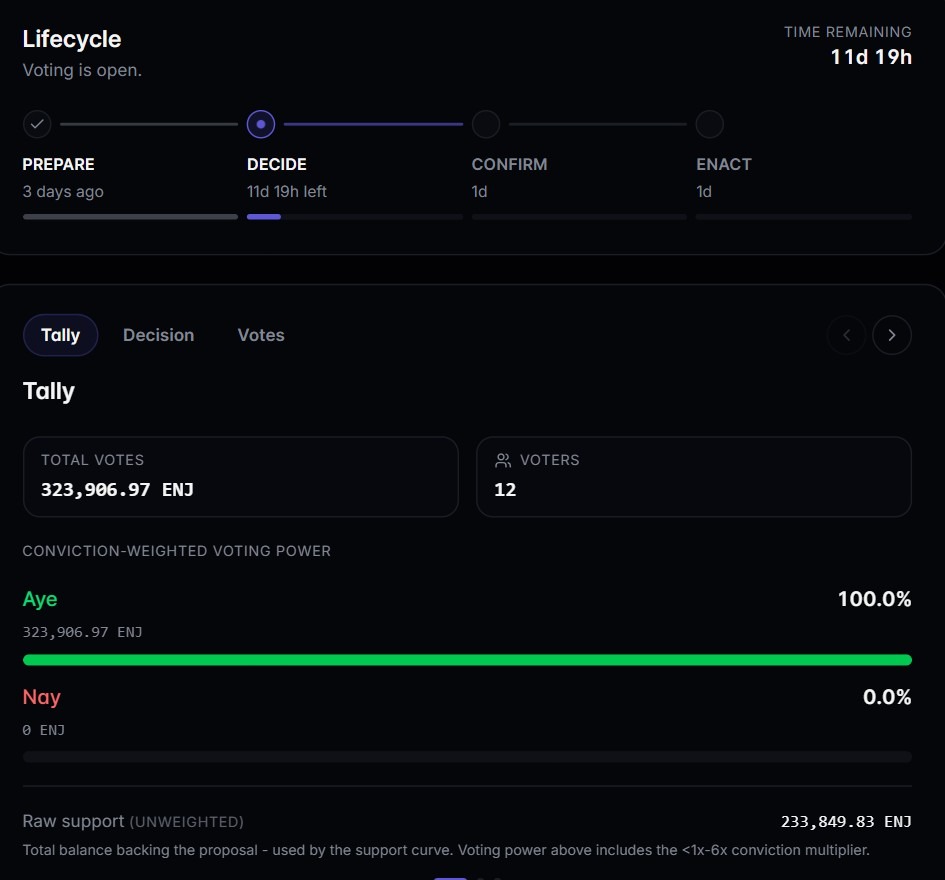
The referendum is currently working its way through a 4-phase lifecycle: prepare, decide, confirm, and enact. Things are looking pretty positive with the voting so far, and there are still 11 days to go at the time of writing.
The economics of decentralization
Validator rewards come from a fixed annual inflation of roughly 4.9 percent, with 96 percent flowing to stakers. The reward pool doesn’t grow when the set does: at 25 validators, a validator earning the standard 5 percent commission takes roughly 15,700 ENJ per month; at 35, roughly 11,200 ENJ; about 29 percent less.
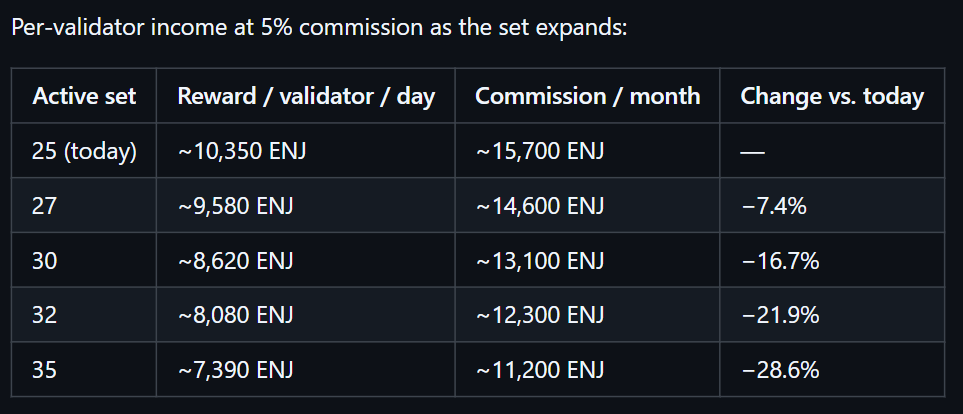
That’s the expected arc of a maturing network: rewards concentrated among a few operators early on, spread across more independent shoulders as the set widens.
The total paid to stakers each era remains the same. The minimum backing needed to become an active validator currently sits at 32.5 million ENJ, a number that shifts from era to era.
Beyond validators: AI tooling and developer momentum
Beyond the validator expansion referendum, Enjin has been actively building its ecosystem. Back in June, they dropped the Enjin Platform v3 roadmap, which is basically a big “to-do” list of upgrades for devs, including Wallet Requests, C# and C++ Software Development Kits (SDKs), and some pretty handy plugins specifically for Unity and Unreal. The whole idea here is to make it way easier for game makers to actually plug blockchain assets into their projects without a massive headache.
Enjin also launched Token Groups, a new onchain organizational layer allowing creators to categorize non-fungible tokens (NFTs) within a collection without enforcing rigid hierarchies.
On the community front, Enjin introduced Bouncer, a Telegram community gating tool, followed by the Envoys creator incentive program in July.
Plus, the Enjin Multiverse campaign, “Essence of the Elements”, is still going strong and getting users to play across different games. The project put up 50,000 ENJ in rewards for every season in games like Lost Relics, The Six Dragons, and Etherscape. All these moves show Enjin is focusing on actual gameplay rather than just hype.
Enjin Coin (ENJ) performance
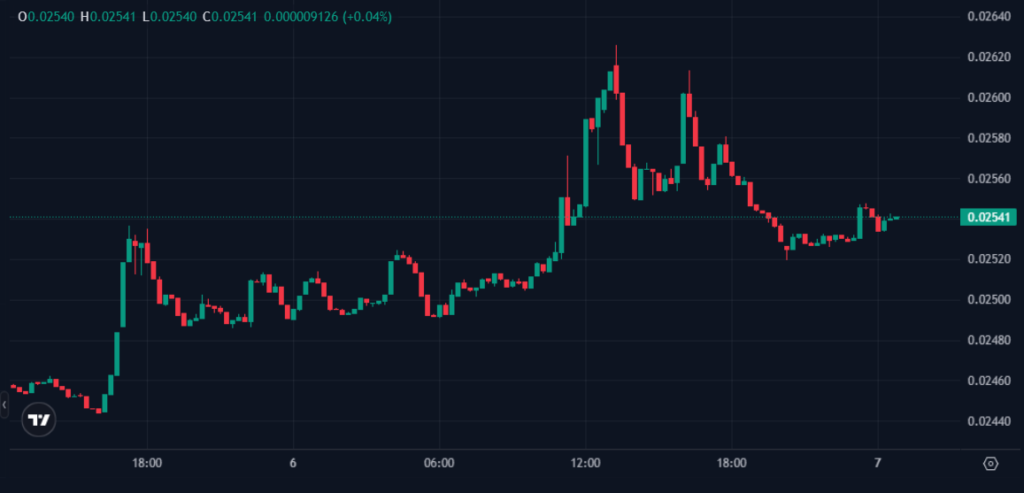
The ENJ token has been trading up around 1.2 percent in the last 24 hours. Trading at $0,02 at the time of writing. Despite being at record lows (down 12 percent in July), it performed steadily in the last week. It will take more than just a project push to start trading up further. The validator expansion is a great opportunity to scale and show that the network can provide stability and still compete in the Web3 gaming ecosystem.