

Bitcoin Core is targeting an October 10 release for version 32.0, with a major package of performance, networking and wallet upgrades aimed at making nodes faster to sync, harder to isolate and easier to operate.
Bitcoin developer Mike Schmidt said in a post on X that the release could make initial blockchain synchronization up to three times faster, with block validation set to fetch transaction inputs from disk in parallel instead of processing them one by one.
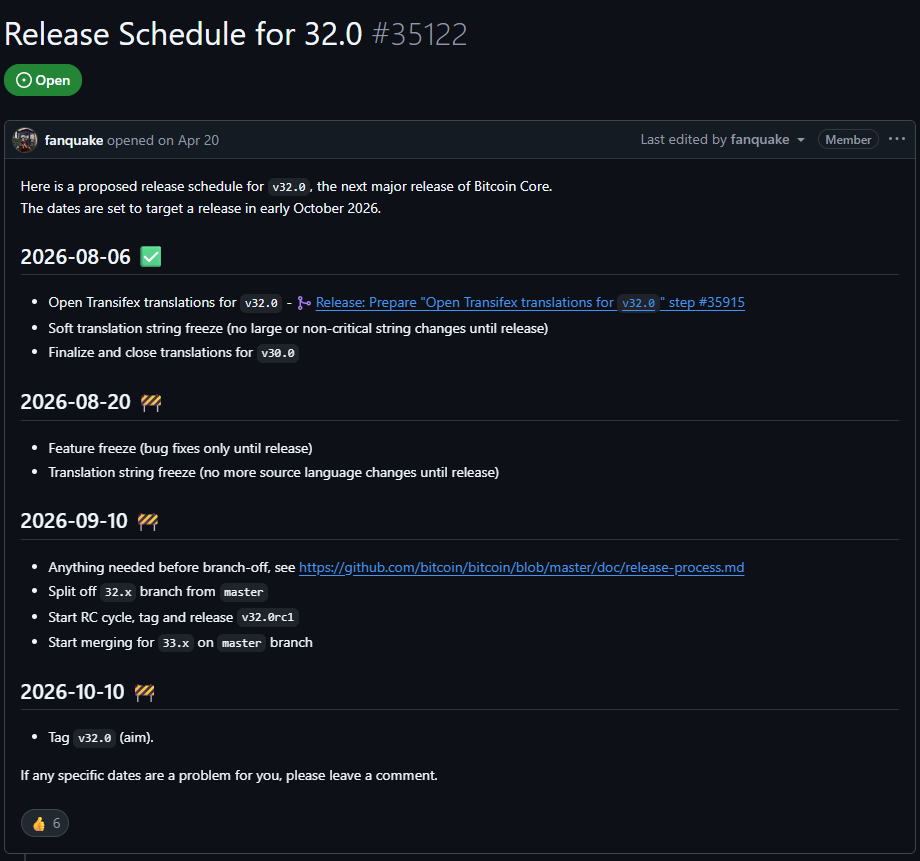
The release schedule points to an August 20 feature freeze, followed by the first release candidate around September 10 and a final release targeted for October 10.
Bitcoin Core v32 pushes speed and network resilience
Among the biggest changes, Bitcoin Core v32.0 is expected to raise the maximum number of peer connections from 125 to 200, giving new nodes more opportunities to connect and sync while improving block propagation across the network.
Schmidt said the higher connection limit should also make Bitcoin nodes more resistant to eclipse and partition attacks, where an attacker attempts to isolate a node from the wider network.
The release will also fully remove the external libevent dependency, continuing Bitcoin Core’s broader effort to reduce reliance on third-party software.
Transaction relay is getting another overhaul, with rate limiting moving from a per-peer model to a global system designed to keep CPU and memory usage more stable during sudden spikes in network activity.
Fee estimation is also being reworked around mempool activity, although Schmidt said that feature is still in progress.
Bitcoin Core v32.0 will additionally ship with features from libsecp256k1 0.8.0, including cryptographic verification improvements of up to around 11%, alongside a Silent Payments module supporting BIP 352.
The update is also set to make PSBTv2, defined under BIP 370, the default format for RPCs creating partially signed Bitcoin transactions, improving coordination for multisig and hardware-wallet setups.
A new ‘Export Watch Only Wallet’ command will allow users to export wallet data without private keys, while Tor’s proof-of-work defense against denial-of-service attacks will be enabled where supported.
What Bitcoin Core does
Bitcoin Core is the open-source software used by node operators to connect directly to Bitcoin’s peer-to-peer network and independently verify transactions and blocks without relying on a third party. By checking that incoming data follows Bitcoin’s consensus rules, full nodes help enforce the rules of the network and reject invalid transactions or blocks.
The software offers wallet functionality and tools for developers, miners and infrastructure providers, without giving any single operator control over Bitcoin itself.
New releases such as v32.0 also do not automatically alter the network’s rules or force users to upgrade. Node operators choose which version of the software they want to run, meaning adoption of v32.0 will depend on how widely users test the release candidates and decide to install the final build once it becomes available.