

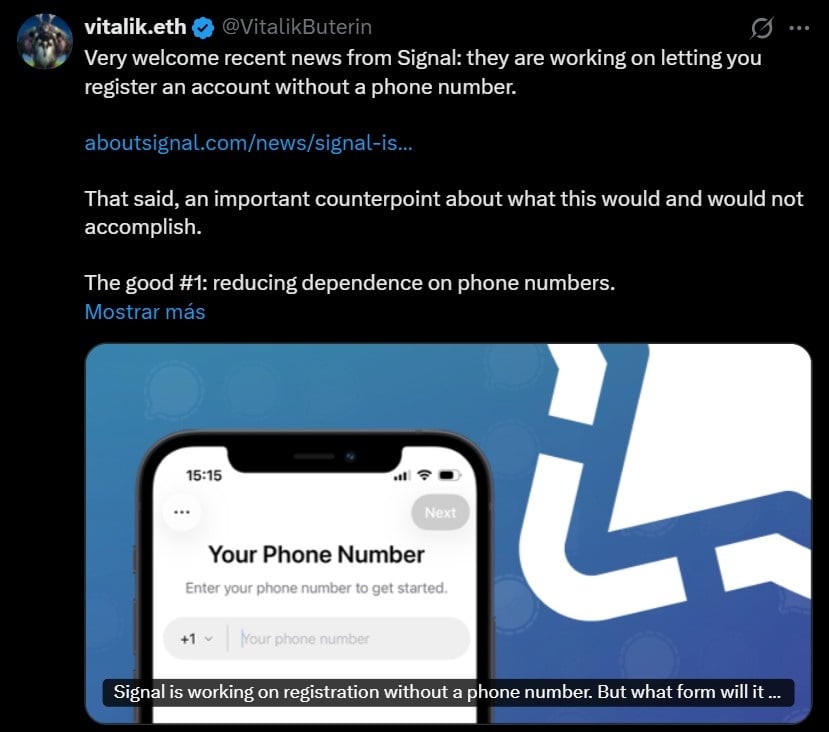
Ethereum’s co-founder Vitalik Buterin shared his perspective on a post about privacy in “the age of artificial intelligence (AI)”, calling pseudonymity a “dead concept” in 2026. While welcoming Signal’s work on phone-number-free registration, Buterin argued that AI has made it too easy to piece together identity from metadata like message timing, frequency, and Internet Protocol (IP) addresses. The only real defense, he said, is message-by-message unlinkability.
The death of pseudonymity
Vitalik Buterin laid out a taxonomy of privacy: “sitting duck” (adversary knows X did Y), “confidentiality” [X did ???, via end-to-end (E2E) encryption], “anonymity” (??? did Y, message-by-message unlinkability), and “ideal” (??? did ???).
Signal has already provided confidentiality for years; phone-number-free registration adds pseudonymity; the adversary knows “0x8b512c… did Y” but may not initially know who that is.
But in 2026, Buterin believes that persistent pseudonymous identity is no longer defensible. There are too many channels by which we leak data: timing of messages, patterns of who we message with what frequency, and size. AI [both large language models (LLMs) and advanced mathematical tools] makes it too easy to piece together those hints. Even hiding IP addresses with a virtual private network (VPN) or Tor leaves many other identity leakage vectors.
The path forward: Message-by-message unlinkability
The ideal is message-by-message unlinkability, where no one except sender and receiver knows the (sender, receiver) pair. This is being explored by mixnet projects and newer messengers like Session and SimpleX.
But the frontier will be spam and Denial-of-Service (DoS) protection: much of the internet blocks Tor exit nodes because that’s where DoS attacks come from. We need ways for people to prove they are not spammers while maintaining message-by-message unlinkability.
Buterin pointed to Zero-Knowledge (ZK) Application Programming Interface (API) credits as one direction, where stake replaces identity and abuse gets slashed.
For now, Signal’s phone-number-free registration is a victory; even if it has zero privacy consequences, it reduces dependence on oligopolistic phone systems and Subscriber Identity Module (SIM)-swap risks.
The technical challenge: Spam prevention without phone numbers
So far, Signal’s move to decouple accounts from phone numbers solves one privacy problem but creates another: spam and abuse prevention.
Signal CTO Ehren Kret acknowledged this directly, stating: “We gotta figure out some way to induce a cost for signing up without a phone number.”
Right now, phone numbers act as a small financial and logistical barrier that makes it way harder for people to just spam-create accounts.
The debate over Signal’s phone number requirement has been ongoing for years now. Critics argue that phone numbers are not truly private; as said, they can be SIM-swapped, Signaling System 7 (SS7)-hijacked, and are often tied to government identification in many countries.
Defenders counter that every alternative either increases friction, breaks contact discovery, or makes abuse significantly easier. As one Signal community member noted, “fully ‘numberless’ messengers tend to stay niche.”
Signal is exploring various solutions: paid registration (likely a small one-time fee), proof-of-work (PoW) mechanisms, or device attestation. But Kret made clear the timeline is uncertain. Signal hopes to make registration without a phone number possible later in 2026. The option will be optional, not a replacement for the current signup process.