

Vitalik Buterin published a massive technical post on indistinguishability obfuscation (iO), a cryptographic primitive he calls the “final boss” of cryptography. The 10,000-word post maps out the entire lineage of iO protocols, explaining how it turns code into an encrypted black box that can be executed without revealing its inner logic.
What is indistinguishability obfuscation?
They say that iO is cryptography’s holy grail: it lets you convert a program into an “encrypted black box.” You feed it inputs and get correct outputs, but the inner logic stays completely hidden.
Combined with blockchains, this could enable trustless private voting, collusion-proof auctions, and Decentralized Autonomous Organizations (DAOs) with almost zero trusted parties, effectively creating a “trustless trusted third party” for any protocol.
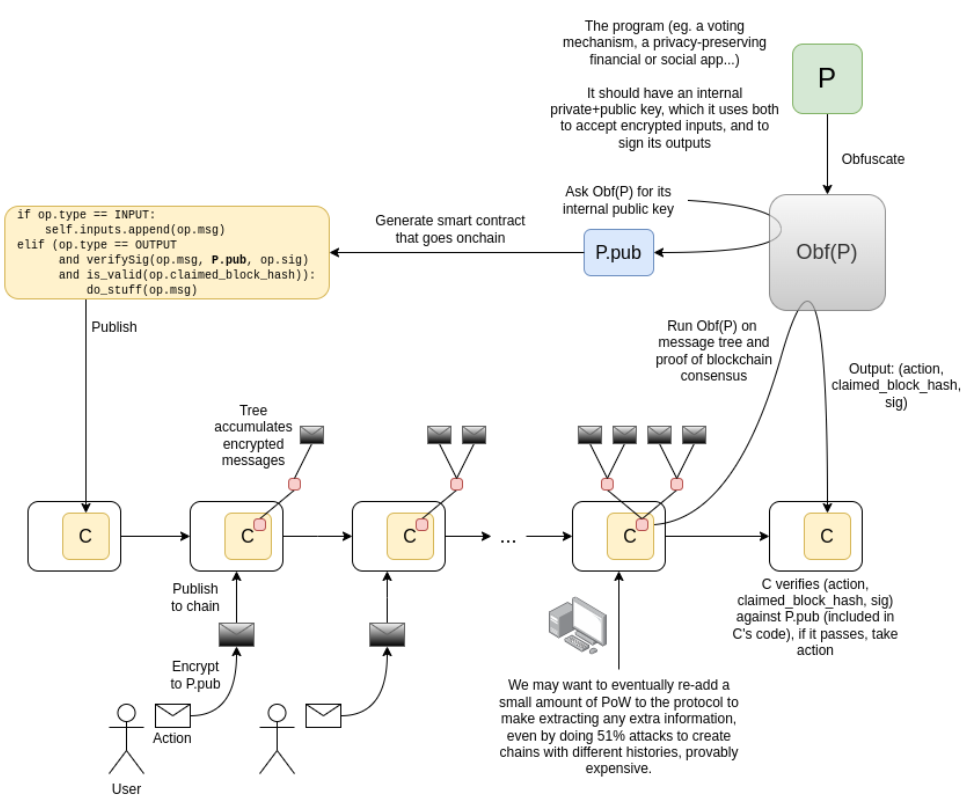
The power here is pretty wild. Check this out: if you combine iO with hashes, you can basically replace encryption, zero-knowledge proofs (ZKPs), and a whole lot more. The only real catch is that an obfuscated program can’t stop someone from copying it, so it can’t handle “stateful” stuff like money on its own, but that’s exactly where blockchains come in to save the day.
The challenge: Galactic runtimes
So, what’s the deal? Current iO protocols are “galactically slow.” Buterin writes that runtimes are “somewhere over λ^10” [where λ is the security parameter (standardly set at 100 or 120)], meaning execution times could take longer than the universe has left to live.
The protocols stack multiple layers of fully homomorphic encryption, each multiplying the overhead. As Buterin explains: “It’s technically polynomial, but it involves stacking many layers of ‘take one thing that’s vaguely like fully homomorphic encryption, now put the circuit for evaluating that into another thing that’s vaguely like fully homomorphic encryption.'”
The roadmap forward
Vitalik Buterin draws a hopeful parallel: this is similar to where Succinct Non-Interactive Arguments of Knowledge (SNARKs) were in 2010. Now that we know iO is possible, “smart people (and bots) will start coming up with clever workarounds to each bottleneck, and chopping off orders of magnitude from the runtime one after the other.”
To this point, Vitalik outlines three paths to practical iO:
- Optimizing the existing tower with new breakthroughs
- Building simpler protocols with more aggressive but still safe assumptions
- Inventing entirely new cryptographic approaches
The post, part of a planned series, will next cover “diamond iO” and “local mixing obfuscation.”