



The U.S. has elongated the number of blacklisted Chinese firms with new names just weeks after U.S. President Donald Trump and Chinese President Xi Jinping met in Beijing for a high stakes tech summit last month. In an undated document published by the Pentagon, the U.S. has alleged that the Alibaba Group Holdings and BYD are among “Chinese military companies” that are operating in the U.S. The aim behind these developments is to keep the national security safeguarded against potential cyber and spy attacks.
The fresh document reviewed by The Coin Headlines shows a total of 138 companies that the U.S. has called linked to China across sectors including e-commerce, aviation, semiconductors, robotics, telecom, infrastructure, biotechnology, and healthcare among others.
China’s e-commerce giant Alibaba, automaker BYD, and tech giant Baidu now join smartphone major Huawei and internet heavyweight Tencent on the list.
While these firms are not formally sanctioned by the Pentagon, their addition to the blacklist would restrict the U.S. government against procuring goods and services from these firms.
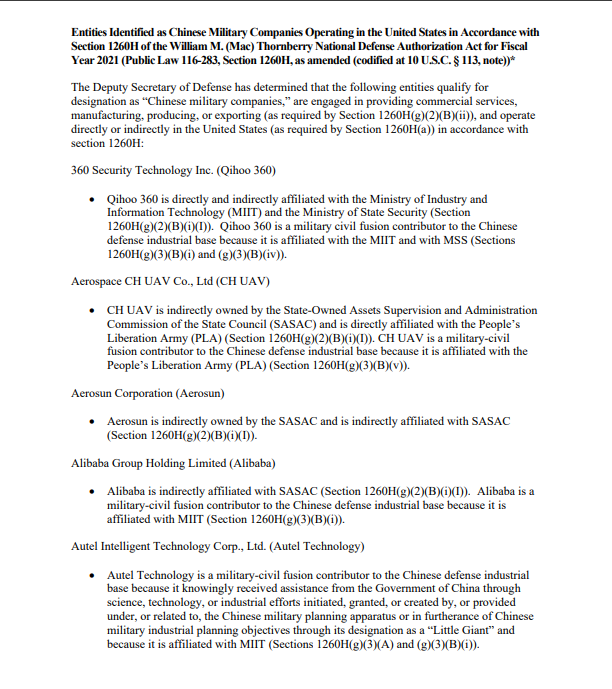
“The Deputy Secretary of Defense has determined that the following entities qualify for
designation as “Chinese military companies,” are engaged in providing commercial services, manufacturing, producing, or exporting and operate directly or indirectly in the United States in accordance with section 1260H,” the U.S. defense department said in its document.
Source: Defense.gov
The South China Morning Post (SCMP), owned by the Alibaba Group, has called this move by the U.S. an effective strategy to restrict China’s access to American capital, technology, and government contracts.
Talking about the list, the report said the Pentagon curates this list to identify those firms which it deems to supoprt China’s military-civil fusion strategy — which is a state-led mandate to fuse the country’s civilian commercial sector and its defense industrial base.
The trade war between the U.S. and China intensified earlier this year with President Trump levying taxes as high as 100 percent on selective Chinese imports.
During the Trump-Xi summit last month, both the leaders discussed about the tech collaboration between the two nations. During the conversations, President Trump did not agree to fully opening the supply of advanced AI semiconductors but allowed China to procure older chips from companies like Nvidia. The U.S., since 2024, has tightened export controls on advanced hardware like Nvidia’s Blackwell-class chips to China.
China has criticized the move saying that the U.S. wishes to keep China out of the AI race. In retaliation, China said it would leverage its own “Malicious Entity List” to harm U.S.’s tech access as well.
For now, a response from Alibaba and BYD to the development remains awaited.
:


