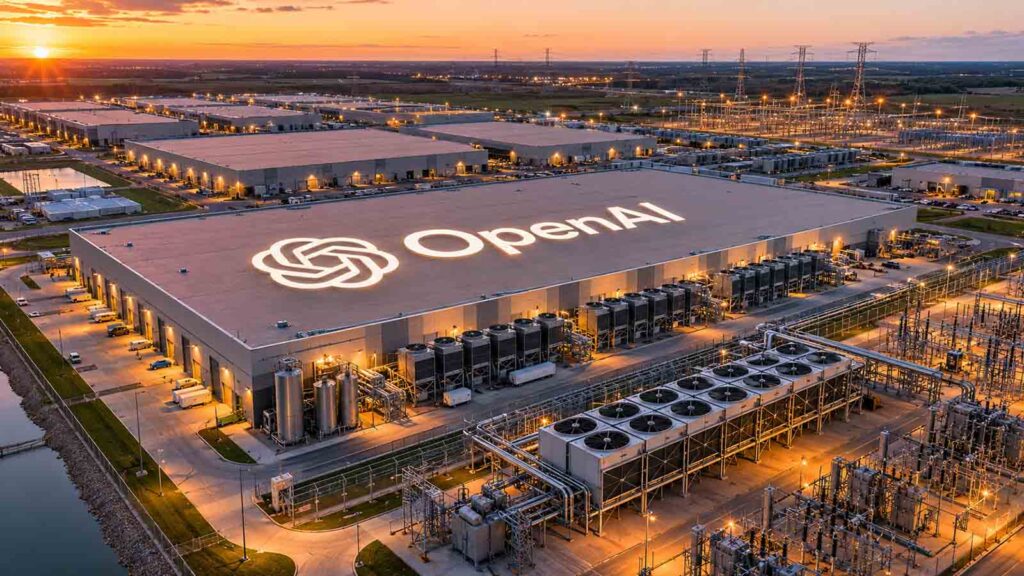


OpenAI’s Stargate project, one of the most ambitious AI infrastructure initiatives underway, is reportedly facing a major reality check as developers grapple with the enormous energy demands needed to power next-generation artificial intelligence.
According to people familiar with the project, building the infrastructure behind Stargate is turning out to be more complicated and expensive than originally anticipated.
While developing advanced AI models often grabs the headlines, the less visible challenge is finding enough reliable electricity to run the massive data centres that make those models possible.
The issue is becoming particularly evident in Abilene, Texas, where infrastructure company Crusoe is helping build a key part of the Stargate network. Crusoe, which also works with Oracle on data centre projects, is reportedly dealing with rising operating costs as it tries to balance power generation with the enormous computing needs of AI systems.
Rising energy needs strain Stargate project
According to Odaily, the project’s energy requirements are putting significant pressure on costs, forcing engineers to work through complex technical and logistical challenges.
At the Abilene site, Crusoe’s hardware teams are reportedly working long hours to coordinate natural gas turbines with what is expected to become one of the world’s most powerful AI supercomputers.
Located on a vast stretch of Texas grassland, the facility is being designed to provide the computing capacity needed for OpenAI’s future AI models. This project demonstrates the current trend in the overall field of artificial intelligence. Making smarter AI entails not only writing better software but also developing necessary hardware infrastructure. This involves producing state-of-the-art computer chips, cooling systems, electricity generation and distribution mechanisms.
Training an extensive neural network model entails using hundreds or even thousands of specially designed computer processors. The training process takes many hours and these processors require vast amounts of electricity and cooling facilities due to considerable heat emission.
Moreover, as artificial intelligence becomes smarter, it also becomes bigger and therefore more difficult to build. Electricity supply has been recognized by industry specialists as potentially one of the major constraints on future AI development.
Instead of relying only on the local energy grid, it seems that the Stargate project uses some kind of dedicated generators, which apparently makes natural gas turbines a part of the project’s infrastructure. Though this solution helps ensure a reliable supply of energy, it entails additional investments.
The challenges facing Stargate reflect a much broader trend across the technology sector. Companies including OpenAI, Microsoft, Google, Anthropic, and others are investing billions of dollars in AI infrastructure as competition intensifies. Access to computing power has become a strategic asset, with companies racing to secure enough capacity to train increasingly advanced models.
Stargate aims to secure OpenAI’s long-term AI computing capacity
For the company’s future, the success of Stargate appears crucial. This facility will allow OpenAI to use large amounts of computing power, reducing dependence on other companies’ infrastructure and meeting the increasing demand in the sector.
At the same time, Crusoe shows that the emergence of a new industry creates opportunities for businesses specializing in infrastructure. Initially, the company worked on capturing stranded natural gas for energy production, yet gradually it began to move toward constructing large facilities for running artificial intelligence.
Although the cost of Stargate and the technical issues associated with building it are becoming increasingly complex, engineers are trying to solve them. After all, many problems have to be solved when constructing such a huge AI computing facility.
Thus, Stargate demonstrates once again that the future of artificial intelligence cannot be imagined without solving various infrastructure-related issues. Without a sophisticated network of hardware, energy, and data centers, no innovative algorithm can be applied in practice. Perhaps, the ability to generate power may soon become as significant for the AI field as technological breakthroughs.