

SpaceX (Nasdaq: SPCX) announced it is partnering with Nvidia Corp. (Nasdaq: NVDA) to design the Starmind AI1 satellite compute payload, with each satellite featuring Nvidia Rubin GPUs (Graphics Processing Units) and Vera CPUs (Central Processing Units) for datacenter-class space computing.
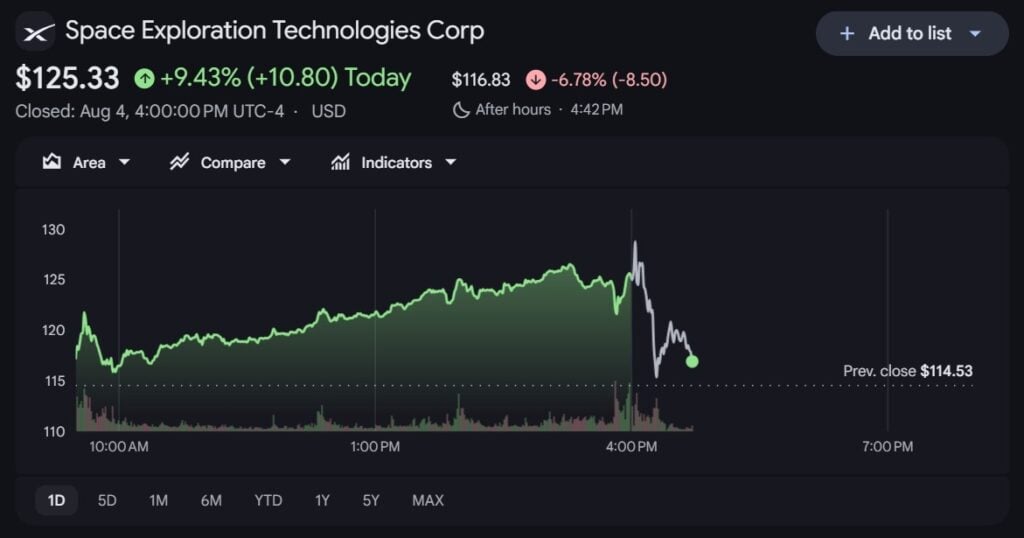
The announcement came as SpaceX prepared for its first earnings report since its June Initial Public Offering (IPO), with the stock surging approximately 10 percent and short interest hitting 34 percent of the float.
The Starmind AI1 satellite
Tech advances, and so does SpaceX. The Starmind AI1 represents a significant leap in space-based computing. Each satellite will include Nvidia Rubin GPUs and Vera CPUs, providing data center-level processing power in orbit.
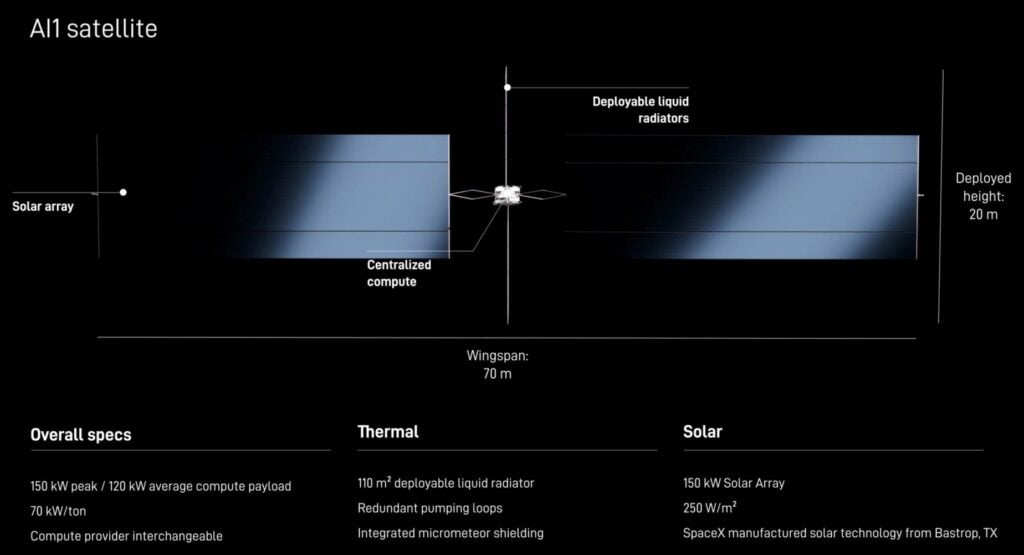
SpaceX recently increased the satellite’s peak power by 67 percent to roughly 250 kilowatts (kW), up from 150 kW, and its average power by 33 percent to 160 kW; enough to power an Nvidia Rubin NVL72 rack containing 72 Rubin GPUs.
This compute capability is designed to power artificial intelligence (AI) workloads directly in space, potentially enabling real-time data processing, onboard machine learning, and autonomous decision-making for satellite constellations.
Earnings vibes and the short squeeze setup
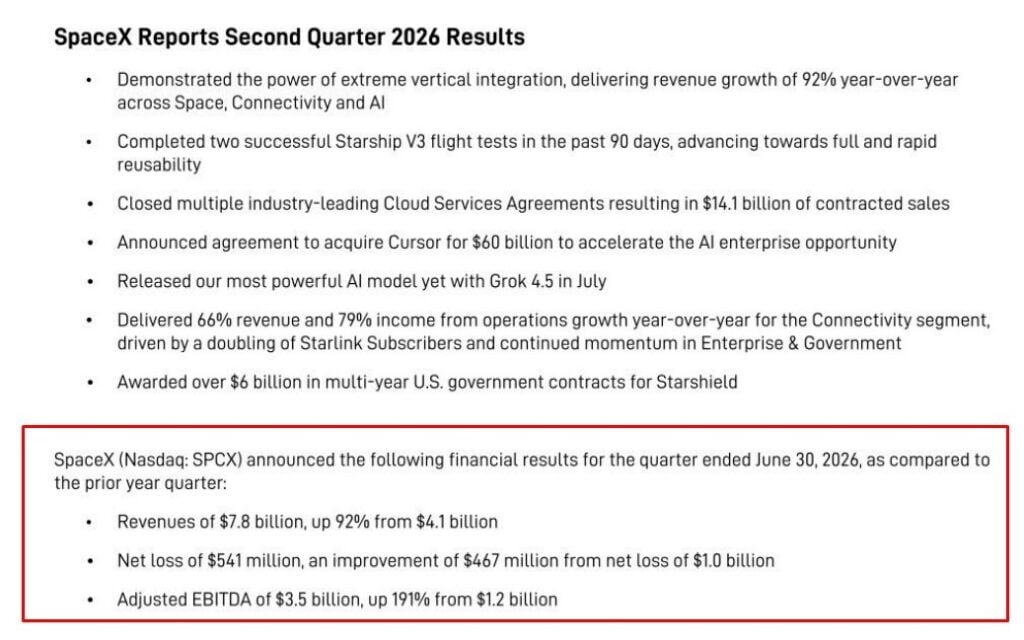
This partnership news is dropping just as SpaceX makes its big splash in the public markets. We just got the very first quarterly update since that massive IPO back on June 12, 2026.
On August 5, 2026, SpaceX shared its Q2 results, and they actually crushed revenue expectations by bringing in $7.8 billion, even with a $541 million net loss. Wall Street was only looking for $6.8 billion in revenue and a 24-cent loss per share.
Meanwhile, the shorts are piling in: short interest is sitting at 34 percent of the float, and 95 percent of the shares available to borrow are already out on loan.
Elon Musk taunted bears on X, saying: “I try to warn them, but they just double down.” Massive open interest in $330 call options expiring Friday (over 450,000 contracts) suggests some traders are positioning for a dramatic upside move, with one Wall Street analyst noting the stock could potentially triple this week.
SpaceX’s broader AI and space compute push
The Starmind AI1 partnership is another big move, making SpaceX an AI infrastructure powerhouse. Since merging with xAI back in February, bringing Grok, X, and the COLOSSUS compute cluster under one roof. With about 550 million people using Grok and X every month, SpaceX now has a direct line to everyday AI users.
The Starmind project itself has been in development since before the IPO, with a vision of orbital data centers that bypass Earth’s power and cooling constraints. The first two prototype AI1 satellites are targeted for early 2027, with production ramping to roughly 1 gigawatt of orbital compute per year by late 2027.
SpaceX has asked regulators for permission to field a constellation of up to 1 million such satellites, ferried by Starship.
Meanwhile, Starlink V3 satellites are already being tested; the 13th Starship flight successfully deployed 20 V3 satellites, each designed to deliver one terabit per second of downlink capacity.
The V3 deployment is central to expanding Starlink’s capacity and enabling direct-to-cell service. Plus, the xAI deal brought Cursor into the family, an AI coding startup they picked up for a cool $60 billion.
Elon Musk has deployed “a few dozen” top Starlink and Starship engineers to accelerate Grok’s development. In investor materials, SpaceX estimated its total addressable market at $28.5 trillion, with AI accounting for $26.5 trillion of that.
It’s worth mentioning that, just in the middle of these win situations, the company has been awarded a $1.6 billion contract for 18 Falcon 9 launches under the National Security Space Launch (NSSL) Phase 3 Lane 1 program. The sky is not the limit.