

OpenAI said it banned two clusters of ChatGPT accounts likely originating from China after they used its models to support covert influence operations targeting U.S. debates over artificial intelligence, data centers and technology policy.
In a June 2026 threat report, OpenAI said the networks appeared to be pushing narratives around American AI infrastructure and U.S. technology competition, while hiding their origins and attempting to pose as ordinary users across social media platforms.
Data center costs become a pressure point
One operation, which OpenAI named “Data Center Bandwagon,” used ChatGPT to generate posts and images claiming AI data centers were driving up electricity demand and raising costs for U.S. households.
The accounts prompted ChatGPT in Simplified Chinese while requesting English- and Chinese-language outputs designed to look like they came from Americans with different backgrounds. OpenAI said the operators used VPNs to access its platform, as its models are not available from China.
The group posted AI-generated content on X alongside links to legitimate news stories about power grid capacity auctions and data center electricity demand.
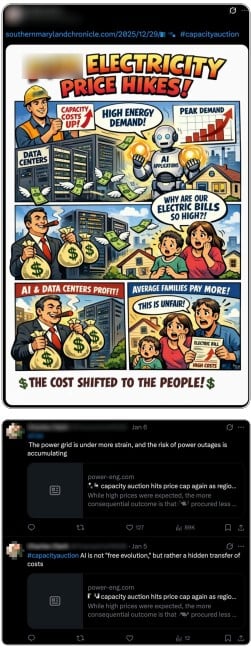
OpenAI said the operators were likely part of a social media operations team at a private Chinese technology company that had worked for Chinese provincial-level government clients.
OpenAI said the users also uploaded a document that laid out plans to influence public opinion and keep social media accounts operating despite platform detection systems.
Overseas Chinese users also targeted
The same cluster also sought to influence overseas Chinese audiences, according to OpenAI. The accounts asked for information about Chinese dissident Li Ying, also known as Teacher Li, and attempted to generate insulting comments aimed at him and other Chinese political commentators.
OpenAI said its models refused requests to create inflammatory or personal attacks.
The operators also experimented with fabricated personas, including U.S.-based Chinese immigrants, students, workers and parents, to encourage online criticism of the United States.
Beyond content creation, the accounts used ChatGPT to support operational tasks, including formatting usernames, processing links and seeking code to help manage activity across social platforms.
Tariffs and OpenAI become targets
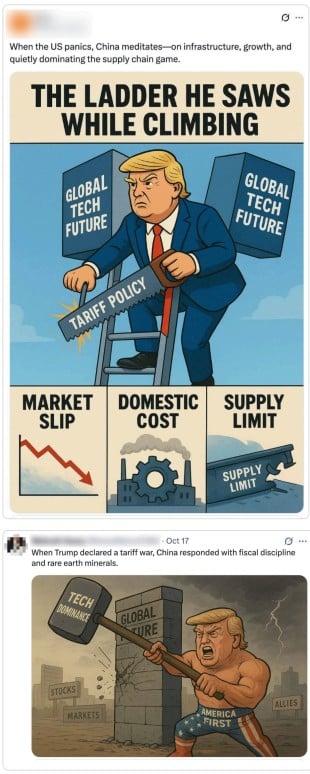
A second operation, called “Tech and Tariffs,” used ChatGPT to generate short comments and political cartoons criticizing U.S. technology policies and tariffs.
OpenAI said the accounts also used wording associated with China’s public security system and, in one case, described their social media accounts as a “water army,” a Chinese term for coordinated online troll or flooding networks.
The campaign portrayed U.S.-China competition over tariffs, rare earths, AI, 5G, clean energy and industrial resilience as a fight for technological dominance, while using cartoons centered on President Donald Trump.
Limited reach, strategic warning
OpenAI assessed the activity as Category One on its Breakout Scale, meaning it was limited to one platform and showed no evidence of meaningful spread. Most posts generated little or no visible engagement.
Still, OpenAI said the campaigns mattered because they showed PRC-origin influence actors trying to insert themselves into legitimate U.S. debates over AI infrastructure, energy costs and technology leadership.
The company said both campaigns reflected a broader pattern in which foreign operators use real public concerns to amplify distrust, weaken confidence in democratic institutions and test narratives around strategically important industries.
The report warned that similar AI-enabled influence efforts are likely to continue as geopolitical competition around artificial intelligence intensifies.