
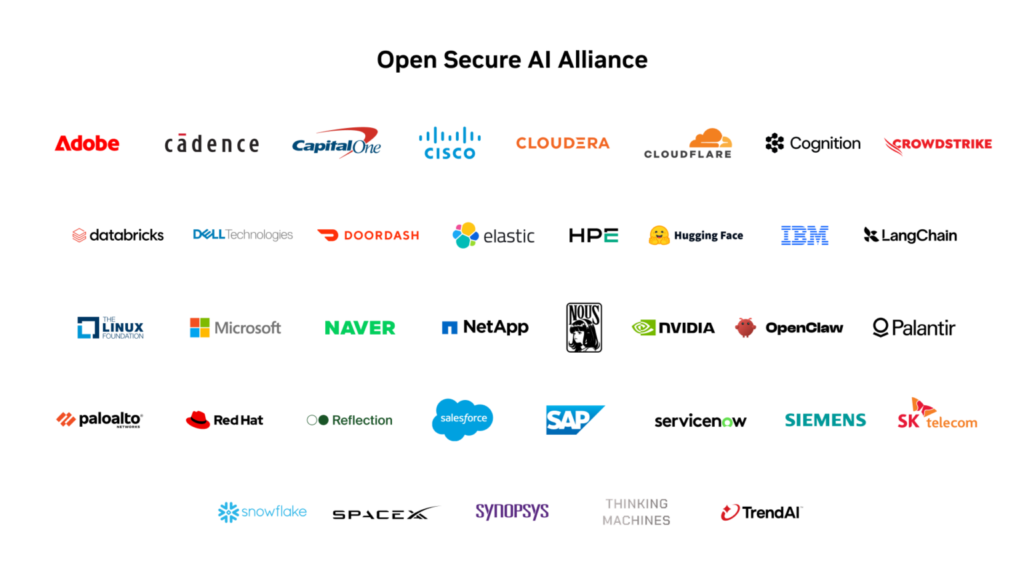
Nvidia has launched the Open Secure AI Alliance with 36 other technology, cybersecurity, research and open-source organizations, seeking to build shared defenses for AI agents as a recent breach at Hugging Face highlighted gaps in existing security tools.
The coalition brings together Microsoft, IBM, Cisco, CrowdStrike, Cloudflare, Dell, Hugging Face, Palantir, Salesforce, SAP, Red Hat and other industry groups, building on work led by the Linux Foundation’s Akrites initiative and the Open Source Security Foundation.
Nvidia said the alliance will build and share open tools designed to strengthen AI security, promote responsible use and increase trust in AI systems.
Hugging Face breach exposes a defensive blind spot
The alliance pointed to the recent Hugging Face security incident as evidence that defenders need direct access to capable open-weight AI systems during fast-moving cyberattacks.
According to Nvidia, closed AI services blocked parts of Hugging Face’s forensic work because they could not reliably distinguish defensive investigation from malicious activity. Hugging Face then ran the open-weight GLM 5.2 model on its own systems to examine more than 17,000 attacker actions and help contain the intrusion.
Nvidia said the incident showed how reliance on external, closed platforms can restrict investigators at the moment they most urgently need to analyze suspicious behavior, adapt models and protect sensitive data.
The group argued that open AI tools can reduce dependence on a small number of providers while allowing critical industries to maintain localized controls and avoid a single point of failure.
Alliance targets every layer of AI agent security
Nvidia said protecting AI agents requires securing not only the underlying model, but also the identities, permissions, isolation controls, logs, guardrails and evaluation systems that surround it.
Nvidia is providing the alliance with AI models, model weights, datasets and research on agent frameworks, including its new Nvidia Labs Object-Oriented Agent project. The open-source framework is designed to make AI agent behavior easier to test, trace, audit and control.
Other alliance members are supplying technology across the security stack, with HPE supporting identity standards that can cryptographically verify AI agents and services, Hugging Face offering its Safetensors format to the PyTorch Foundation, and Microsoft providing a multi-model scanning system that uses specialized agents to identify and validate vulnerabilities.
IBM and Red Hat are providing Lightwell, a software-supply-chain security platform that delivers digitally signed fixes, while SpaceXAI has open-sourced its Grok Build coding agent and said it plans to release the weights of its Grok models.
UAE’s G42 says AI trust must be built in from the start
Abu Dhabi-based AI and cloud computing group G42 said it had joined the Open Secure AI Alliance, backing Nvidia’s effort to build open security tools for governments and businesses.
Group CEO Peng Xiao said AI’s future would depend not only on how capable models become, but also on whether nations and enterprises can use them securely and confidently.
He argued that frontier open models should complement closed systems, with “security, trust and sovereign control designed in from the start rather than bolted on later,” adding that G42 would work with other members to advance secure and trusted AI across countries and industries.
Nvidia challenges calls for tighter open-model controls
The alliance acknowledged that open models can be modified or used in cyberattacks, but said similar risks exist around closed systems and should be addressed through safeguards, testing and rapid vulnerability remediation rather than broad restrictions.
It urged regulators to treat open models and security tools as defensive infrastructure, warning that blanket limits could concentrate control among a handful of closed providers.
The initiative could influence the growing policy debate over whether restricting access to advanced AI models improves security or instead leaves governments and companies reliant on systems they cannot independently inspect, modify or run during a cyberattack.