

Mastercard is diving into the future with its new “Agent Pay for Machines” pilot program. Basically, they’re using artificial intelligence (AI) and smart software agents to let machines handle their own payments without needing a human to step in.
It’s an interesting program, involving over 30 heavy hitters like Stripe, Coinbase, and Ripple. They’re focusing on machine-to-machine payments for automated services like logistics and data feeds by using Ripple’s XRP Ledger and the RLUSD stablecoin to settle everything smoothly behind the scenes.

What machine-to-machine payments are all about
The pilot targets microtransactions that could occur thousands of times per hour as AI agents buy compute, data, or Application Programming Interface (API) access. Mastercard’s program uses the XRP Ledger and RLUSD stablecoin for settlement, not the XRP token directly.
Here, it is good to emphasize that “the pieces that took center stage were the XRP Ledger and the RLUSD stablecoin, not the XRP token directly,” meaning that Mastercard’s enterprise experiment leans on Ripple’s ledger and a dollar-pegged asset for compliance and stability.
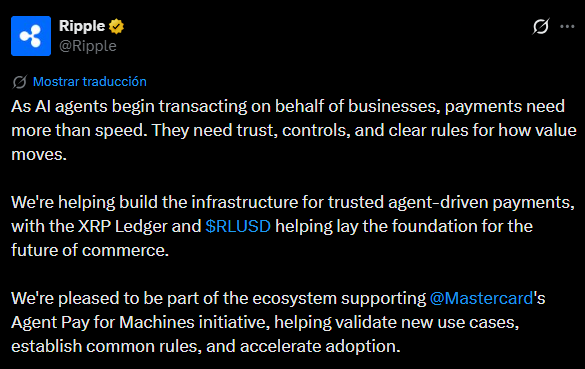
The day after the Mastercard announcement, Ripple unveiled its “XRPL AI Starter Kit,” described as a way for developers to build AI agents that can send and receive payments autonomously using both XRP and RLUSD over a new real-time payment protocol designed for software-to-software transactions.
RLUSD and XRP: Two halves of the same machine
These two updates act as “two halves of the same machine.” Big institutions are sticking to a regulated stablecoin and ledger setup, while devs in the open ecosystem are tapping into XRP and RLUSD to get a massive agent economy going. RLUSD is set up to be “the stable regulated dollar that the institutions settle in,” and XRP keeps doing its thing as the asset supporting the open-payment layer.
The big takeaway is that machine-to-machine payments might soon outpace human transactions, pushing us to move away from old-school, account-based banking towards zippy, low-cost networks like the XRP Ledger.
Latest Mastercard blockchain developments: A multi-pronged push
Since June 2026, Mastercard has really ramped up its blockchain game, allowing card payments to settle with regulated stablecoins across eight different networks, including Ethereum, Solana, and XRPL.
They’ve also rolled out “Agent Pay for Machines” to enable AI-to-AI payments with over 30 partners, including big names like Coinbase and Ripple. Plus, they have kicked off a Crypto Partner Program with over 100 firms, bought the stablecoin infrastructure company BVNK for $1.8 billion, and snagged a New York BitLicense back in May 2026. Basically, Mastercard is positioning itself as the go-to infrastructure provider for a future where payments are always on and blockchain-powered.