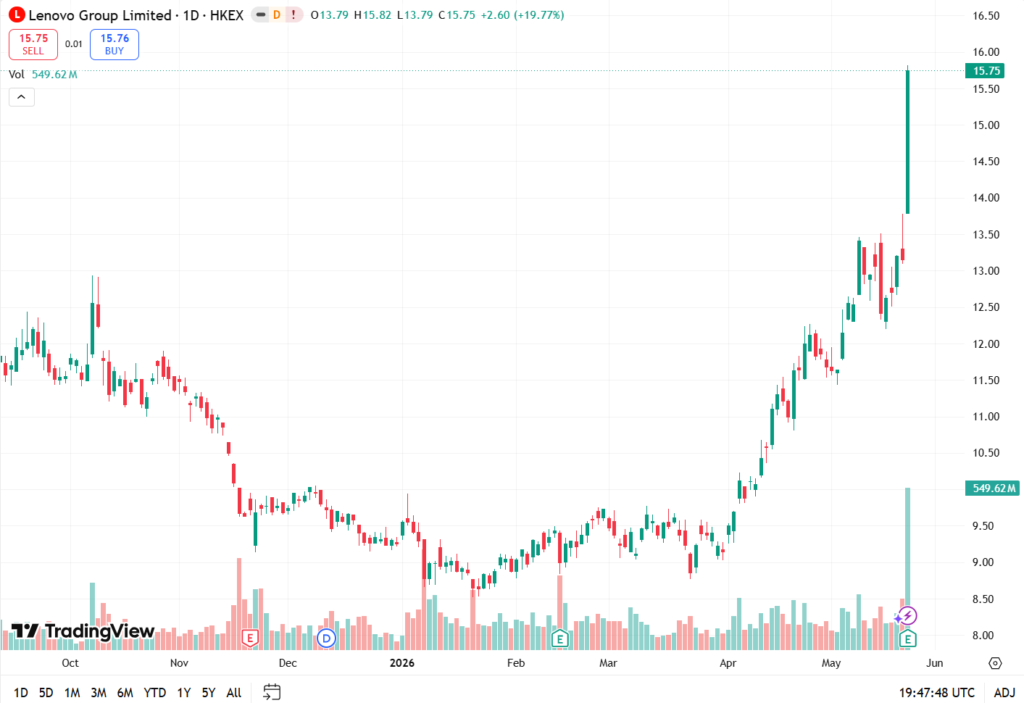

Lenovo Group announced a stronger-than-expected fourth-quarter (Q4) performance as demand for PCs, AI infrastructure, and services lifted revenue, sending its Hong Kong-listed shares up nearly 20 percent after the results.
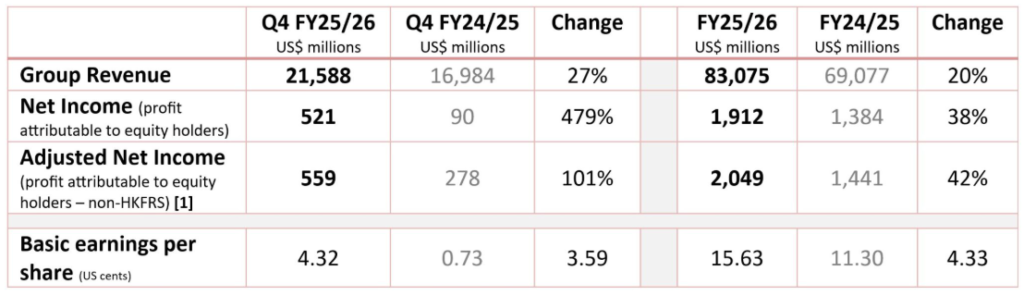
The company said in its earnings release that group revenue rose 27 percent year-on-year to $21.6 billion in the fiscal fourth quarter, while adjusted net income doubled to $559 million.
Net income attributable to shareholders climbed to $521 million from $90 million a year earlier, while full-year revenue rose 20 percent to a record $83.1 billion and adjusted net income increased 42 percent to about $2 billion.
PCs, servers and services drive the quarter
Lenovo’s largest division, the Intelligent Devices Group, led the quarter’s gains, with revenue rising 24 percent to $14.6 billion. The company said PC and smart-device revenue grew 26 percent, its fastest pace in five years, while its global PC market share reached 24.4 percent, keeping it in the top industry position.
The Infrastructure Solutions Group delivered the fastest divisional growth, with revenue climbing 37 percent to a record $5.6 billion and operating profit reaching $202 million.
Lenovo said the unit was supported by rising demand for AI servers and a pipeline worth $21 billion, alongside more than 5,800 customer AI deployments.
Its Solutions and Services Group also extended its growth streak, with revenue up 19 percent to $2.6 billion. The company said managed services and project-based solutions made up 62 percent of the unit’s revenue, pointing to a gradual shift toward recurring and higher-margin work rather than one-off hardware sales.
AI becomes a larger part of Lenovo’s growth
AI emerged as one of the strongest drivers behind Lenovo’s latest results, with AI-related revenue growing 84 percent year-on-year in the fourth quarter and accounting for 38 percent of total group revenue.
For the full year, AI-related revenue more than doubled and represented 33 percent of Lenovo’s business, showing how quickly the company is repositioning around AI PCs, enterprise AI services, and data center infrastructure.
That push builds on several recent initiatives. In March, Lenovo expanded its Hybrid AI Advantage with NVIDIA, a platform aimed at moving AI workloads across personal devices, enterprise systems, and cloud-scale deployments, with a focus on inference and faster deployment for businesses.
At CES 2026, Lenovo also unveiled Qira, a personal AI system designed to connect tasks and context across PCs, tablets, and phones, with rollout planned on select Lenovo and Motorola products in 2026.
On the infrastructure side, Lenovo has been working with NVIDIA on rack-scale AI systems and AI factory deployments, including support for NVIDIA’s Vera Rubin NVL72 platform for AI training and inference.
The company’s latest results indicate that its AI push is starting to show up more clearly in revenue, particularly across servers and services.
Shares rally 20 percent after results
Lenovo’s Hong Kong-listed shares surged nearly 20 percent to HK$15.75 in heavy trading, showing renewed investor confidence after quarterly revenue rose 27 percent to a record fourth-quarter high of $21.6 billion, helped by stronger PC demand and faster growth in AI-related revenue.