

Gensyn AI introduced Evidence Markets, a new spin on prediction markets that incentivizes both accurate forecasts and the evidence behind them. The mechanism, detailed in a fresh arXiv paper and a blog post, addresses two core limitations of traditional prediction markets: they reveal what the crowd believes but not why, and they require externally resolvable events/outcomes with known future dates; thus, traders are stuck waiting for specific outside events to settle the bet.
What are Evidence Markets?
Check this out: Standard prediction markets turn thousands of private judgments into a single price. That number is useful, but it discards the reasoning that produced it. Evidence Markets fix this by letting traders submit checkable evidence [a prompt where one artificial intelligence (AI) model fails and another succeeds, a replication attempt, a policy study] alongside their beliefs.
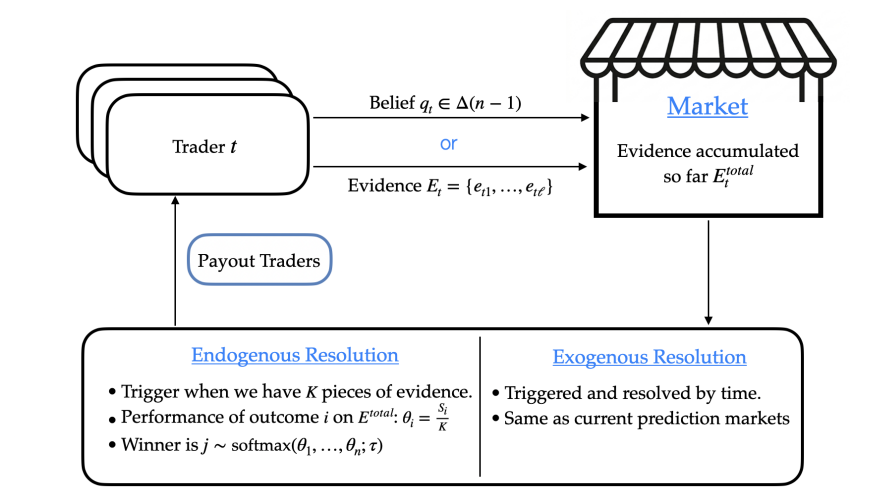
Think of it like this: a risk-averse lawyer who knows exactly which model reviews contracts better can just submit a discriminating test case, get paid for that evidence, and walk away holding no position at all (skipping the whole betting part entirely). But a bettor can do both. The market pays for evidence proportionally to how much it reduces uncertainty. Below, some other examples:

When the crowd is torn, a good piece of evidence is worth a great deal; when the question is settled, the same piece is worth almost nothing. The mechanism uses a dynamic liquidity parameter that decreases as evidence quality increases, ensuring platform loss remains bounded.
How Evidence Markets change the prediction market sector
Prediction markets have a branding problem. Through early 2026, sports made up roughly 80 percent of trading volume on Kalshi and 39 percent on Polymarket. The usual explanation blames the crowd; people just want to gamble. Gensyn’s Gabriel Andrade argues the opposite:
“Markets attract what they pay for. A venue that pays you to take a position on an externally resolved event, hands back nothing but a price, and runs on an order book that rewards speed and inventory will be populated by bettors, arbitrageurs, and market-makers.”
Evidence Markets change what they pay for. The output is no longer a bare price; it is closer to an analyst’s report (produced in public), by the crowd, and priced as it is built. When the market resolves, the evidence doesn’t disappear. It becomes a reusable artifact: a set of discriminating questions and documented failures that the whole field can reuse, long after the last trade clears. Speculation becomes a subsidy for public knowledge.
What comes next
Gensyn’s evidence markets are currently a research prototype with a formal paper, not a live product. The immediate next step is building a production-ready implementation for Large Language Model (LLM) evaluation; arguably the sharpest use case. That means designing a user interface for submitting and disputing evidence, integrating LLM-as-a-judge verification with staking mechanisms, and launching a testnet market where participants can experiment with the mechanism.
The team is also exploring applications beyond AI model evaluation: scientific replication markets where researchers get paid for replication attempts, policy analysis markets where evidence of causal effects is traded, and procurement markets where companies source discriminating test cases for vendor selection.
There are still some big hurdles, like figuring out more efficient evidence scoring functions, robust dispute resolution, and avoiding judge model centralization, but the foundation is solid. If they can pull it off, these markets could totally change how we fund and create knowledge online.