
Circle just dropped an open-source prediction markets sample app on Arc Testnet. It uses UMA Protocol’s Optimistic Oracle V2 to handle decentralized market resolutions. This new app really shows off what Arc can do: think sub-second settlements, native USDC/EURC support, cross-chain USDC deposits, and gas fees in USDC that actually make sense. The code is up on GitHub now; anyone can check it out, fork it, or start deploying your own projects.
Circle’s prediction market blueprint
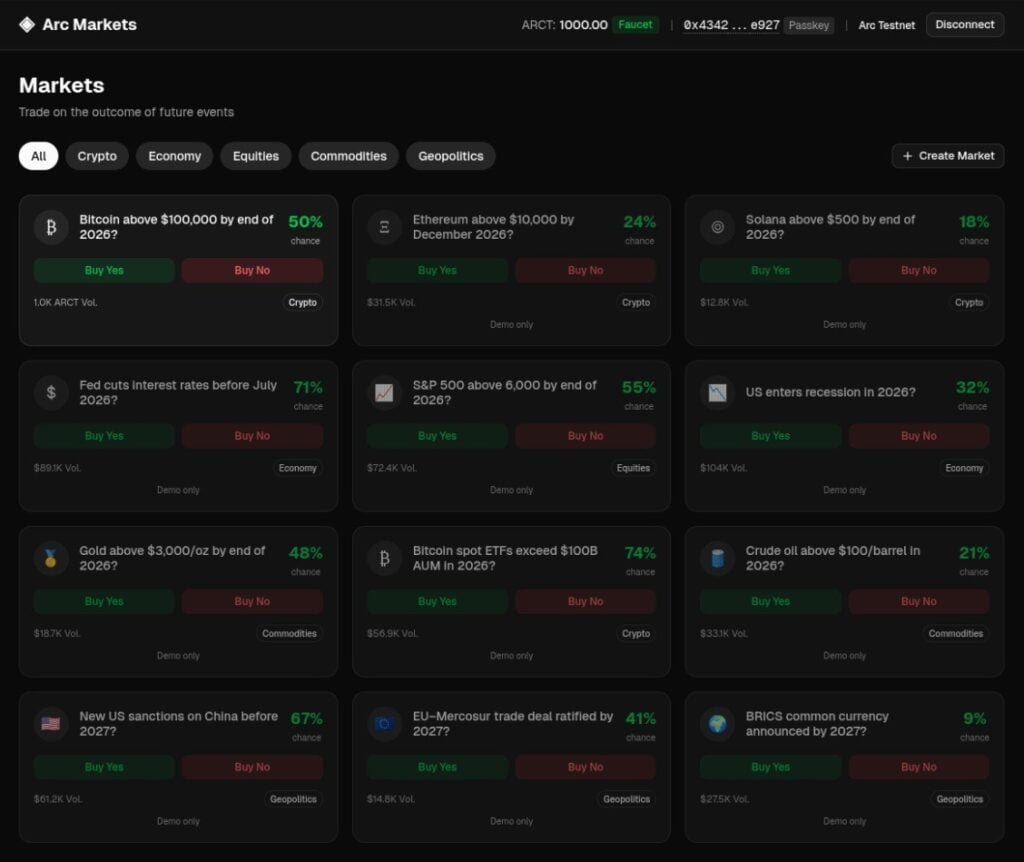
Just to be clear, Circle isn’t launching a prediction market; they’re giving builders the blueprint to launch their own. The sample app, hosted on GitHub under the CircleFin organization, is a fully functional decentralized prediction markets platform. It ships with a live Bitcoin market (“Will BTC exceed $100K?”) and a grid of demo markets across Crypto, Economy, Equities, Commodities, and Geopolitics.
But the killer feature is that anyone can create custom onchain markets directly from the user interface (UI). Click “Create Market,” enter a yes/no question, and the server-side Application Programming Interface (API) deploys fresh EventBasedPredictionMarket and PredictionMarketAMM contracts, seeds them with 1,000 ARCT of liquidity, and adds the market to the grid. No coding required.
For the devs out there, this repo is a goldmine. It’s a production-ready template packed with all the good stuff: Next.js App Router, wagmi + viem for wallet interactions, Solidity contracts for the market and Automated Market Maker (AMM), and Tailwind CSS with shadcn/ui components. There’s everything you need to run your own project.
Why UMA Protocol?
UMA’s Optimistic Oracle V2 is a natural fit for prediction markets. Here’s how it works: anyone can propose an outcome to a market (e.g., “Bitcoin exceeded $100K by the deadline”). If no one disputes it within a liveness period, the market settles. If someone disagrees, they post a bond, and the dispute escalates to UMA’s Data Verification Mechanism (DVM) for arbitration.
This “optimistic” model is efficient (most resolutions go unchallenged) but still has a backstop for disputes. The sample app implements the full lifecycle: market initialization requests a price from the Optimistic Oracle (OO), proposers stake bonds, disputers can escalate, and after liveness expires, anyone can settle.
The market uses event-based mode, which handles multiple dispute rounds by re-requesting prices with fresh timestamps. The deploy script bootstraps the entire UMA ecosystem on Arc Testnet (Finder, IdentifierWhitelist, AddressWhitelist, Store, MockOracleAncillary, and OptimisticOracleV2), as UMA is not yet natively deployed there. And, if you are a builder, this means you get a battle-tested oracle system without deploying your own.
What is Arc trying to achieve?
Arc is Circle’s answer to a question that’s been haunting crypto for years: can we build a blockchain that feels like a payment network? Arc is an Ethereum Virtual Machine (EVM)-compatible Layer-2 (L2) settlement network designed for speed and predictable costs. The key differentiator here is USDC as native gas. Users pay transaction fees in USDC or EURC, not in a volatile protocol token. No more “I have ETH, but I need gas” headaches.
The prediction markets sample app showcases Arc’s core value proposition: sub-second settlement (critical for markets where prices change fast), cross-chain USDC deposits (bridging liquidity from other chains), and predictable gas fees (no surprises when trading).
To this point, by open sourcing a complex dApp (prediction markets require oracles, AMMs, token creation, and dispute resolution), Circle is giving builders a complete reference architecture. If you can build a prediction market on Arc, you can build almost anything. At least that’s the idea.