


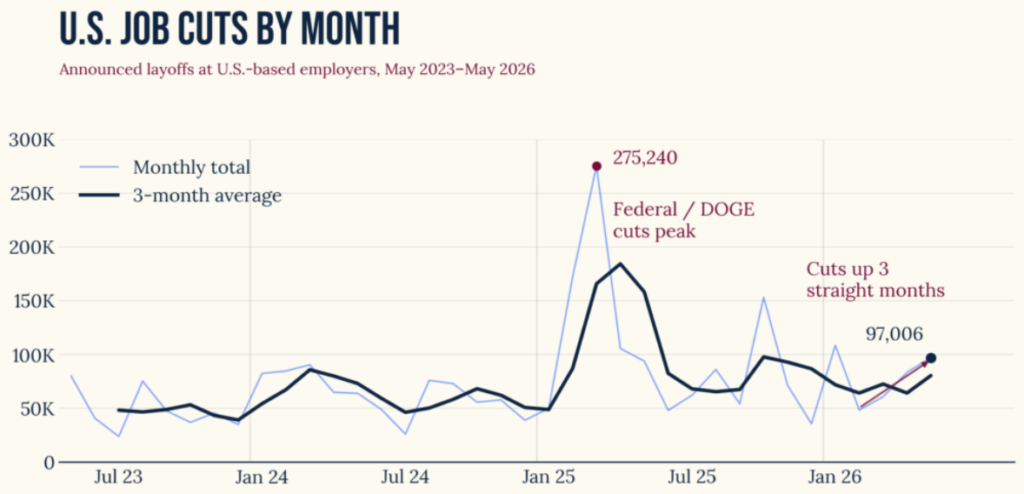
Challenger, Gray & Christmas reported that U.S. employers announced 97,006 job cuts in May, the highest monthly total since the pandemic-era peak of 2020 and a 16 percent increase from April. Artificial intelligence (AI) was cited in 38,579 cuts, accounting for 40 percent of all layoffs and marking the third consecutive month AI led the reasons for job reductions.
AI has become the leading reason for job cuts
Get this first. Recently, in May, at the Commonwealth Bank of Australia (CBA), OpenAI’s CEO Sam Altman said he was wrong about a job apocalypse, especially regarding entry-level white-collar roles being replaced by AI. Well, it seems he is wrong again, simply because data says otherwise.
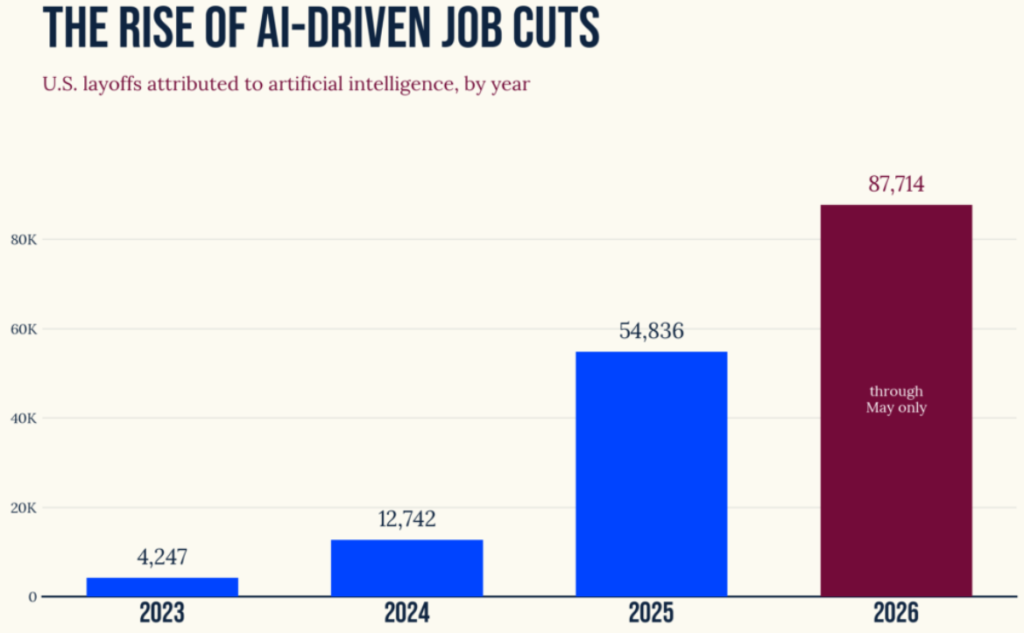
For three months running, AI has topped the list of reasons companies give for layoffs. In May, AI-related cuts reached 38,579, marking the highest monthly total ever recorded since Challenger began tracking the category in 2023. That represents a sharp escalation from January, when AI accounted for just 7 percent of all cuts.
So far in 2026, AI has been cited in 87,714 job cuts, or 22 percent of all layoffs, already surpassing the 54,836 attributed to AI in all of 2025. Andy Challenger, the firm’s labor and workplace expert, noted: “AI isn’t yet the jobpocalypse some predicted. Like spreadsheets and email before it, the technology will ultimately make workers more productive, but our data shows companies are already acting on it.” The open question, he added, is not whether AI changes the workforce, but how fast.
Technology sector hit hardest
Technology led all industries in May with 38,242 announced job cuts, its highest monthly total since August 2024. For the year, tech has announced 123,653 cuts, up 66 percent from the same period in 2025, making it the leading job cutter of 2026 by a wide margin. But, ironically, technology is also the sector with the most hiring plans this year, reflecting the churn of an industry simultaneously shedding and creating roles.
Transportation followed tech with 6,909 cuts in May [up 449 percent year-to-date (YTD)], while pharmaceutical companies announced 5,045 cuts in May (up 753 percent from the previous year). FinTech companies also posted 5,731 job cuts in May, the bulk of which cited AI in their announcements.
Restructuring and bankruptcy add to the toll
Beyond AI, the May report showed a sharp rise in cuts tied to acquisitions, mergers, and bankruptcy-related losses. Bankruptcy was attributed to 5,637 cuts in May, the highest monthly total since February 2025. Closings accounted for 14,546 cuts, and restructuring for 9,942. Andy Challenger noted that “companies are restructuring aggressively as they reposition for an AI-driven economy.”
Year-to-date, 69,645 cuts have been attributed to market and economic conditions, and 66,733 to closings. Acquisitions and mergers have driven 11,989 cuts so far in 2026, more than six times the 1,889 attributed to that reason through May 2025. All these different factors show we’re in a major transition: not just automating roles, but consolidating, shuttering, and rebuilding around new capabilities (i.e., the Dune analytics firm restructuring).
To this point, despite what any CEO can say on massive layoffs, it is increasingly clear that AI is making a strong impact on the job market. Not sure if “time will tell” is good enough for this moment, since this shift is already happening.


