

On Wednesday, Web3 security service provider CertiK released their H1 2026 report, with the main takeaway being that the first half of the year was overwhelmingly dominated by so-called crypto wrench attacks. In fact, such attacks are accelerating faster than on-chain exploits.
Crypto wrench attacks are all the rage
According to the report, although crypto losses have fallen about 46.8 percent year-on-year to about $1.32 billion across 344 incidents in H1 2026, it doesn’t necessarily mean that the wider crypto ecosystem has become safer.
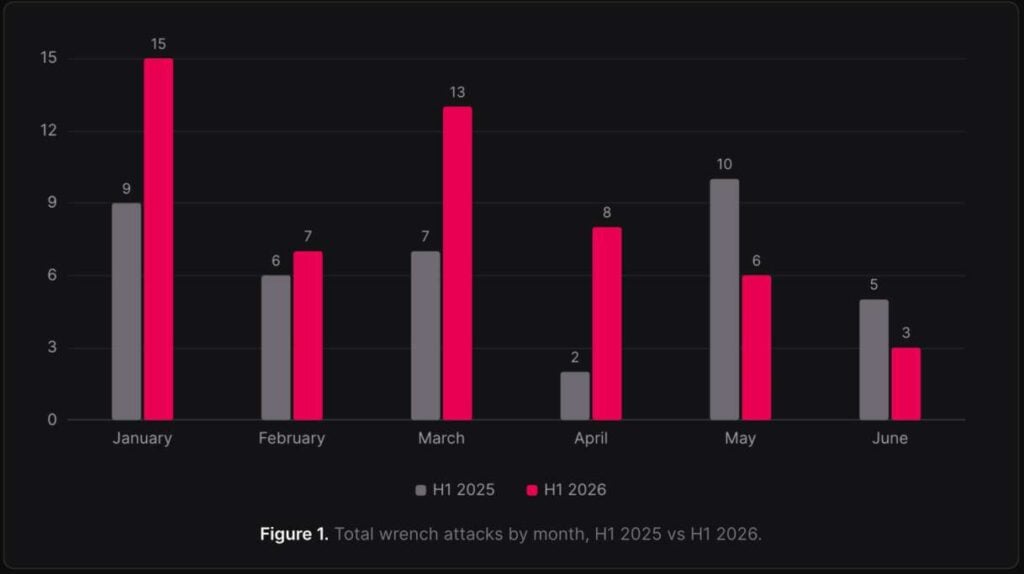
The report mentions that a large part of the decline is due to an absence of a Bybit-scale event that resulted in a loss of $1.4 billion in 2025. However, the report mentioned that there were 34 verified wrench attacks between January and April 2026 – representing a 41 percent increase from 24 incidents in the same period in 2025.
Total losses associated with such attacks during H1 2026 was around $101 million. If the current pace holds, CertiK projects roughly 130 incidents for the full year, with losses potentially reaching several hundred million dollars.
For the uninitiated, a crypto wrench attack is a physical attack, in which criminals use threats or violence to force someone to reveal their cryptocurrency wallet passwords.
Unlike cyberattacks that exploit software vulnerabilities, wrench attacks directly target the wallet owner – making personal security, and protecting recovery credentials just as important as digital security.
It is worth highlighting that Europe accounted for roughly 82 percent of recorded wrench attacks in the first 4 months of 2026, up sharply from 39.3 percent for the full year of 2025. France alone recorded 24 such incidents.
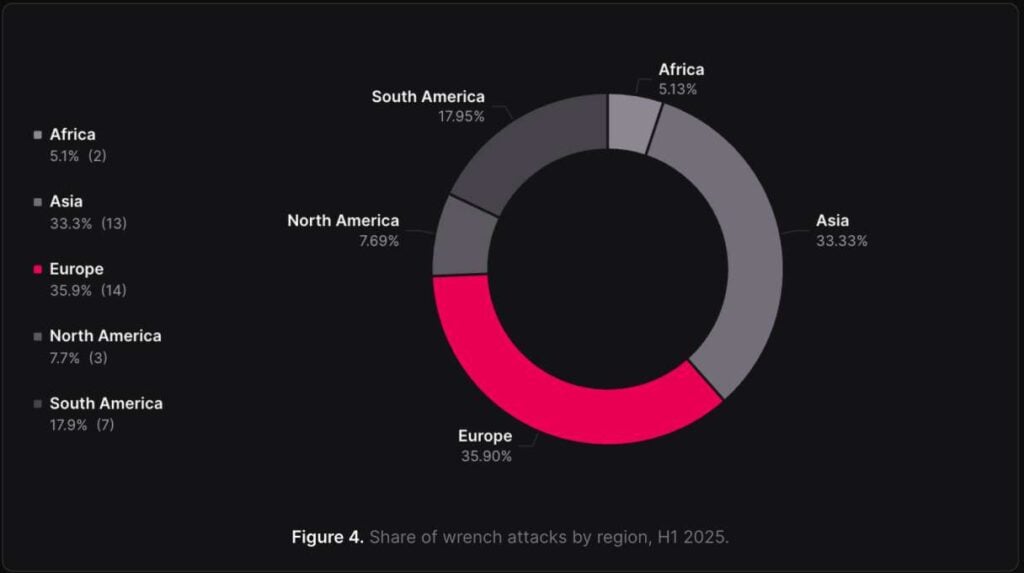
The report notes a significant escalation in targeting methodology, as more than 50 percent of incidents in France involved a family member of the main target rather than the holder directly.
Hacks are hampering DeFi adoption
Crypto hacks are not only resulting in loss of users’ funds. One of the cascading effects is hampering the adoption of emerging subspaces like decentralized finance (DeFi). On April 23, JPMorgan flagged DeFi hacks and flat TVL as key barriers to institutional adoption.
On May 6, DeFi protocol Ekubo suffered a $1.4 million hack, adding to the expanding list of DeFi hacks 2026 has seen to date. Similarly, Humanity Protocol said that its $36 million hack was associated with a compromised employee laptop.