

Bitcoin (BTC) is changing hands around the $65,540 level after a 1.35 percent drop in 24 hours and a minor gain of 0.44 percent in the week. Bigger insight comes from derivative trading, as short positions suffered the brunt of liquidations across the top crypto exchanges.
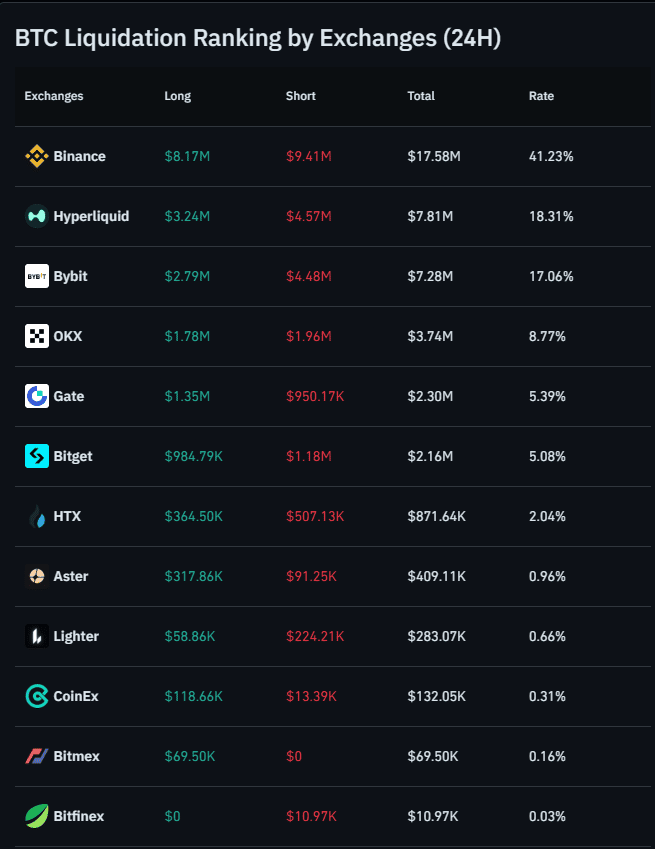
Binance short liquidations stood at $9.41 million against $8.17 million longs. HyperLiquid saw $4.57 million in shorts being liquidated against $3.24 million in long positions. Bybit recorded $4.48 million shorts liquidated and $2.79 million longs. Most major exchanges reflected the same data. The signal from this is that the increase in price resulted in a short squeeze, which has subsequently collapsed.
Bitcoin took out the sellers near the key level of $67,000
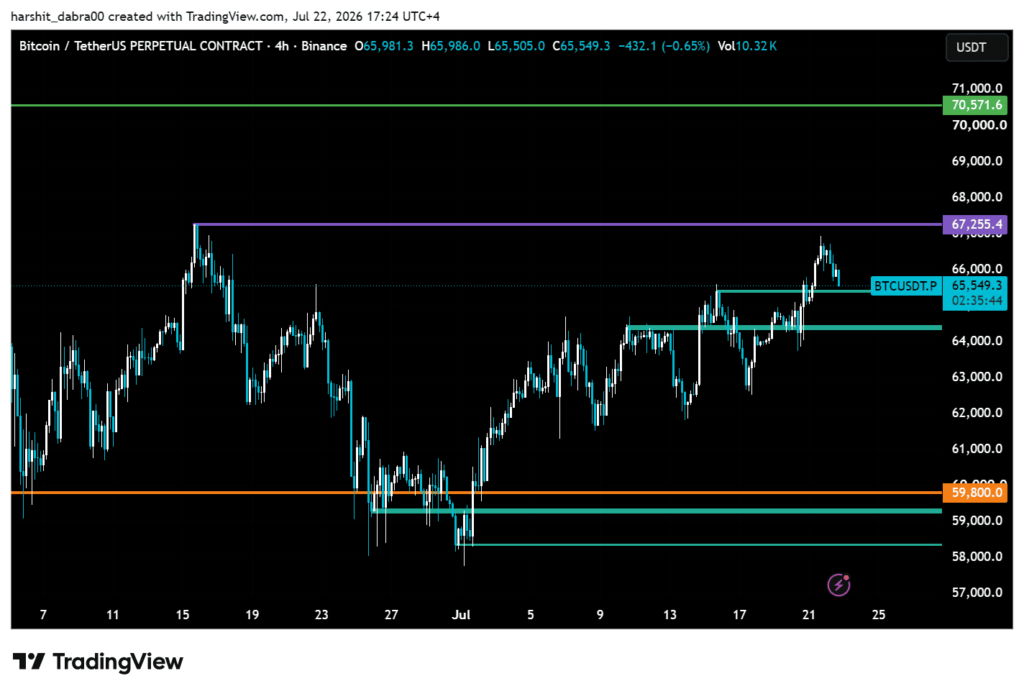
Bitcoin pushed past the $66,000 zone, with price going as far as close to $67,000 and creating forced liquidation on bearish positions when price moved away from them. The move went on to clear the $67,255 before turning the other direction. This largest cryptocurrency’s price has since gone back down to $65,540 and beneath the daily pivot level near $66,176.
The thing that matters is the result that came after the small liquidations. The squeeze led to buy-side pressure to push prices higher but the price of Bitcoin failed to maintain the breakout level. The market participants who bought the move above $66k now see red as the price turns bearish and slides back below the level that induced the squeeze.
As such, the $67,255 area will be key to keep an eye on as resistance. If this area can be cleanly breached, the path higher could open again. Alternatively, if we see a push towards this resistance and then a sell-off, it’ll show sellers remain active at the top of the current price action range.
The ETF trend is on the more solid side
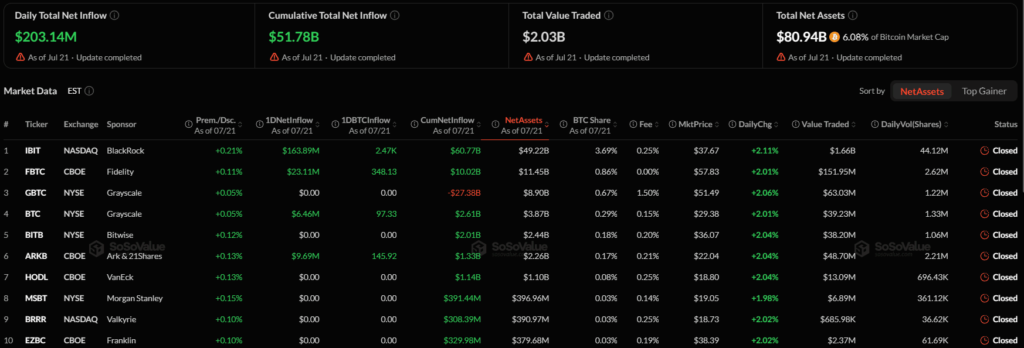
Spot Bitcoin ETFs posted net inflows of roughly $203.14 million in the last active session, pushing cumulative net inflows to approximately $51.78 billion. ETF assets are close to $80.94 billion in total. BlackRock’s spot Bitcoin ETF, IBIT, saw net inflows of roughly $163.89 million on the back of net inflows recorded by other ETF issuers. Grayscale’s spot Bitcoin ETF, GBTC, still has net outflows and remains among spot Bitcoin ETFs with substantial cumulative outflows.
ETF inflow shows there’s still strong interest, but it isn’t enough to keep BTC above 66K. Inflows into these products create slower and more constant demand compared to the volatile short-term movements made by traders through the futures markets with high leverage. In the interim, spot demand keeps BTC well-supported and futures activity the primary price driver short-term.
The resistance is still holding strong apart from the strong momentum
Short-term momentum remains positive for Bitcoin. MACD is in the green. BTC is above the 7-day EMA ($64,991) and 30-day EMA ($64,041) but below the 200-day EMA ($74,806), indicating the longer-term uptrend is not fully back.
Bitcoin’s 7-day RSI of 72.36 is approaching overbought levels, while 14-day and 21-day readings of 61.56 and 55.61 reflect strong momentum on shorter timeframes. This digital gold needs to break through $67,255, which will then allow BTC to target $69,402 and $72,572. If the price drops back down below $64,000 and then the 30-day simple moving average is around $62,714, the rebound could be invalidated.
The breakout could influence the next move for Bitcoin
Bitcoin has already squeezed shorts once but failed to hold above resistance. A break and sustained move above $67,255 could trigger another wave of short liquidations and open the path toward $69,400, while another rejection would shift focus to $64,000 and then $62,714 as key support levels. ETF inflows remain positive, but they have not yet been enough to confirm a sustained breakout, leaving Bitcoin caught between steady spot demand and sellers defending the same resistance zone.