



The reality of real-world assets (RWA) on a blockchain was just a concept if we look at it a few years back. Not so long ago the common counterargument was “no-one credible will ever go near it.” The counter-argument doesn’t hold that strong now. In March 2024, Blackrock issued BUIDL, a tokenized money market fund, and had accumulated over $500 million in AUM within weeks. Franklin Templeton has been involved in a tokenized government money fund on Stellar and Polygon since 2021. J.P. Morgan has transacted $700 billion worth of tokenized repo trades on its Onyx platform. The institutions have entered quietly but have brought significant size, which the retail does not get an idea of until significant changes happen in this crypto space.
As per the data providers like rwa.xyz, the tokenized RWA market currently sits at a distributed value of $33.65 billion, depending on how the scope is defined.
What tokenization actually does
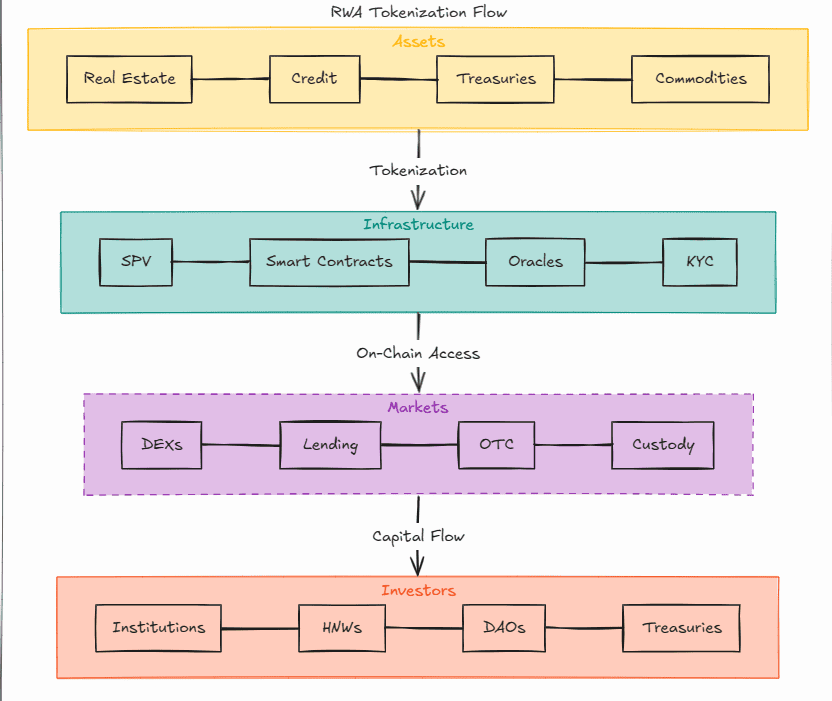
It’s used broadly and to be more accurate on its definition: Tokenizing a real-world asset means tokenizing is the issuance of a digital version of an ownership claim or a right to a cash stream on a blockchain. A token isn’t the asset. A tokenized Treasury bill is a smart contract granting rights to the payments of an off-chain security under custodianship of a regulated custodian. And The thing to note is that the asset doesn’t shift onchain, only the wrapper of it stays onchain.
That difference is what dictates both the opportunity and the limitation. For the first pointer, defining the opportunity is that the tokenized asset can be transacted peer-to-peer, be used as collateral in a lending protocol and be accessed from any whitelisted wallet anywhere in the world.
Now if we consider the other side of it, the limitation is that it’s only as good as the legal framework backing the token. If the custodian defaults, the entry on the blockchain means nothing.
Where the real flows are going
For the real flows part of it, the largest portion of tokenized capital has been put into government securities and private credit. Short-dated government debt is a predictable yield that DeFi protocols can make use of. Treasuries and on-chain treasury and stablecoin backing strategies are the natural buyers.
Private credit is where this becomes more interesting to note. Marketplaces have popped up to link institutional borrowers and real business lending to DeFi liquidity and have closed billions of loans on-chain. The reasoning is relatively simple. DeFi is an incredibly cheap pool of liquidity. Traditional lending to small and medium businesses has incredibly high spreads. Tokenization can be called a bridge joining both of them.
The remaining friction still exists on the implementation side and where there is a comparison of theory and what actually took place. The potential market size is insane. Actual adoption has been limited and has seen failures in the past and we can’t deny that. This is not a technical problem. Tokenization cannot magically generate liquidity. A fraction of a commercial building on the chain is still a fraction of an illiquid asset. Blockchain tracks programmable assets but it will not pop the buyers up.
The regulatory variable
The degree of regulatory clarity is kind of mixed. In the United States most tokenized securities are being set up under exemptions that do not include retail investors. The EU system offers more definition but is yet to be fully put into practice. Territories such as Singapore, the UAE and Hong Kong have now shown up with a shift more quickly because their regulatory systems were more readily adaptable. The reality of these is most of the early institutional issuances are designed to avoid the most uncertain territory.
And if we look at the trend from the past, that is changing. The direction of regulatory travel, throughout most major jurisdictions, is more on the side of accommodation in comparison to restriction. The importance is more of the pace that is followed, not the ultimate endpoint of this.
The second-order shift
The more hidden effect that RWA growth is how it is making the changes in the DeFi ecosystem and how it is beneficial. Real yield-generating tokens are one of the few true, non-speculative sources of real return in DeFi given shrinking farming yield. They’ve pulled capital in amounts that would have otherwise not flowed in at all. In addition to this, these real assets imply that protocols are not carrying that much dependency on the inflation and are more economically sound.
The important point to note is that there is a more gradual structural change in how institutional money thinks about on-chain exposure. It is in the transition phase and it is going from thinking of crypto as directional to viewing on-chain as infrastructure as a settlement layer for real-world assets.